


Standing in a kitchen showroom or scrolling a renovation mood board, the same question keeps coming up: open shelves or closed cabinets? Open shelving tends to suit small kitchens, renters, and anyone who likes displaying dishware, while closed cabinets tend to suit busy family households and anyone renovating with resale value in mind. The short version: if you’ll actually keep it tidy, open shelves can transform a cramped kitchen. If not, closed cabinets are the safer, lower-maintenance choice.
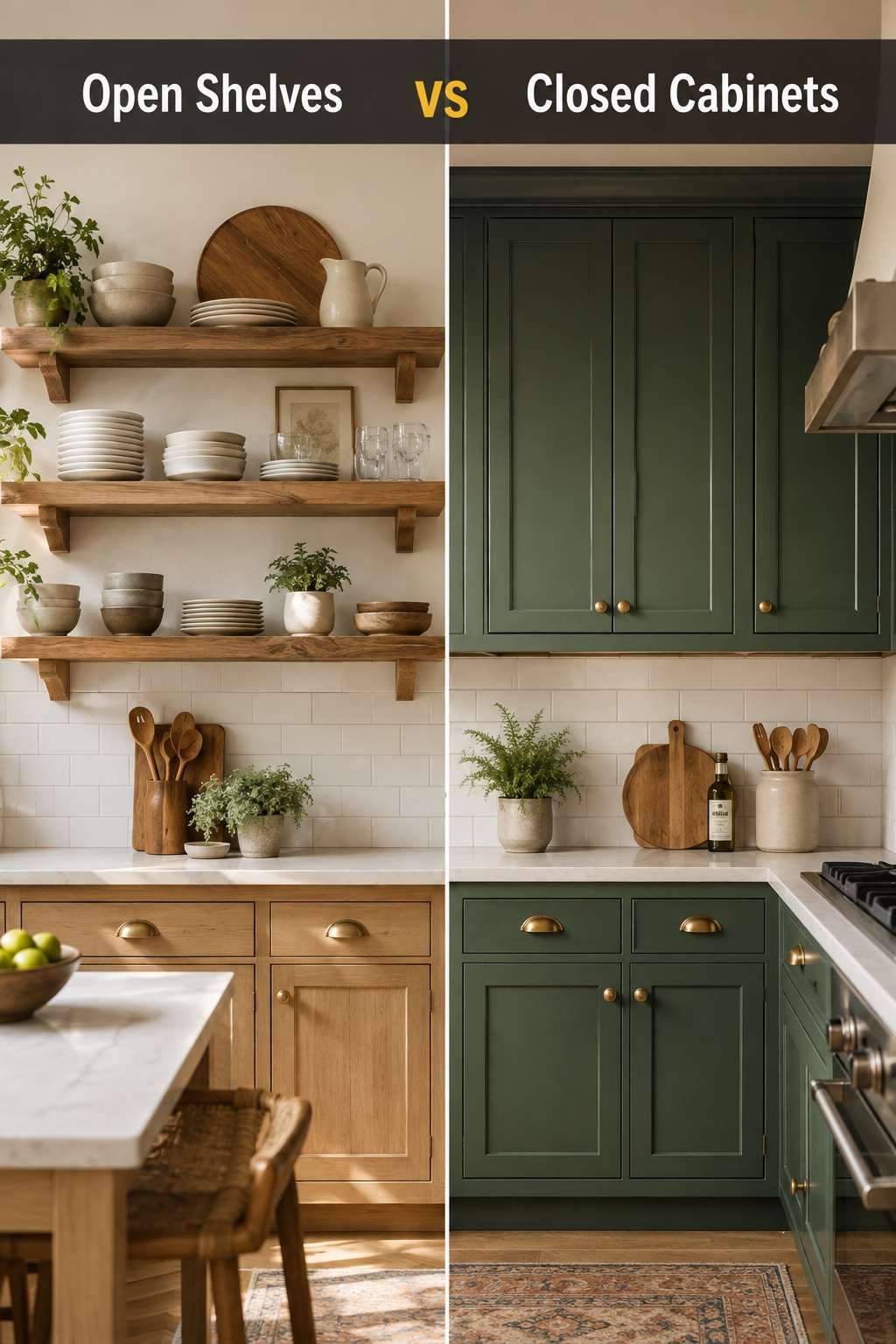
Open Shelves vs Closed Cabinets: The Full Comparison
| Criteria | Open Shelves | Closed Cabinets |
|---|---|---|
| Cost (per linear ft, installed) | $30–$70 | $150–$500+ |
| Maintenance | Frequent dusting and wiping down grease splatter, especially near the stove | Occasional wipe-down; mess and dust stay hidden behind doors |
| Installation Difficulty | Easy — many are DIY-friendly with basic tools | Moderate to hard — usually needs a contractor or cabinet installer |
| Storage Concealment | Fully visible, limited concealment for mismatched items | Fully concealed, hides clutter and mismatched cookware |
| Style Impact | Airy, curated, cottage or Scandinavian-leaning look | Clean, seamless, traditional or modern-luxury look |
| Resale Value | Neutral to slightly negative with typical buyers | Positive — expected by most home buyers |
| Best For | Small kitchens, renters, style-forward cooks who stay tidy | Family kitchens, busy households, resale-focused homeowners |
The numbers above translate simply in a real kitchen: open shelving saves money upfront and makes a small room feel bigger, but it demands weekly upkeep and a willingness to keep things looking intentional. Closed cabinets cost more and take longer to install, but they do the concealing and protecting for you, which matters most in a busy household or a kitchen you’re prepping for sale.
Quick Look: Open Shelves vs Closed Cabinets at a Glance
Open Shelves
Budget-friendly, quick to install, and great for small kitchens — as long as you’re willing to keep them styled and dusted.
View on Amazon →Closed Cabinets
Higher upfront cost, but low daily upkeep and full concealment for a busy, high-traffic kitchen.
View on Amazon →Deep Dive: Open Shelves
Open shelving works best for small to mid-size kitchens, cooks who like displaying their dishware, and renters looking for a low-commitment upgrade. It’s also the go-to choice for anyone renovating on a tight timeline or budget.
Pros
- Makes small kitchens feel more open and airy
- Lower cost and faster to install than cabinets
- Easy, grab-and-go access to everyday items
- Doubles as a styling opportunity for personality and color
Cons
- Needs regular dusting and degreasing
- Clutter and mismatched items are always on display
- Offers little protection from dust, steam, or grease
- Can feel exposed in a high-traffic household
Deep Dive: Closed Cabinets
Closed cabinets remain the default for a reason — they hide clutter, protect dishware, and match what most buyers expect to see in a kitchen. They tend to be the better fit for larger kitchens, families, and long-term resale planning.
Pros
- Hides clutter and mismatched cookware completely
- Supports resale value and matches buyer expectations
- Protects dishware from dust, grease, and steam
- Scales well for large kitchens and heavy storage needs
Cons
- Higher cost, often requires professional installation
- Can make a small kitchen feel heavier or boxed-in
- Harder and more expensive to reconfigure later
- Doors and hinges add another maintenance point over time
Real Kitchens: Which One Wins by Scenario
Small Kitchen
Open Shelves win
Opens up a tight footprint visually.
Budget Renovation
Open Shelves win
Lower cost, DIY-friendly install.
Luxury Build
Closed Cabinets win
Seamless, high-end buyer expectation.
Rental-Friendly
Open Shelves win
Removable brackets, no permanent damage.
High-Traffic Family Kitchen
Closed Cabinets win
Conceals daily mess, holds up to kids.
Professional Tips & Regret-Proofing Advice
- If you’re not confident you’ll keep shelves tidy every day, default to closed cabinets — open shelving only looks good when it’s maintained.
- Mixing both is often the safest move: open shelves at eye level for display, closed cabinets below for bulk storage.
- Before pulling cabinet doors, check comparable listings in your area — resale expectations for open shelving vary by market.
- Grease build-up near the stove is the most common regret with open shelving — keep open shelves a few feet from the cooktop and vent.
- Reserve closed cabinets for anything mismatched, oversized, or rarely used, and save open shelves for what you’d actually want on display.
Shop the Winner
If you’re leaning toward Open Shelves, here’s what to get started with:
Best Overall
A sturdy floating wood shelf with hidden bracket mounting for a clean, gap-free look. Our guide on how to decorate a kitchen shelf walks through this step by step.
Best Budget
An affordable L-bracket shelf kit that’s simple enough for a weekend DIY install.
Best Premium
A solid hardwood shelf set with soft-close, concealed-mount bracket hardware.
If you’re leaning toward Closed Cabinets, here’s what to get started with:
Best Overall
A pull-out cabinet organizer system that maximizes concealed storage space.
Best Budget
Stackable cabinet shelf risers that instantly double usable shelf space.
Best Premium
A soft-close cabinet hinge and drawer upgrade kit for a high-end finish feel.
Frequently Asked Questions
Are open shelves cheaper than closed cabinets?
Yes, in most cases. Open shelving typically runs $30 to $70 per linear foot installed, while closed cabinets run $150 to $500 or more per linear foot depending on material and finish.
Do open shelves make a kitchen look messy?
They can if they are not kept tidy. Open shelves only look good when items are curated and organized, so they are a better fit for people who enjoy styling their dishware regularly.
How often do you need to clean open shelves?
Most homeowners wipe open shelves down weekly, and more often near the stove where grease and steam settle faster than on enclosed cabinet surfaces.
Can I mix open shelves and closed cabinets in the same kitchen?
Yes, and it is one of the most popular approaches. Many kitchens use open shelves for display pieces at eye level and closed cabinets below for bulk and everyday storage.
Do open shelves hurt resale value?
Open shelving is generally resale-neutral to slightly negative, since most buyers expect closed storage. Closed cabinets tend to be safer for resale in most markets.
What’s the best material for open kitchen shelves?
Solid wood and sealed butcher block hold up best against moisture and daily use. Floating shelves with a hidden steel bracket system tend to look the cleanest. Our floating shelves vs cabinets comparison covers that decision in more depth.
How do I stop open shelves from collecting dust and grease?
Keep open shelves a few feet away from the stove and vent hood, wipe them down weekly, and store dishware you use often so items rotate instead of sitting untouched.
Are closed cabinets worth the extra cost?
For most households, yes. Closed cabinets conceal clutter, protect dishware from dust, and tend to be what buyers expect, which supports resale value.
What’s the average install time for closed cabinets vs open shelves?
Open shelves can often be installed in a single afternoon. Closed cabinets typically take several days to a few weeks depending on whether they are stock, semi-custom, or fully custom.
Can I convert existing cabinets into open shelves myself?
Yes, removing upper cabinet doors is a common DIY project. Just check that the cabinet interior and shelving look finished, since it will now be visible.
Do open shelves work in a small kitchen?
Open shelves often work well in small kitchens because they visually open up the space and avoid the boxed-in feeling that floor-to-ceiling cabinets can create.
What should I avoid storing on open shelves?
Avoid storing rarely used items, mismatched plastic containers, or anything you would not want on display, since everything on an open shelf is visible at all times.
Are floating shelves strong enough for dishes?
A properly mounted floating shelf with hidden steel brackets anchored into studs can typically hold 30 to 50 pounds per shelf, which is enough for everyday dishware.
How do closed cabinets affect a kitchen’s resale value?
Closed cabinets are generally viewed as a standard expectation by buyers, so they tend to support resale value rather than add a premium on their own.
What’s the standard depth for kitchen shelves vs cabinets?
Open shelves are typically 10 to 12 inches deep, while standard upper cabinets run closer to 12 to 14 inches deep to accommodate cabinet doors and hardware.
Is it hard to keep open shelves organized long-term?
It takes more ongoing effort than closed cabinets, since there is no door to hide clutter behind. Households that enjoy tidying and styling tend to keep up with it more easily.
Do renters install open shelving without damaging walls?
Many renters use removable bracket systems or tension-mounted shelving that avoids permanent wall damage, making open shelving a popular rental-friendly upgrade.
What’s a good compromise between open shelves and closed cabinets?
A hybrid layout with open shelves at eye level for display pieces and closed cabinets below for bulk storage gives you the visual benefit of open shelving without losing concealed storage.
How much weight can a wall-mounted shelf bracket hold?
Most hidden steel floating shelf brackets are rated to hold 30 to 50 pounds when anchored properly into wall studs, though ratings vary by product.
Which option is better for a high-traffic family kitchen?
Closed cabinets tend to work better for high-traffic family kitchens, since they conceal daily clutter and hold up better against kids and fast-paced cooking.
Final Verdict
If you have a small kitchen, a tight budget, or you genuinely enjoy styling and tidying, open shelves are the smarter pick — they cost less, install faster, and make a compact room feel bigger. If you’re renovating a family kitchen, planning for resale, or you know clutter tends to pile up, closed cabinets are the safer long-term investment. When in doubt, the hybrid approach — open shelves up top, closed cabinets below — gives you both the display and the concealment without fully committing to either extreme.

