


If you’re renovating a room where a swinging door just doesn’t fit, you’ve probably landed on the same two options everyone else does: a pocket door that slides away inside the wall, or a barn door that hangs in front of it on an exposed track. They solve the same space problem in very different ways, and the right pick depends more on your wall structure, your budget, and how much privacy that doorway actually needs than it does on which one looks better on Pinterest. Here’s the short version before we get into the details: a pocket door wins when privacy and a finished, disappearing look matter most, and a barn door wins when budget, install speed, and a bold visual statement matter most.
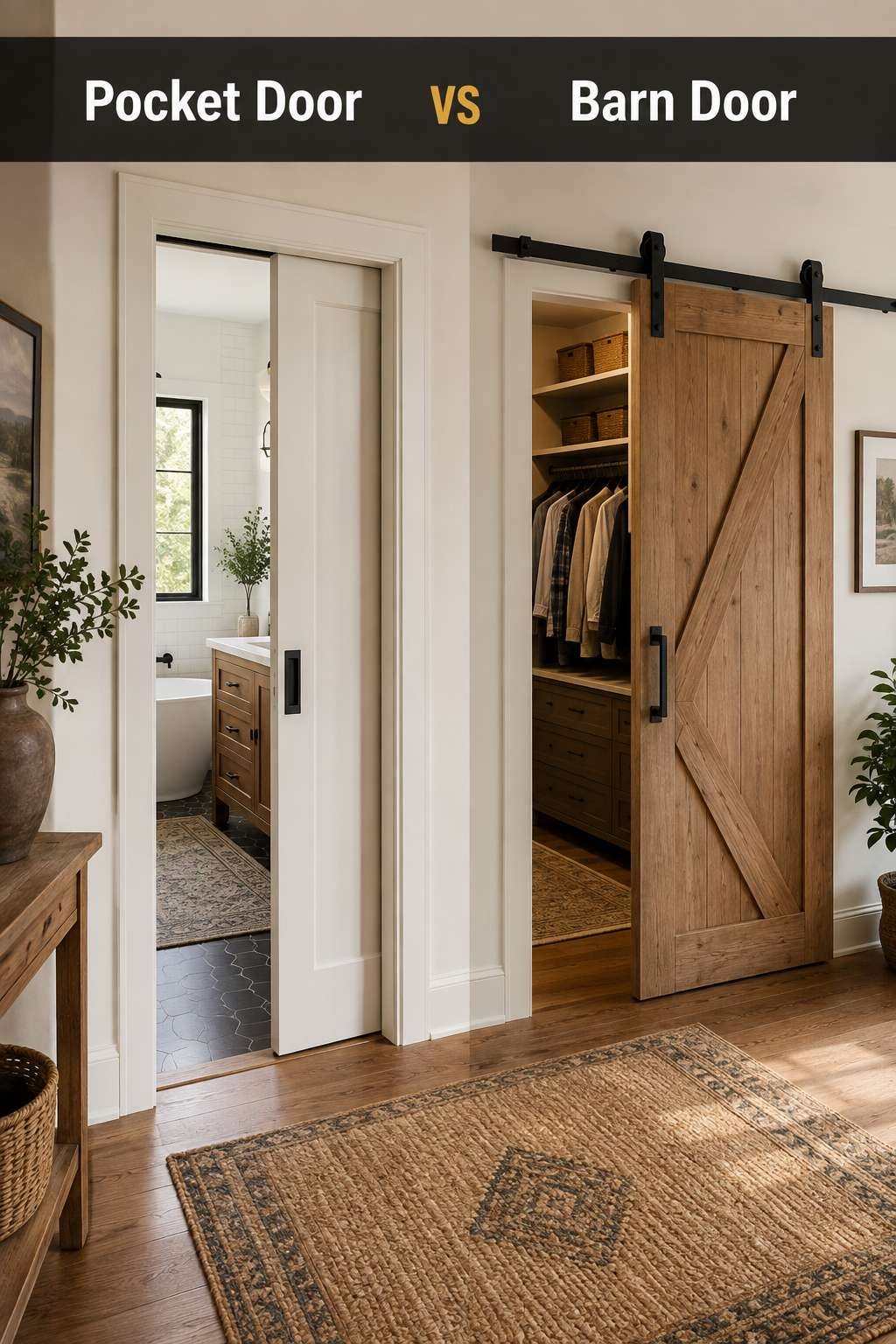
Pocket Door vs Barn Door: The Full Comparison
| Criteria | Pocket Door | Barn Door |
|---|---|---|
| Installed Cost | $700–$2,200, including wall framing and drywall repair | $350–$1,400 for hardware and door, no wall demo needed |
| Space Required | None in the room — slides fully into the wall cavity | Open wall space beside the doorway for the door to slide onto |
| Privacy & Sound | Good — seals into a frame | Limited — gaps top/sides |
| Install Difficulty | High — requires opening and reframing the wall | Moderate — header and track mount to existing studs |
| Wall Requirements | Wall cavity must be free of plumbing, wiring, or ductwork | Needs solid stud backing above the opening, no demo required |
| Maintenance | Low — occasional roller check | Moderate — track realignment |
| Aesthetic Flexibility | Minimal, blends in, disappears when open | Bold statement piece, wide range of styles |
| Resale Value | Neutral to positive, reads as a permanent upgrade | Trend-dependent, can polarize buyers |
What This Actually Means in a Real Home
The cost gap comes down to labor: a pocket door means cutting into drywall, confirming the wall is clear of plumbing and wiring, and building a frame inside it, while a barn door just needs a header board bolted into studs. That’s also why pocket doors take longer and usually need a contractor, while a handy homeowner can hang a barn door in an afternoon. The privacy difference is the one buyers underestimate most — a barn door looks finished in photos, but it doesn’t seal, so sound and light leak around the edges in a way a pocket door simply doesn’t. Our barn door ideas has more inspiration along these same lines.
Quick Look: Pocket Door vs Barn Door at a Glance
Pocket Door
Slides fully inside the wall for a clean, disappearing look with real privacy — best when you can afford to open the wall.
View on Amazon →Barn Door
Hangs on an exposed track with no wall demo needed — fast to install and a bold style statement for the room.
View on Amazon →Deep Dive: Pocket Door
Pocket doors are the right call anywhere privacy is non-negotiable — primary bathrooms, home offices next to a living room, or bedrooms where you want a truly finished look with zero visible hardware. They cost more upfront because the wall has to come open, but once installed, they behave like any other interior door: they seal, they lock, and they disappear completely when not in use.
Pros
- Disappears completely into the wall, saving the full door-swing radius
- Real privacy and sound blocking with a proper frame seal
- Clean, minimal look that fits any interior style
- Available with a built-in privacy lock
Cons
- Expensive to retrofit since it requires opening the wall
- Can’t be installed if the wall has plumbing, wiring, or ductwork
- Harder to repair since the hardware sits inside the wall cavity
- Longer project timeline, usually needs a contractor
Deep Dive: Barn Door
Barn doors make the most sense where budget and speed matter more than absolute privacy — pantries, laundry rooms, closets, and rentals where you can’t touch the wall structure. They’ve earned their popularity honestly: for the cost and effort, nothing else transforms a doorway this fast or this dramatically. Our how to make a barn door guide covers this in more detail.
Pros
- No wall demolition — mounts to existing studs above the opening
- Faster and generally cheaper to install than a pocket door
- Big visual statement, wide range of styles and finishes
- Easy to retrofit into almost any existing home
Cons
- Doesn’t fully block sound or light — gaps at the top and sides
- Needs open wall space beside the doorway to slide onto
- No true lock — needs a separate privacy latch for bathrooms/bedrooms
- Track can loosen over time and needs periodic re-tightening
Real Room & Scenario Examples
Small Bathroom
Privacy is critical and every inch counts.
Winner: Pocket DoorBudget Hallway Closet
Cost-sensitive renovation, no wall demo budget.
Winner: Barn DoorLuxury Primary Closet
A statement piece that anchors the room.
Winner: Barn DoorRental-Friendly Apartment
No wall modification allowed by the landlord.
Winner: Barn DoorHigh-Traffic Laundry Room
Heavy daily use, durability over demolition cost.
Winner: Barn DoorProfessional Tips
- Measure the full wall cavity before falling in love with a pocket door. If there’s plumbing, wiring, or ductwork running through that section of wall, a pocket door isn’t an option without expensive rerouting — always confirm this before you commit.
- Undersizing the barn door header board is the most common install mistake. The header needs to span well past the studs on both sides and be properly anchored — a header that’s too short or under-secured is the top cause of barn door track sag over time.
- If privacy is a real concern for a barn door, budget for a soundproofing/draft strip. These press-fit strips close most of the gap around the frame and meaningfully cut down on sound and light leakage without changing the door.
- For resale, a well-installed pocket door reads as a permanent upgrade, while a barn door reads as a style choice. If you’re renovating with resale in mind and the buyer pool skews traditional, keep that in mind for primary living spaces.
- Soft-close hardware is worth the upgrade on any high-traffic barn door. Without it, repeated slamming loosens the track and rollers years faster than normal wear would.
Shop the Winner
If you’re leaning toward a Pocket Door…
Here’s what to get started with for your pocket door installation:
Best Overall
A complete split-stud pocket door frame kit with soft-close rollers, sized to standard door widths.
Best Budget
A basic steel frame kit with standard rollers, ideal for a straightforward interior closet or hallway install.
Best Premium
A heavy-duty frame kit with a built-in privacy lock and soft-close, sized for wider bathroom or bedroom openings.
If you’re leaning toward a Barn Door…
Here’s what to get started with for your barn door installation:
Best Overall
A standard black steel rail and roller kit with a header board included, sized for most interior doorways.
Best Budget
A compact hardware kit covering the essentials — rail, rollers, and floor guide — for a straightforward closet or pantry install.
Best Premium
A heavy-duty soft-close rail system built for wider, heavier doors and high-traffic doorways.
See our full Best Barn Door Hardware Kits guide for detailed picks and installation notes.
See the Full Buying Guide →Frequently Asked Questions
What is the main difference between a pocket door and a barn door?
A pocket door slides inside the wall cavity and disappears completely when open, while a barn door hangs on an exposed track mounted on the wall surface above the doorway. Pocket doors need the wall opened up during installation; barn doors do not.
Is a pocket door more expensive than a barn door?
Yes, in most cases. A pocket door typically costs $700–$2,200 installed because it requires opening the wall and reframing it, while a barn door usually costs $350–$1,400 including the door and hardware since no wall demolition is needed.
Do barn doors block sound well?
Not fully. Barn doors hang in front of the opening rather than sealing into a frame, so gaps at the top and sides let sound and light through even with quality hardware. This makes them a weaker choice for bathrooms or home offices where privacy matters. Our guide on how to make a door look like wood walks through this step by step.
Can I install a pocket door in an existing wall?
Yes, but it requires opening the drywall, checking for plumbing, wiring, or ductwork inside that wall cavity, and installing a pocket door frame kit. It is a bigger job than a barn door and is usually best handled by a contractor.
Are barn doors good for bathrooms?
They work for a powder room or a bathroom where privacy is less critical, but for a primary bathroom or shared family bathroom, the sound and light gaps around a barn door are usually a dealbreaker. A pocket door is the better choice there.
How much does it cost to install a pocket door?
Expect $700–$2,200 installed, depending on whether the wall needs plumbing or electrical rerouted, the door material, and local labor rates. A basic DIY-friendly pocket door frame kit alone can run $150–$400 before installation labor.
How much does a barn door hardware kit cost?
A basic barn door hardware kit runs roughly $60–$200, while heavier-duty or soft-close kits run $150–$400. Add the door itself, which ranges from $150–$900 depending on material and finish.
Do pocket doors need special framing?
Yes. A pocket door needs a split-stud frame kit installed inside the wall cavity so the door has a track to slide into. This requires the wall to be free of plumbing, wiring, or HVAC ducts in that section.
Can I install a barn door without damaging the wall?
Mostly yes. The track mounts to a header board secured into wall studs above the doorway, which is far less invasive than opening a wall, though it does require solid backing and will leave mounting holes if removed later.
Which is better for a small bathroom, pocket door or barn door?
A pocket door is generally the better choice for a small bathroom because it seals into a frame for real privacy and sound blocking, and it does not require open wall space beside the doorway like a barn door does.
Do barn doors work in rental apartments?
Surface-mounted barn door kits can work in a rental if the landlord allows mounting into studs above a doorway, since no wall demolition is required. Always get written permission first and expect to patch mounting holes when you move out.
How much space does a pocket door need inside the wall?
A pocket door needs a wall cavity roughly twice the width of the door opening, since the door slides fully into the wall. That wall section must be free of plumbing, wiring, or ductwork for the full length of the pocket.
Are pocket doors hard to fix if they break?
Repairs are more involved than a barn door because the rollers and track sit inside the wall, sometimes requiring drywall access. Well-installed pocket door hardware is durable, but a broken roller usually means opening the wall to service it.
Do barn doors provide privacy?
They provide visual privacy but not full acoustic or light privacy, since the door does not seal into a frame the way a hinged or pocket door does. For closets, pantries, and laundry rooms this is rarely an issue.
Which door type is better for resale value?
A well-installed pocket door tends to read as a permanent, functional upgrade to buyers, while a barn door is more trend-dependent and can polarize buyers who prefer a more traditional look. Neither hurts value significantly if installed well.
Can a barn door be used on a bedroom for privacy?
It can, but be aware that most barn doors do not include a true lock, only a privacy latch, and sound will carry more than with a hinged or pocket door. Many homeowners pair a barn door with a soundproofing strip for bedrooms.
What is the standard size for barn door hardware?
Most barn door hardware kits are sized for doors between 30 and 42 inches wide, with the track needing to be roughly double the door width to allow it to slide fully clear of the opening. Always measure your specific opening before buying.
Do pocket doors have locks?
Yes, pocket door hardware kits are available with a privacy lock built into an edge pull, which is a common choice for bathrooms and bedrooms where a pocket door is installed.
How long do barn door tracks and rollers last?
Quality steel hardware can last well over a decade with occasional maintenance, but tracks can loosen from repeated use and need re-tightening into the studs every few years, especially in high-traffic doorways.
Which is easier to DIY install, a barn door or a pocket door?
A barn door is significantly easier to DIY install since it only requires mounting a header board and track into wall studs. A pocket door involves opening the wall, checking for utilities, and installing a frame kit, which is a much bigger project for most homeowners.
The Verdict
Choose a pocket door if you’re renovating a bathroom, bedroom, or home office where real privacy and sound blocking matter, and you’re willing to invest in opening the wall to get a completely disappearing, finished look.
Choose a barn door if you’re working with a tighter budget or timeline, renovating a pantry, laundry room, closet, or rental where you can’t modify the wall structure, and you want a doorway that doubles as a design statement.
If you’re still torn, default to the room’s actual privacy needs, not the trend: a barn door photographs better, but a pocket door is the one you won’t regret behind a closed bathroom door.

