


Dresser or chest of drawers usually comes down to one question: how much wall length do you actually have? A dresser is wide and low, built to pair with a mirror and hold folded clothes across a long, shallow footprint. A chest of drawers is tall and narrow, built to stack storage vertically when floor space is tight. Both solve the same problem — clothing storage — but in very different shapes, and picking the wrong one means either a cramped room or a piece that doesn’t hold what you need. Here’s how the two actually compare, so you can shop for the right shape instead of just the one you saw first.
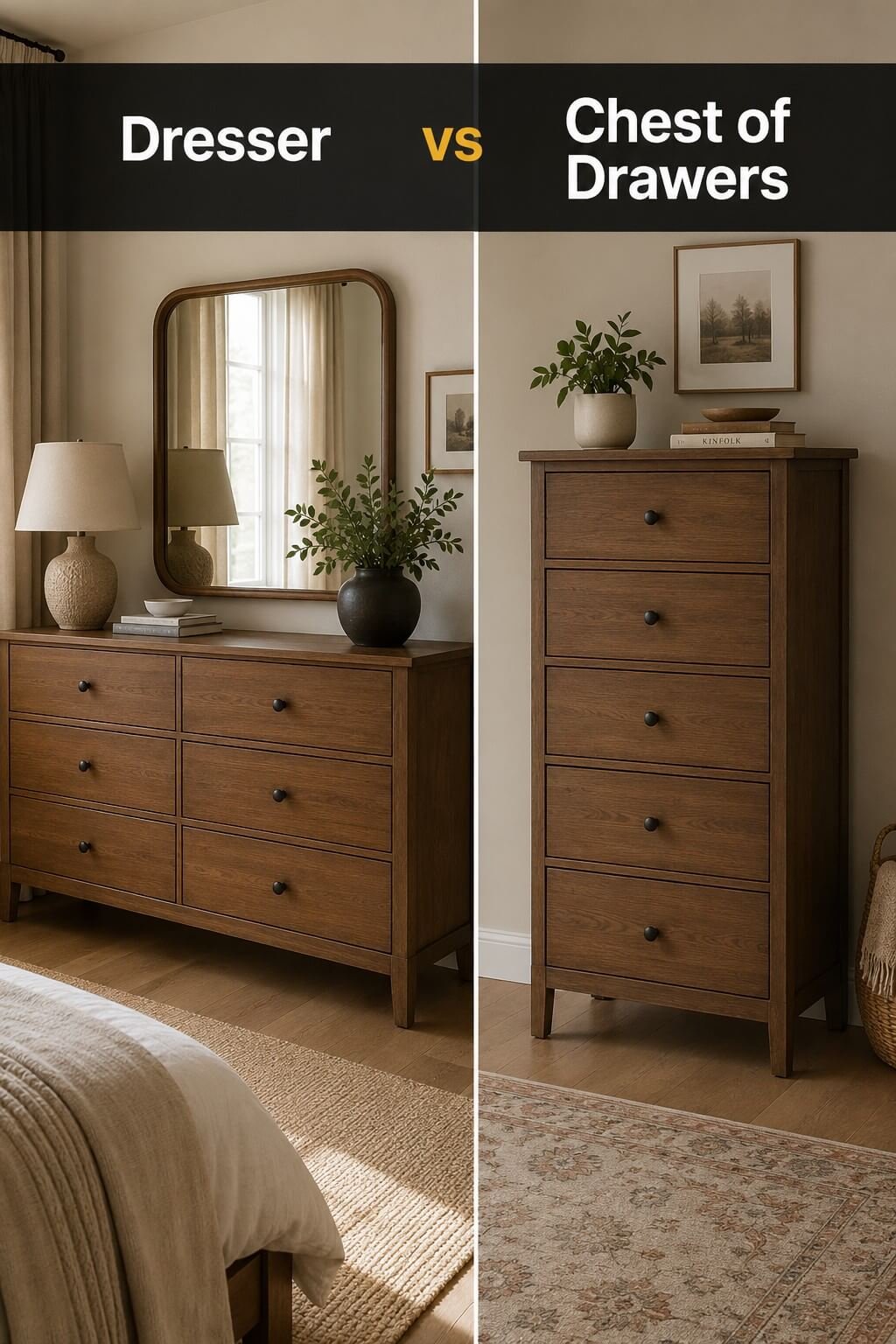
Dresser vs Chest of Drawers: The Full Comparison
| Criteria | Dresser | Chest of Drawers |
|---|---|---|
| Dimensions | 50 to 72 in wide, 30 to 36 in tall, 18 to 20 in deep | 30 to 40 in wide, 45 to 58 in tall, 18 to 20 in deep |
| Storage Capacity | High — 6 to 9 wide drawers, good for folded and bulky items | Moderate to high — 5 to 7 narrower drawers, better for smaller folded items |
| Cost | $300 to $1,500+ depending on material and size | $200 to $1,200+ depending on material and height |
| Durability | 15 to 25+ years for solid wood construction | 15 to 20+ years for solid wood, slightly more glide wear from stacking |
| Style Flexibility | Pairs naturally with a wall mirror; works as a TV stand or changing table | Fits narrow walls and corners; doubles as a tall accent piece |
| Tip-Over Risk | Lower center of gravity, lower risk, still needs anchoring with kids | Higher center of gravity, higher risk, anchoring is essential |
In real terms: a dresser needs a long, uninterrupted wall to look proportional and earn its keep, while a chest of drawers is the fix when that wall doesn’t exist. The trade-off is capacity per square foot versus capacity per drawer — a dresser’s wide drawers hold bulky folded items more easily, while a chest packs more vertical storage into a footprint a dresser could never fit into. Our 29 clever bedroom storage ideas has more inspiration along these same lines.
Quick Look: Dresser vs Chest of Drawers at a Glance
Dresser
A wide, low piece with side-by-side drawers, often paired with a mirror — built for a long wall and bulky folded items.
View on Amazon →Chest of Drawers
A tall, narrow piece with stacked drawers, built to fit a small footprint and maximize vertical storage. Our small walk in closet ideas has more inspiration along these same lines.
View on Amazon →Deep Dive: Dresser
Best-fit scenarios: primary bedrooms with a long wall, nurseries that need a changing surface, and rooms where you want to pair storage with a wall mirror.
Pros
- Wide drawers fit folded sweaters, jeans, and bulky items without piling
- Low profile pairs naturally with a wall mirror or TV
- Doubles easily as a nursery changing station
- Lower center of gravity means a lower tip-over risk
Cons
- Takes up more wall length, often 5 to 6 feet
- Needs a long, uninterrupted wall to look balanced
- Harder to fit into small bedrooms or narrow apartments
- Higher price at comparable quality due to more material used
Real cost range: $300 for a basic laminate six-drawer dresser, up to $1,500+ for a solid wood nine-drawer dresser with a matching mirror.
Deep Dive: Chest of Drawers
Best-fit scenarios: small bedrooms, shared kids’ rooms, narrow walls, studio apartments, and any room where floor space is tighter than storage needs.
Pros
- Small footprint fits narrow walls and tight corners
- Vertical storage adds capacity without using floor space
- Often less expensive than a comparable-quality dresser
- Works well as a stand-alone piece without needing a mirror pairing
Cons
- Narrower drawers make bulky folded items harder to store flat
- Higher center of gravity raises tip-over risk; anchoring is essential
- Small top surface limits use as display or changing space
- Tall top drawers can be hard for young kids to reach safely
Real cost range: $200 for a basic five-drawer laminate chest, up to $1,200+ for a solid wood tallboy.
Real Room Examples: Which One Wins
Small Bedroom
A narrow chest of drawers fits a tight wall without crowding the room.
Chest of Drawers wins
Nursery
A wide dresser top doubles as a safe, stable changing station.
Dresser wins
Shared Kids’ Room
Two chests give each child separate storage in less combined floor space.
Chest of Drawers wins
Primary Bedroom
A long wall and mirror pairing suit a wide dresser’s proportions.
Dresser wins
Small Apartment / Studio
Vertical storage frees up floor space in a tight, multi-use footprint.
Chest of Drawers wins
Professional Tips
- Designer tie-breaker: if the wall is under 3 feet wide, go with a chest of drawers; with 5+ feet of open wall, a dresser will look more proportional and give you mirror-pairing options.
- Common regret mistake: buying a wide dresser because it looked right in a showroom, then finding it blocks a door swing or closet at home.
- Safety note: anchor any piece taller than it is wide to the wall with an anti-tip kit, especially in any room a child will be in — chests of drawers need this more than dressers due to their higher center of gravity.
- Style-pairing note: a dresser without a mirror above it can look bottom-heavy in a tall-ceiling room, while a chest of drawers without a companion piece can look isolated in a large room — balance the piece to the room’s proportions, not just the wall.
Shop the Winner: Bedroom Dressers & Chests of Drawers
Whether you’ve measured your wall and landed on a dresser or a chest of drawers, here’s where to start shopping once you’ve picked a side:
Best Overall
A solid wood construction with metal drawer glides — durable enough for daily use in either a dresser or chest silhouette.
Best Budget
An engineered-wood option with a wall anti-tip kit included, ideal for a first apartment or a kids’ room.
Best Premium
A designer solid wood piece with soft-close drawers and a matching mirror option for the dresser style.
See our full Best Bedroom Dressers & Chests of Drawers guide for the complete breakdown and current picks.
See the Full GuideFrequently Asked Questions
What’s the difference between a dresser and a chest of drawers?
A dresser is a wide, low, horizontal piece of furniture, usually with drawers arranged side by side across a long width and often paired with a mirror. A chest of drawers is taller and narrower, with drawers stacked vertically in a single column, designed to maximize storage on a smaller floor footprint.
Is a chest of drawers the same as a tallboy?
Mostly, yes. “Tallboy” is another name for a chest of drawers, describing its tall, narrow silhouette. Some retailers use “highboy” for a chest of drawers set on a stand with legs, but the core shape is the same.
How many drawers does a standard dresser have?
Most standard dressers have 6 drawers, arranged in two or three columns across the width. Larger dressers can have up to 9 drawers, while compact versions may have as few as 4.
What size dresser fits a small bedroom?
In a small bedroom, look for a narrower dresser around 36 to 48 inches wide rather than the standard 60-inch six-drawer version, or consider a chest of drawers instead, since its narrower footprint fits tighter walls more comfortably.
Do chests of drawers tip over easily?
Chests of drawers have a higher center of gravity than dressers, which does raise tip-over risk, especially when top drawers are opened while lower ones are also extended. Anchoring the piece to the wall with an anti-tip kit largely eliminates this risk.
How do I anchor a dresser or chest of drawers to the wall?
Most furniture includes a wall-anchor kit with an L-bracket or strap that screws into a wall stud and attaches to the back of the dresser or chest. If a kit wasn’t included, anti-tip straps are inexpensive and widely available, and installation takes about 15 minutes with a stud finder and drill.
Is a dresser or chest of drawers better for a nursery?
A dresser is generally the better nursery choice because its wide, flat top comfortably fits a changing pad and its lower center of gravity is safer in a room where a child will be climbing and pulling on furniture. A chest of drawers can work in a nursery too, but it should always be anchored to the wall.
How much does a good dresser cost?
A solid wood dresser from a mid-range retailer typically runs $500 to $1,200, while budget laminate or engineered-wood versions start around $300. High-end or custom solid wood dressers can exceed $1,500.
How much does a good chest of drawers cost?
A chest of drawers typically costs $200 for a basic laminate version up to $600 to $1,200 for a solid wood tallboy from a mid-range retailer. Custom or designer pieces can run higher.
Can a chest of drawers be used as a nightstand?
A narrow chest of drawers can work as a nightstand in a pinch, especially in a small bedroom where floor space is tight, but its height is usually taller than a standard nightstand, which can throw off the proportions next to a bed. A dedicated nightstand is generally a better fit if the budget allows. Check our bed size chart if you want exact numbers before you shop.
What’s the average height of a chest of drawers?
Most chests of drawers range from 45 to 58 inches tall, though some tallboy styles reach 60 inches or more. Height varies by the number of drawers stacked, typically 5 to 7.
Do I need a mirror with a dresser?
No, a mirror is optional. Pairing a dresser with a wall mirror is a common styling choice that adds functionality and visually balances the piece’s horizontal shape, but plenty of dressers are used on their own, especially when wall space or budget is limited.
Which is better for a shared kids’ room, a dresser or a chest of drawers?
In most shared kids’ rooms, two chests of drawers placed side by side work better than one shared dresser, since each child gets a separate, clearly defined storage space in a smaller combined footprint. Just make sure both pieces are anchored to the wall.
How much weight can a dresser drawer hold?
Most standard dresser drawers are rated to hold 30 to 50 pounds of clothing and folded items, though this varies by drawer size and construction quality. Solid wood drawers with metal glides generally handle more weight than particleboard drawers on plastic glides.
Is solid wood or particleboard better for a dresser?
Solid wood is more durable and holds up better over 15 to 25+ years of daily use, but it costs significantly more than particleboard or engineered wood, which typically lasts 5 to 10 years before drawer glides or joints start to wear. For a piece you’ll keep long-term, solid wood is usually worth the extra cost.
What’s the difference between a highboy and a lowboy?
A highboy is a chest of drawers set on a separate base with legs, giving it extra height and a more furniture-like presence. A lowboy is a shorter, wider chest, closer in proportion to a dresser, sometimes used as a dressing table.
Can a chest of drawers double as a TV stand?
A chest of drawers’ top surface is usually too narrow and too high to comfortably support a TV, and the added weight raises tip-over risk. A low, wide dresser is a much better and safer match for a TV stand.
How do I measure my room for a dresser?
Measure the full wall length where the piece will sit, and subtract space for any door swing, closet door, or window that needs to stay clear. Then compare that number to the dresser or chest of drawers’ width, leaving at least a few inches of breathing room on each side.
Are chests of drawers going out of style?
No, chests of drawers remain a standard piece in furniture lines, particularly for smaller bedrooms, kids’ rooms, and studio apartments where floor space is limited. Style details change with trends, but the tall, narrow silhouette continues to solve a footprint problem that dressers can’t.
What’s the best material for a nursery dresser?
Solid wood is the best choice for a nursery dresser because it holds up to years of diaper changes, spills, and daily wear better than particleboard. Look for a non-toxic, low-VOC finish as well, since the piece will be used closely around a baby.
The Verdict
If you have a long, uninterrupted wall and want mirror pairing or a nursery changing station, get a dresser — it holds bulky folded items well and has the lower tip-over profile that a nursery needs. If you’re working with a narrow wall, a small bedroom, a shared kids’ room, or a studio apartment, a chest of drawers is the smarter buy, since it packs storage into a footprint a dresser simply can’t fit into.
The biggest regret we hear is buying based on how a piece looked in a showroom instead of the actual wall width at home. Measure first, anchor whichever piece you choose to the wall, and match the shape to your room — not the other way around.

