


If you’re down to two finalists for that awkward doorway — a bathroom, a closet, a home office nook — you’ve probably already ruled out a standard swinging door. Both a sliding door and a pocket door solve the swing-clearance problem, but they solve it in very different ways, at very different price points.
A sliding door mounts on the wall surface and is fast, cheap, and reversible. A pocket door disappears into the wall entirely, but getting it there usually means opening up drywall and hoping there’s no plumbing in the way. Short version: if you want a weekend upgrade you can undo later, go sliding; if you’re already mid-renovation and want the cleanest possible finished look, go pocket. Here’s the full breakdown.
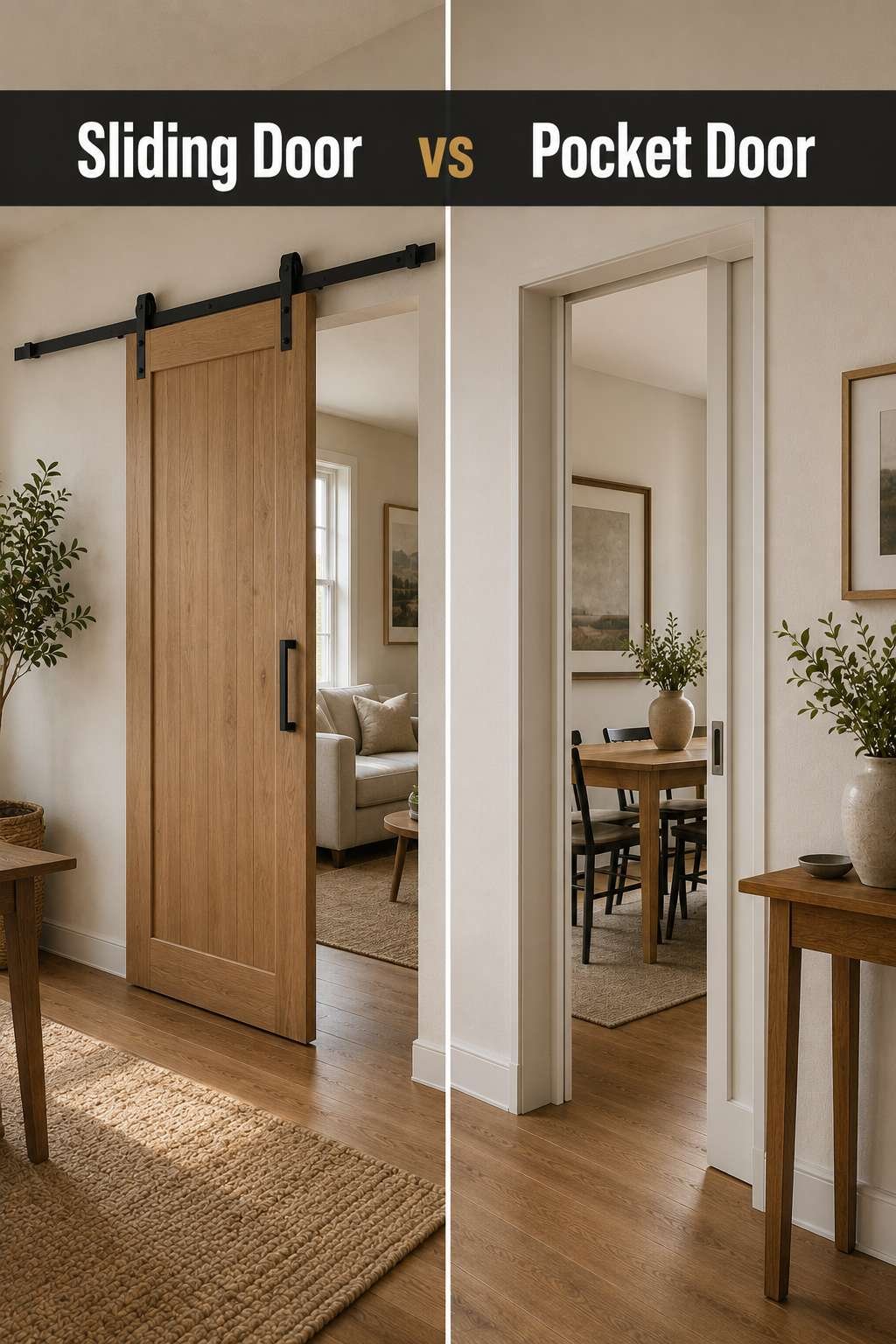
Sliding Door vs Pocket Door: Quick Comparison Chart
| Criteria | Sliding Door | Pocket Door |
|---|---|---|
| Cost (installed) | $150–$600 for a basic setup; $700–$1,500+ for barn-style upgrades | $300–$700 in new construction; $1,000–$2,500+ as a retrofit |
| Durability | 10–15 years with standard hardware, longer with upgraded rollers | 15–25 years, since hardware is protected inside the wall |
| Maintenance | Low — occasional track cleaning and roller lubrication | Moderate — hardware sits inside the wall, harder to reach if it fails |
| Install Difficulty | Easy, DIY-friendly — no wall opening required | Hard — requires opening the wall and checking for plumbing or wiring |
| Privacy / Sound | Fair — visible gaps let in more light and sound | Good fit, but similar sound transfer to sliding since the door slab is the same thickness |
| Wall-Space Impact | Uses wall space beside the opening — no switches or shelving there | None — the door hides fully inside the wall |
| Resale Value | Neutral — barn-style can be polarizing to some buyers | Slight edge — reads as a permanent, higher-end upgrade |
The numbers tell most of the story: sliding doors win on speed, cost, and reversibility, while pocket doors win on finished look and space efficiency once they’re installed. The install-difficulty row is the one that trips people up most — a pocket door isn’t just a different door, it’s a small construction project, since the frame has to go inside the wall before drywall goes back up. If your wall is finished and you’re not already renovating, that single row can outweigh every other advantage on the chart. See our sliding door ideas for more direction in this style.
Quick Look: Sliding Door vs Pocket Door at a Glance
Sliding Door
Surface-mounted and budget-friendly — the fastest, most reversible upgrade for tight spaces.
View on Amazon →Pocket Door
Disappears fully into the wall for a clean, swing-free finish in permanent remodels.
View on Amazon →Sliding Door: Is It Right for Your Space?
A sliding door is the right call when you want a real upgrade without opening a single wall. It’s the go-to for closets, laundry nooks, pantries, and any room where you’re not precious about the wall space beside the doorway. It’s also the safer pick if you’re renting, still deciding on a layout, or just want to test whether a swing-free door actually improves how the room feels before committing to anything permanent. Our sliding door vs french door comparison covers that decision in more depth.
Pros
- Fast, budget-friendly installation with no wall demolition
- Fully reversible — easy to remove or swap back later
- Wide style range, from budget hollow-core to statement barn doors Our barn door ideas has more inspiration along these same lines.
- Works on drywall, plaster, or brick since hardware mounts on the surface
Cons
- Uses wall space beside the opening that can’t hold switches or shelving
- Visible gaps at the top and sides let in more sound and light
- Exposed track collects dust and needs occasional cleaning
- Heavier barn-style doors can pull on drywall without proper blocking
Real cost range: expect $150 to $600 installed for a basic surface-mounted sliding door with standard track hardware. Barn-style upgrades with heavier hardware and a statement door slab typically run $700 to $1,500 or more.
Pocket Door: Is It Right for Your Space?
A pocket door is the right call when you’re already mid-renovation, opening walls anyway, and want the cleanest possible finished look with zero swing clearance to plan around. It shines in small bathrooms and home offices where every square foot of wall and floor space matters, and it’s the choice a designer will usually push for in a higher-end remodel where a visible track just doesn’t fit the aesthetic.
Pros
- Fully disappears into the wall, freeing floor and wall space
- Cleaner, more finished look for higher-end remodels
- No door swing to plan furniture or layout around
- Reads as a permanent, higher-end upgrade at resale
Cons
- Retrofit installs require opening the wall — can reveal hidden plumbing or wiring
- Higher installed cost, especially outside new construction
- Harder to service — hardware sits inside the wall cavity
- Not truly soundproof; the flush fit reduces gaps but the door slab is the same thickness
Real cost range: expect $300 to $700 installed in new construction, where the wall cavity is already open. Retrofit installs into an existing finished wall typically run $1,000 to $2,500 or more once framing, drywall patching, and hardware are all included.
Real Room Examples: Which Door Wins Where
Small Bathroom
Pocket door wins. Reclaims the wall space for a mirror, towel bar, or switch that a sliding door would block.
Closet / Laundry Nook
Sliding door wins. Fast and affordable, and the wall space isn’t usually needed for anything else.
Home Office Nook
Pocket door wins. Swing-free access keeps a small desk layout unobstructed.
High-Traffic Hallway
Sliding door wins. Opens one-handed while carrying laundry or groceries, no wall demolition needed.
Rental-Friendly Apartment
Sliding door wins. Fully reversible, no structural changes, landlord-friendly.
Professional Tips & Designer Tie-Breakers
- Check for plumbing and wiring before committing to a pocket door — a short stud-finder and inspection session can save an expensive mid-project surprise.
- Reinforce the header track for barn-style sliding doors. Undersized hardware is the single most common regret homeowners report a year in.
- Budget for soft-close hardware on either door type — it’s a small upcharge that prevents slamming and noisy complaints from the next room.
- Add a privacy latch in bathrooms. Neither door style locks by default, so this is an easy add-on worth planning for upfront.
- Vacuum or wipe down the track on both door types every few months — dust buildup is the most common cause of a sticky, noisy slide.
Designer tie-breaker: if you’re stuck, ask which mistake you’d rather live with — a sliding door’s visible track and reduced privacy, or a pocket door’s higher cost and retrofit risk. Most readers find that question settles it faster than any spec sheet.
Shop the Winner: Sliding & Pocket Door Hardware
If you’re leaning toward a sliding door, here’s what to get started with:
Best Overall
A soft-close track kit rated for standard interior door weights, with a low-profile rail that mounts cleanly on drywall or wood-backed walls.
Best Budget
A basic surface-mount track and roller set, ideal for closets and laundry nooks where a heavier barn-style look isn’t needed.
Best Premium
A heavy-duty barn-style hardware kit with a black or brushed finish, built for statement doors and higher-traffic openings.
If you’re leaning toward a pocket door, here’s what to get started with:
Best Overall
A complete pocket door frame kit with pre-assembled steel studs, sized for standard 2×4 wall construction.
Best Budget
A basic pocket door frame and roller kit for straightforward new-construction installs without extra features.
Best Premium
A soft-close pocket door hardware set with a reinforced frame, built for heavier solid-core doors and daily high-traffic use.
Frequently Asked Questions
What is the main difference between a sliding door and a pocket door?
A sliding door mounts on the surface of the wall and slides along an exposed track, while a pocket door slides inside the wall itself and disappears completely into a hidden cavity when open.
Is a pocket door more expensive than a sliding door?
Usually yes. A basic sliding door often installs for $150 to $600, while a pocket door typically runs $300 to $700 in new construction and $1,000 to $2,500 or more as a retrofit into an existing wall.
Do pocket doors need the wall opened up?
In new construction, the wall is already open. In an existing home, a contractor typically needs to open the wall cavity to install the frame and check for plumbing or wiring before the door can be installed.
Can I install a sliding door without professional help?
Yes, most surface-mounted sliding doors are DIY-friendly as long as the wall has solid blocking to support the track hardware, which many homeowners can install in a weekend.
Which door type is better for a small bathroom?
A pocket door is usually the better fit for a small bathroom because it reclaims the wall space beside the opening for a mirror, towel bar, or light switch that a sliding door would otherwise block.
Are pocket doors good for soundproofing?
A pocket door’s flush fit reduces visible gaps, but it uses the same thin door slab as most sliding doors, so soundproofing performance is similar unless you upgrade to a solid-core door on either style.
Do sliding doors save more space than pocket doors?
Pocket doors save more usable space because they disappear into the wall entirely, while sliding doors still need open wall space beside the doorway for the door to slide across.
Can a pocket door be added to an existing wall?
Yes, but it is a real renovation project. A contractor needs to open the wall, confirm there is no plumbing or wiring in the way, frame the pocket, and patch the drywall afterward.
Which door type is better for renters?
A sliding door is the better choice for renters because it mounts on the wall surface, requires no structural changes, and can be removed or swapped back to the original door before move-out.
Do sliding doors provide enough privacy for a bathroom?
A sliding door can work for a bathroom, but the visible gaps at the top and sides let in more light and sound than a standard swinging or pocket door, so it suits a half-bath or guest bath better than a primary bath.
How long does a pocket door installation take?
In new construction it can be a same-day install alongside normal framing. As a retrofit into an existing wall, plan for one to three days once demolition, framing, hardware, and drywall patching are all included.
What is the average cost of installing a sliding door?
A basic surface-mounted sliding door with standard hardware typically costs $150 to $600 installed, while a heavier barn-style door with upgraded hardware can run $700 to $1,500 or more.
Are pocket doors ADA compliant?
Pocket doors can be ADA compliant when the hardware and clear opening width meet accessibility guidelines, and their swing-free design is often preferred in accessible bathroom layouts.
Can plumbing or wiring block a pocket door installation?
Yes. This is the single biggest retrofit risk with pocket doors, which is why a contractor should check the wall cavity for plumbing or electrical lines before you commit to the project.
Which door is easier to maintain over time?
Sliding doors are generally easier to maintain because the track and rollers stay visible and accessible, while a pocket door’s hardware sits inside the wall and is harder to reach if it needs service.
Do sliding doors work well in high-traffic hallways?
Yes, sliding doors work well in hallways because they open with one hand, don’t swing into walking paths, and don’t require any structural changes to the hallway wall.
Is a pocket door a good resale value upgrade?
In mid-to-high-end remodels, a pocket door is often viewed as a polished, permanent upgrade, while a sliding barn-style door is more of a style statement that not every buyer will love.
Can I convert a sliding door opening into a pocket door later?
Yes, but it means opening the wall and reframing the opening as a full renovation project, so it’s worth deciding upfront rather than planning to switch later.
What hardware do I need for a sliding door?
At minimum you need a wall-mounted track, rollers rated for your door’s weight, a floor or wall guide to keep the door from swinging, and blocking behind the wall to anchor the track securely.
Which door type is best for a home office nook?
A pocket door tends to work best for a home office nook because it keeps the floor plan swing-free, which matters most in small rooms where a desk sits close to the doorway.
Final Verdict: Which Door Should You Actually Choose?
If you’re renting, working with a tight budget, or want an upgrade you can undo, the sliding door wins — it’s faster, cheaper, and fully reversible. If you’re already mid-renovation, tackling a small bathroom or home office nook, and want the cleanest possible finished look with zero swing clearance, the pocket door wins — just budget for the wall work and confirm there’s no plumbing or wiring hiding behind that drywall before you commit. Either way, don’t buy hardware before you’ve settled the install-difficulty question — it’s the one factor most buyers underestimate.

