


Standing in the plumbing aisle staring at two very different bathroom sinks is a more consequential moment than it feels like. A vessel sink and an undermount sink solve the same basic problem — washing your hands — but they ask completely different things of your counter, your cleaning routine, and your budget.
A vessel sink sits proudly on top of the counter like a piece of tabletop sculpture. An undermount sink disappears beneath the counter’s edge for a seamless, low-fuss surface. Neither one is objectively “better” — but for your specific bathroom, one of them almost certainly is. Here’s how to tell which. Our guide on how to organize your room walks through this step by step.
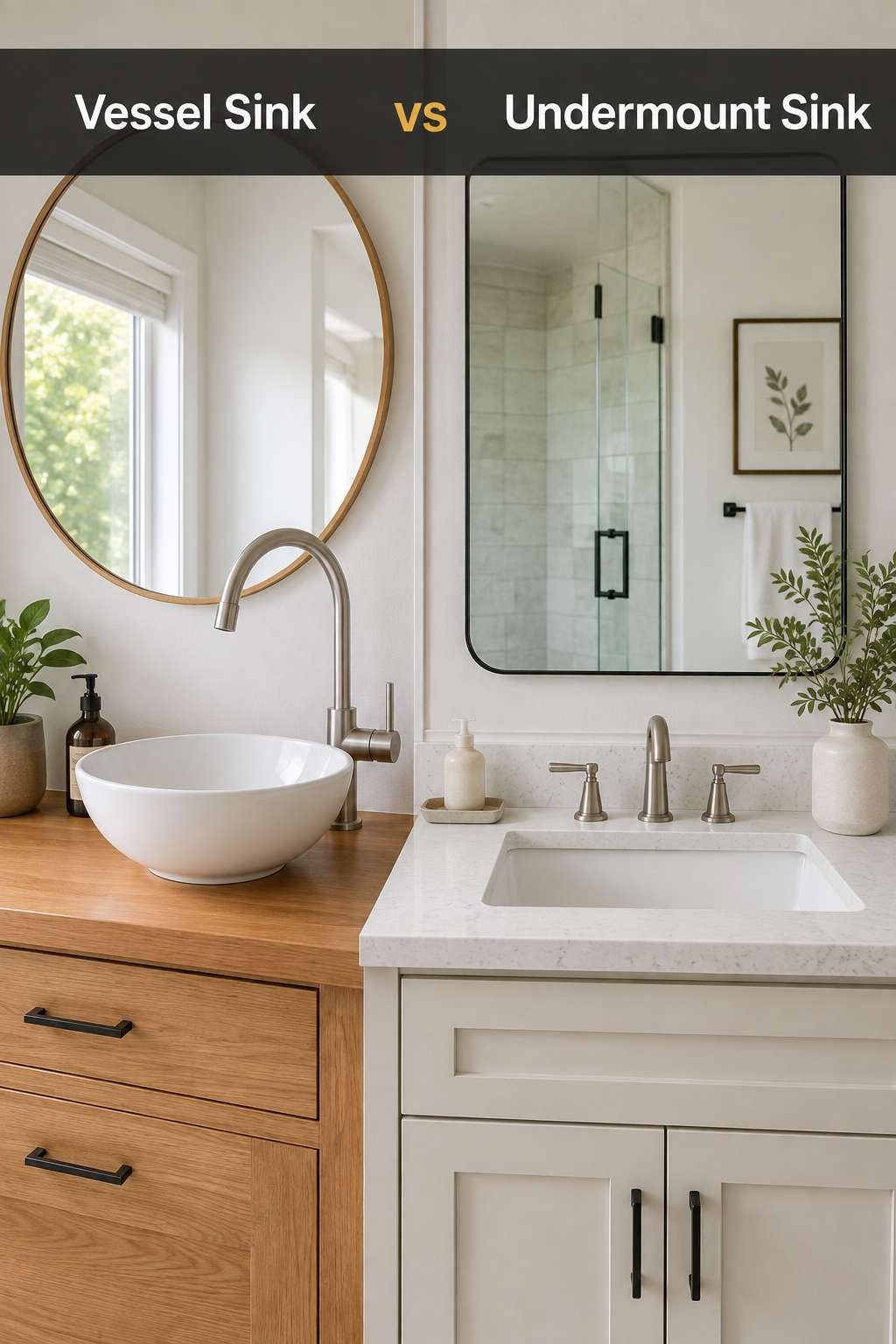
Vessel Sink vs Undermount Sink: The Full Comparison
| Criteria | Vessel Sink | Undermount Sink |
|---|---|---|
| Average Cost (installed) | $400–$1,200+ | $350–$900 |
| Installation Difficulty | Moderate | High |
| Daily Cleaning Effort | Higher | Lower |
| Durability | 10–20 yrs | 15–25 yrs |
| Counter Height Comfort | Non-standard | Standard |
| Style Impact | Bold statement | Understated |
| Resale Appeal | Polarizing | Broad appeal |
Those ratings are only useful once you know what they mean in real life. “Moderate” installation difficulty for a vessel sink means a confident DIYer can often handle it with a basic drain kit, while “High” for an undermount sink means it genuinely needs a professional, since the sink is bonded and clipped to the underside of a solid stone or quartz counter.
“Higher” daily cleaning effort for a vessel sink isn’t about the bowl itself — it’s the base seam where the bowl meets the counter, and the water that splashes past the rim onto the surrounding counter, that adds the extra wiping. “Non-standard” counter height means a vessel sink typically needs a vanity a few inches shorter than usual, since the bowl itself adds height on top of the counter — something worth measuring before you fall in love with a particular bowl.
Quick Look: Vessel Sink vs Undermount Sink at a Glance
Vessel Sink
A sculptural bowl that sits on top of the counter, built to be the design focal point of a powder room or guest bath.
View on Amazon →Undermount Sink
A seamless basin mounted beneath the counter, built for effortless daily cleanup in a busy family or primary bathroom.
View on Amazon →Deep Dive: Vessel Sink
A vessel sink earns its keep in rooms where design matters more than daily wear — think powder rooms, guest bathrooms, and boutique-style primary baths where the sink doubles as a decorative object.
Pros
- Striking, sculptural focal point that elevates a plain vanity
- Wide range of bowl materials and shapes — glass, stone, ceramic, copper — for a custom look
- Easy to reach into and clean the bowl interior, since there’s no overhanging rim
- Can pair with a shorter, often more affordable vanity cabinet
Cons
- Prone to splashing water onto the counter and floor
- Requires a taller, pricier faucet to clear the rim
- The base seam where the bowl meets the counter can trap grime
- Counter height often needs adjusting, which isn’t always practical in an existing vanity
Real cost range: $400–$1,200+ installed, including a taller faucet. Budget ceramic bowls start around $120, while designer glass or stone bowls run $400–$800+ before installation and faucet costs.
Deep Dive: Undermount Sink
An undermount sink earns its keep in rooms that see heavy daily use — primary bathrooms, family bathrooms, and rental properties where low maintenance beats visual drama.
Pros
- Seamless edge makes wiping counter debris directly into the sink effortless
- No rim to trap grime or water rings
- Works with a standard-height faucet, keeping cost predictable
- Broadly appealing look that doesn’t polarize future buyers
Cons
- Requires a solid stone or engineered-quartz countertop — won’t work with laminate
- Installation isn’t a realistic DIY project; it needs a professional
- Less of a design statement than a vessel sink
- A mounting-clip failure is a bigger repair job than replacing a drop-in or vessel bowl
Real cost range: $350–$900 installed with a standard faucet. Basic vitreous china bowls start around $80, while premium stone or fireclay bowls run $300–$600+ before installation.
Which One Wins by Room?
Powder Room
Vessel Sink wins — it’s the one room built for a design splurge, and low daily traffic means the splash factor barely matters.
Budget Renovation
Vessel Sink wins — it pairs with an affordable laminate counter, skipping the stone-counter requirement that drives up undermount costs.
Luxury Primary Bath
Undermount Sink wins — paired with a stone or quartz counter, it gives a seamless, spa-like look built for daily two-person use.
Rental-Friendly Bathroom
Undermount Sink wins — it’s low-maintenance, broadly appealing to future tenants, and holds up to everyday use.
High-Traffic Family Bathroom
Undermount Sink wins — no rim to trap grime means faster cleanup after every toothpaste-covered afternoon.
Professional Tips & Common Regrets
- Designer tie-breaker: if you’re still torn, let the room’s daily traffic decide — statement rooms lean vessel, workhorse rooms lean undermount.
- Common regret: choosing a vessel sink without checking vanity height first. A standard 32–36 inch vanity plus a vessel bowl can push the rim above a comfortable elbow height for shorter household members.
- Resale-value note: undermount sinks read as more universally desirable to future buyers, while a vessel sink is a personal-taste feature that can help or hurt depending on who’s touring the house.
- Maintenance reality check: hard water spots show up faster on a glossy vessel bowl’s exterior than inside a recessed undermount basin — factor in your local water hardness before choosing a high-gloss finish.
Shop the Winner: Bathroom Sink Faucets
If you’re leaning toward the Vessel Sink, here’s what to get started with:
Best Overall
A tall single-handle gooseneck faucet sized to clear most vessel bowl rims, with an easy-to-use lever handle for everyday washing.
Best Budget
An affordable tall vessel faucet in a simple chrome finish, a solid entry point for a guest bath or powder room refresh.
Best Premium
A designer matte black or brushed brass vessel faucet with a waterfall-style spout for a boutique, high-end finish.
If you’re leaning toward the Undermount Sink, here’s what to get started with:
Best Overall
A reliable single-handle faucet at standard height, built for daily use in a primary or family bathroom.
Best Budget
A basic chrome two-handle faucet that covers the essentials without stretching a renovation budget.
Best Premium
A widespread faucet set in a brushed nickel or matte black finish for a polished, primary-bath-ready look.
Frequently Asked Questions
Is a vessel sink harder to keep clean than an undermount sink?
Generally yes. A vessel sink has an exposed rim and a base seam where it meets the counter, both of which trap water and grime. An undermount sink has a seamless edge that lets you wipe counter debris straight into the basin, which makes daily cleanup faster.
Do vessel sinks need a special faucet?
Yes. Because a vessel sink sits on top of the counter, it needs a taller faucet, usually a gooseneck or vessel-height style, so the water clears the rim. Standard-height faucets typically will not work with a vessel bowl.
How much does it cost to install a vessel sink vs an undermount sink?
A vessel sink typically runs $400 to $1,200 or more installed, including the taller faucet it requires. An undermount sink typically runs $350 to $900 installed with a standard faucet, though it also requires a solid stone or quartz countertop.
Can I install a vessel sink myself?
A vessel sink is one of the more DIY-friendly sink styles, since it sits on top of the counter with a simple drain kit. It is still worth having a plumber check the drain and faucet connections if you are not confident working with plumbing.
Do undermount sinks require a stone or quartz countertop?
Yes. An undermount sink is mounted from below and needs a solid surface like granite, quartz, or engineered stone to support the clips and seal properly. It will not work with laminate countertops.
Which sink type is better for resale value?
An undermount sink is the safer choice for resale, since its clean, low-maintenance look appeals broadly to buyers. A vessel sink is more of a personal style statement that some buyers love and others see as a feature to replace.
Are vessel sinks going out of style?
Vessel sinks remain popular in powder rooms and guest bathrooms where a design statement matters, though they have never been the default for primary or family bathrooms. Expect them to stay a strong niche choice rather than an everyday standard.
What vanity height works best with a vessel sink?
Because the bowl adds several inches on top of the counter, a vessel sink usually needs a vanity a few inches shorter than standard to keep the rim at a comfortable height. Check the bowl height against your household’s typical user before buying.
Do vessel sinks splash more than undermount sinks?
Yes, vessel sinks are more prone to splashing water onto the counter and floor because the bowl sits above the counter surface with less containment. An undermount sink’s recessed basin naturally contains more splash.
Which sink is easier to clean around the edges?
An undermount sink is easier to clean around the edges since there is no rim or seam catching water and debris. A vessel sink’s base seam, where the bowl meets the counter, needs more regular attention to prevent buildup.
Can I put an undermount sink in a laminate countertop?
No. Laminate cannot support an undermount sink’s mounting clips or provide a proper seal, so it will fail over time. If your countertop is laminate, a drop-in or vessel sink is the more realistic option.
Which sink type is better for a small bathroom?
A vessel sink can make a small powder room feel more intentional and styled, since it doubles as a decorative element. In a small but heavily used family bathroom, an undermount sink’s low-maintenance surface is usually more practical.
Are vessel sinks more fragile than undermount sinks?
It depends on material. Glass or thin ceramic vessel bowls can chip more easily than a thick vitreous china undermount basin, though stone or fireclay vessel bowls hold up well. Check the specific material rather than assuming by sink style alone.
How long do vessel sinks typically last?
A well-made ceramic or stone vessel sink typically lasts 10 to 20 years or more with normal care. Lifespan depends heavily on material quality and how carefully the bowl is cleaned to avoid scratching or chipping.
Is an undermount sink a good choice for a rental property?
Yes. An undermount sink’s durability and broad appeal make it a practical choice for rentals, since it holds up to different tenants’ daily use without the splash and cleaning issues a vessel sink can bring.
Which sink is better for a family bathroom with kids?
An undermount sink is generally the better fit for a family bathroom, since its seamless edge is faster to wipe down after kids use it and it does not have a rim that traps toothpaste residue and grime.
Do vessel sinks work with a pedestal-style vanity?
Vessel sinks are more commonly paired with a flat-top console or floating vanity that gives the bowl a stable surface to sit on, rather than a traditional pedestal sink base. Confirm your vanity has adequate flat surface area before choosing a vessel bowl.
What’s the average lifespan of an undermount sink?
A quality undermount sink in vitreous china or stone typically lasts 15 to 25 years or more. The mounting clips and seal are the parts most likely to eventually need attention, though this is uncommon with a proper installation.
Which sink style is trending for 2026 bathroom remodels?
Undermount sinks remain the dominant choice for primary and family bathroom remodels heading into 2026 thanks to their low-maintenance appeal, while vessel sinks continue trending strongly in powder rooms and guest baths as a design statement.
Can I switch from an undermount sink to a vessel sink without replacing the countertop?
Sometimes, if the existing countertop material can support a vessel bowl and the undermount cutout can be adapted or covered, but in most cases the countertop needs modification or replacement to properly support a vessel sink installation. A contractor can confirm what your specific counter allows.
Final Verdict
Choose the Vessel Sink if you’re outfitting a powder room, guest bath, or any low-traffic space where you want the sink itself to be a design statement — and you’re willing to trade a bit of extra cleaning and a taller faucet for that look.
Choose the Undermount Sink if you’re outfitting a primary bathroom, family bathroom, or rental where daily durability and easy cleanup matter more than making a style statement, and you already have (or are installing) a stone or quartz counter.
If you genuinely can’t decide, default to the undermount sink. It’s the safer choice for resale, daily livability, and long-term satisfaction — save the vessel sink for a room where its downsides matter the least.

