


Picking between laminate and quartz countertops usually comes down to one honest question: are you renovating for the next five years, or the next twenty-five? Laminate wins on upfront cost and forgiveness — it’s the practical choice for rentals, flips, and tight budgets. Quartz wins on durability, resale value, and long-term maintenance — it’s the choice for a kitchen you don’t plan to touch again. Below is a real side-by-side comparison, honest pros and cons for both, and a clear verdict for your specific situation.
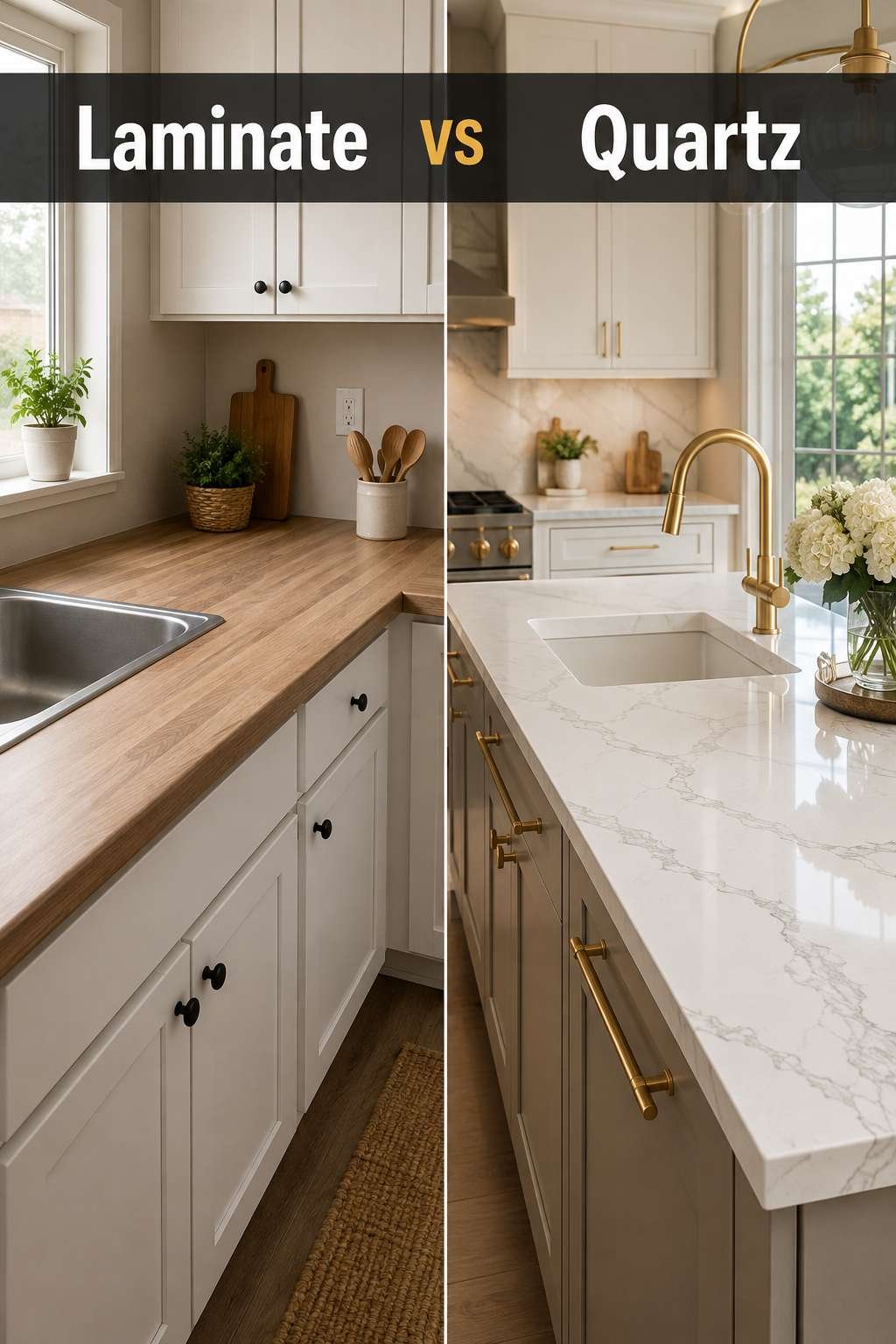
Laminate vs Quartz: The Master Comparison Chart
| Criteria | Laminate Countertops | Quartz Countertops |
|---|---|---|
| Cost per Sq Ft | $20–$50 per sq ft installed | $50–$120 per sq ft installed |
| Durability | Moderate — can scratch or chip at seams | Excellent — resists scratches and everyday chips |
| Heat Resistance | Low — can scorch near hot pans or dishes | High, but not heatproof — avoid direct hot pans |
| Maintenance | Wipe clean, avoid abrasive cleaners | Wipe clean, never needs sealing |
| Install Difficulty | Low — DIY-friendly | High — professional templating required |
| Average Lifespan | 10–15 yrs | 25+ yrs |
| Resale Value | Neutral to slightly negative | Positive in most markets |
| Aesthetic Flexibility | Hundreds of patterns, budget-friendly | Natural stone look, premium feel |
What This Chart Actually Means in a Real Kitchen
Numbers on a chart don’t tell you what “moderate durability” feels like at 6pm on a Tuesday with dinner on the stove. In practice, laminate’s lower heat and scratch resistance means you’ll want cutting boards and trivets as a habit, not an afterthought — skip that step for a few years and the wear shows, especially right around the sink and stove. Quartz’s durability advantage shows up less in daily use and more in the years you don’t think about your countertop at all: no resealing reminders, no seam repairs, no replacing a section because a pattern got discontinued.
The install-difficulty gap matters more than people expect. Laminate’s low install difficulty means a confident DIYer can genuinely save on labor. Quartz’s high install difficulty isn’t just a warning label — slabs are heavy, templating has to be precise, and a bad quartz install is expensive to fix. Budget for professional installation on quartz; don’t try to shortcut it. Our guide on how to make your kitchen look expensive walks through this step by step.
Quick Look: Laminate vs Quartz at a Glance
Laminate Countertops
An affordable, DIY-friendly countertop in hundreds of patterns — best for budget renovations and rental-friendly updates.
View on Amazon →Quartz Countertops
A low-maintenance engineered stone that resists stains and scratches for decades — best for busy kitchens and long-term homes.
View on Amazon →Deep Dive: Laminate Countertops
Best-fit scenarios: rental units, house flips, tight renovation budgets, DIY installs, laundry rooms, and secondary kitchens where premium durability isn’t the priority.
Pros
- Budget-friendly at $20–$50 per sq ft installed
- Hundreds of colors and patterns, including stone-look options
- DIY-friendly installation for confident renovators
- Easy and inexpensive to replace if your style changes
- Lightweight — rarely requires cabinet reinforcement
Cons
- Can scratch, chip, or scorch near hot pans
- Seams can lift or swell with prolonged water exposure
- Doesn’t add significant resale value
- Can read as less premium up close, especially at edges
- Damaged sections are usually replaced, not repaired
Real cost range: $20–$50 per sq ft installed. For a typical 30 sq ft kitchen run, expect roughly $600–$1,500 installed, materials and labor included.
Deep Dive: Quartz Countertops
Best-fit scenarios: forever homes, high-traffic family kitchens, luxury remodels, and resale-focused renovations where long-term durability outweighs upfront cost. Our kitchen remodel checklist covers the rest of the details worth planning for.
Pros
- Extremely durable — resists scratches and everyday stains
- Never needs sealing, unlike natural stone
- Wide range of stone-look patterns without natural stone upkeep
- Adds real resale value in most markets
- Long lifespan — often 25+ years
Cons
- Higher upfront cost at $50–$120 per sq ft installed
- Heavy — may require cabinet reinforcement
- Not fully heatproof despite its reputation — trivets still needed
- Requires professional installation and templating
- Can crack under heavy point-impact, like a dropped cast-iron pan
Real cost range: $50–$120 per sq ft installed. For a typical 30 sq ft kitchen run, expect roughly $1,500–$3,600 installed, materials and labor included.
Which One Wins in Your Kitchen?
Rental-Friendly Kitchen
Laminate wins — low cost, easy to update, no landlord approval headaches.
Budget Renovation
Laminate wins — frees up budget for cabinets, lighting, and appliances.
Luxury New Build
Quartz wins — durability and resale value match the investment level.
High-Traffic Family Kitchen
Quartz wins — stands up to daily cooking and constant wear.
Laundry Room / Basement Bar
Laminate wins — lower-traffic space where budget matters more than premium durability.
Professional Tips & Common Regret Mistakes
Use a trivet on quartz, always. Despite its heat-resistant reputation, thermal shock from a hot pan can still crack the resin binder. This is the single most common quartz regret we hear about.
Flipping a property? Laminate frees up renovation budget for higher-ROI updates like fixtures, paint, and lighting — buyers notice the whole kitchen, not just the countertop material.
For resale, matching your neighborhood matters more than the material itself. Quartz typically outperforms laminate on resale, but over-improving a starter-home kitchen rarely pays back dollar for dollar.
Get laminate seams professionally finished. Most water-damage complaints trace back to a poorly sealed seam, not the material failing on its own.
Order physical samples of both before committing. Undertones shift dramatically under kitchen lighting compared to a bright showroom.
Shop the Winner
If you’re leaning toward quartz — the pick most homeowners settle on for a forever kitchen — here’s what to get started with once it’s installed:
Best Overall
All-in-One Quartz Care Kit — stone-safe spray cleaner, microfiber cloths, and a trivet set for daily upkeep.
Best Budget
pH-Neutral Stone Cleaner Spray — a single bottle for anyone who just wants a safe, reliable daily cleaner.
Best Premium
Quartz Care & Polish Bundle — daily cleaner, weekly polish, and heat-resistant trivets for long-term shine.
Leaning toward laminate instead? Good news — it skips the specialty cleaners entirely. A mild dish soap and a soft cloth is genuinely all it needs.
See Our Full Best Quartz Countertop Cleaning Kits Guide →Frequently Asked Questions
Is quartz worth the extra cost over laminate?
For kitchens you plan to keep long-term, yes — quartz costs more upfront but lasts longer, resists damage better, and typically returns more value at resale. For short-term ownership or rental units, laminate often makes more financial sense.
What is the price difference between laminate and quartz countertops?
Laminate typically runs $20 to $50 per square foot installed, while quartz runs $50 to $120 per square foot installed, so quartz can cost two to three times as much depending on the slab and edge profile chosen.
Does laminate countertop scratch easily?
Laminate can scratch or chip more easily than quartz, especially at seams and edges, though everyday wear with cutting boards and normal use is usually manageable.
Can you put a hot pan on quartz countertops?
Quartz resists heat far better than laminate, but it is not fully heatproof — the resin binder can still crack under sudden temperature changes, so a trivet is still recommended.
How long do laminate countertops last?
Laminate countertops typically last 10 to 15 years with normal use before showing significant wear at seams and edges. It’s a similar trade-off to deciding on quartz vs granite countertops elsewhere in the space.
How long do quartz countertops last?
Quartz countertops typically last 25 years or more, and many homeowners keep the same quartz countertop for the life of the home.
Does laminate countertop lower resale value?
Laminate is generally neutral to slightly negative for resale value compared to stone surfaces, though it rarely tanks a sale on its own — buyers weigh the whole kitchen, not just the countertop.
Can laminate countertops look like quartz?
Modern laminate includes convincing stone-look patterns that mimic quartz from a distance, though the texture and edge detail still read as laminate up close.
Is quartz countertop maintenance-free?
Quartz never needs sealing and wipes clean easily, but it still benefits from a stone-safe cleaner and avoiding harsh chemicals or abrasive scrubbers that can dull the surface over time.
Can you repair a scratched laminate countertop?
Minor scratches can sometimes be filled with a color-matched laminate repair paste, but deeper scratches or chips usually mean replacing that section rather than refinishing it.
Can you repair a chipped quartz countertop?
Small chips in quartz can often be repaired with a resin filler by a professional, but larger cracks typically require a full slab replacement.
Is laminate a good countertop for rentals?
Laminate is one of the most practical choices for rental units because it is inexpensive to install and easy to replace between tenants if it gets damaged.
Do quartz countertops need sealing?
No — quartz is a non-porous engineered stone and never needs sealing, unlike natural stone surfaces such as granite or marble.
Which countertop is better for resale value, laminate or quartz?
Quartz generally adds more resale value in most markets, but laminate is not a dealbreaker in budget-focused neighborhoods or rental-heavy markets.
Can you install laminate countertops yourself?
Yes, laminate is DIY-friendly for confident renovators, especially pre-formed laminate sheets, though clean seams and precise cuts still take practice.
Can you install quartz countertops yourself?
Quartz installation is not recommended as a DIY project — the slabs are heavy and require professional templating and cutting equipment for a proper fit.
Is quartz heavier than laminate?
Yes, quartz is significantly heavier than laminate, and some cabinet bases may need reinforcement to support the added weight.
Which countertop is better for a small kitchen?
Either works well in a small kitchen — laminate keeps costs down for a starter space, while quartz adds a premium look without demanding much square footage.
Does quartz countertop stain?
Quartz strongly resists staining from everyday spills like wine, coffee, and oil because it is non-porous, though pigmented substances left too long can still leave a mark on lighter colors.
What’s the best countertop for a budget kitchen renovation?
Laminate is generally the best choice for a budget renovation, freeing up funds for higher-impact updates like cabinets, lighting, and appliances.
Final Verdict
If you’re renovating a rental, flipping a property, or working with a tight budget: choose laminate. It’s affordable, DIY-friendly, and easy to update again later without much financial risk.
If you’re building or renovating your forever kitchen, cook often, or care about resale value: choose quartz. The higher upfront cost buys two to three decades of low-maintenance durability that laminate simply can’t match.
For most homeowners settling into a long-term home, quartz is the smarter long-run investment — but there’s no wrong answer if the material actually matches how long you’ll own the kitchen.

