Gas and induction are the two most debated cooktop technologies for a reason: both can deliver serious cooking performance, but they get there in completely different ways. Gas gives you instant, visual flame control and still works when the power goes out; induction heats faster, holds a more precise temperature, and wipes clean in seconds — as long as your cookware is on board. Below, we break down the real costs, the everyday trade-offs, and which one wins for your specific kitchen — no fence-sitting, just a clear answer.
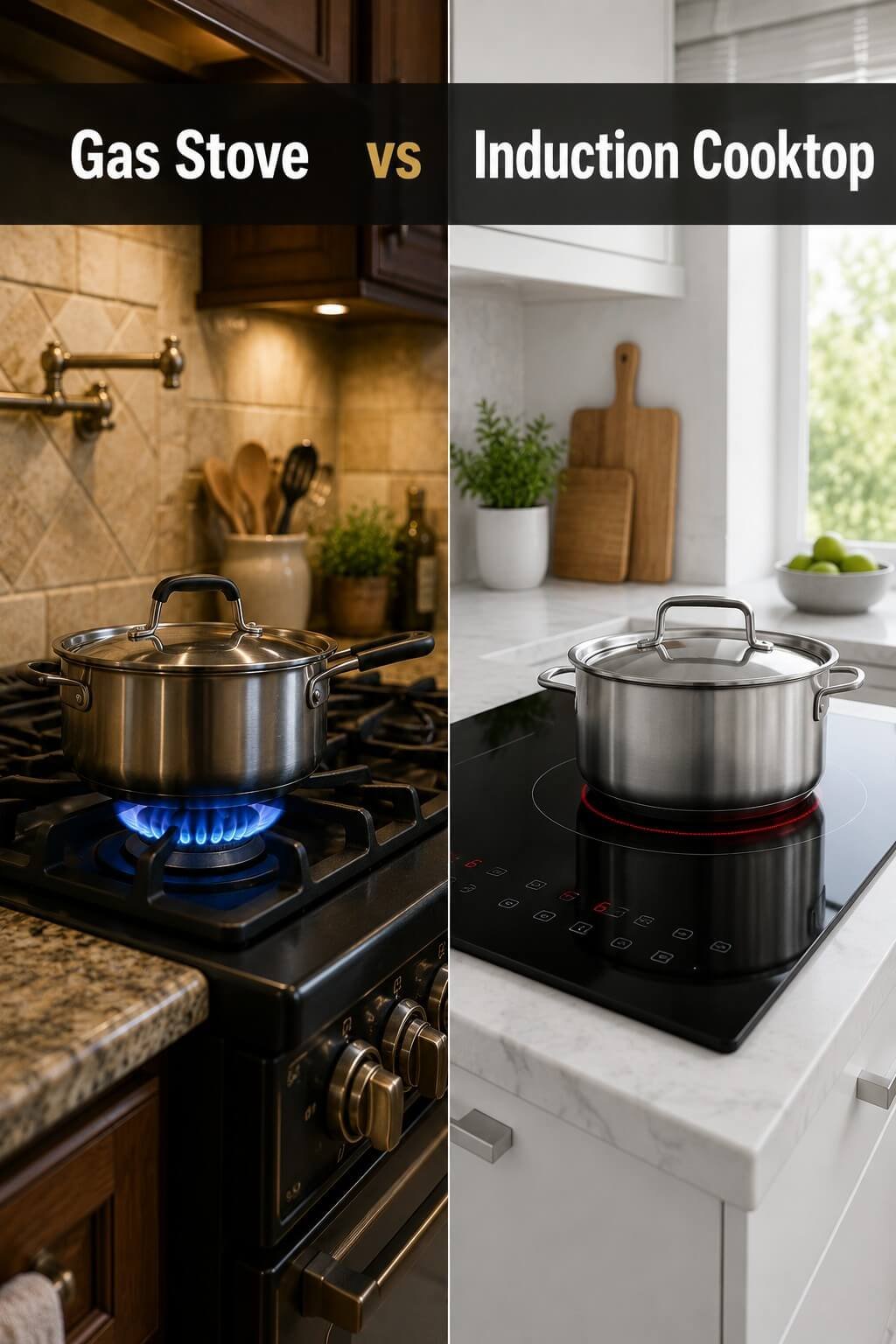
Gas vs Induction: Master Comparison Chart
| Criteria | Gas Stove | Induction Cooktop |
|---|---|---|
| Cooking Technology | Open flame, fueled by natural gas or propane | Electromagnetic field, heats the cookware directly |
| Installed Cost | $400–$2,500+ installed | $1,000–$3,500+ installed |
| Heating Speed | Fast, but heat spreads around the pan | Very fast — often boils water quickest |
| Temperature Control | Excellent — instant visual adjustment | Excellent — precise digital control |
| Energy Efficiency | Moderate — some heat escapes around the pan | High — heat transfers directly into the cookware |
| Safety | Open flame — burn and gas-leak risk | No open flame — surface stays cooler |
| Cleaning & Maintenance | Grates and burner caps need regular cleaning | Flat glass top wipes clean in seconds |
| Cookware Compatibility | Works with any cookware type | Requires magnetic cookware only |
| Works in a Power Outage | Yes, most models with manual ignition | No — fully electric, no power means no cooking |
What this actually means at the stove: “very fast” heating on induction means a pot of water can hit a boil noticeably quicker than on gas, since the pan itself becomes the heat source instead of the air around it. “Moderate efficiency” for gas isn’t a dealbreaker for most cooks — it just means a bit more of that flame’s heat escapes past the edges of the pan instead of going into your food. The bigger practical difference is what happens without power or without the right pan: gas keeps working, induction simply won’t turn on, and neither will it heat a non-magnetic pot no matter how long you wait. Our guide on how to decorate a kitchen shelf walks through this step by step.
Quick Look: Gas Stove vs Induction Cooktop at a Glance
Gas Stove
Instant, visual flame control that keeps working even during a power outage.
View on Amazon →Induction Cooktop
Fast, precise electromagnetic heat with a flat glass surface that cleans in seconds.
View on Amazon →Deep Dive: Gas Stove
Gas tends to suit cooks who want instant, visual flame control, households in areas with frequent power outages, and kitchens that already have gas plumbed in. If you like being able to see and adjust your heat the moment you turn the knob, gas still delivers that in a way no digital display quite replicates.
Pros
- Instant, visual heat control you can see and adjust immediately
- Works during a power outage on most manual-ignition models
- Compatible with any cookware — no need to replace pots and pans
- Familiar, well-understood technology for most home cooks
Cons
- Open flame carries burn and gas-leak risk Our how to decorate open kitchen shelves guide covers this in more detail.
- Combustion can affect indoor air quality without good ventilation
- Grates and burner caps require regular cleaning to keep flames even
- Less precise at very low simmer settings than induction
Real cost range: roughly $400–$2,500+ installed, depending on unit tier and whether a new gas line is needed.
Deep Dive: Induction Cooktop
Induction tends to suit cooks who want the fastest boil times, households prioritizing indoor air quality and easy cleanup, and kitchens without existing gas service. If “wipe it down and move on” matters more to you than the ritual of a visible flame, induction is the more practical everyday choice.
Pros
- Fastest heat-up time of any common cooktop type
- Precise, consistent digital temperature control
- Flat glass surface wipes clean in seconds
- No open flame — cooler surface, safer around kids and pets
Cons
- Requires magnetic cookware — not all pots and pans will work
- Doesn’t function at all during a power outage
- Higher upfront cost, sometimes requires an electrical panel upgrade
- Some units produce a faint hum or buzzing sound
Real cost range: roughly $1,000–$3,500+ installed, higher if an electrical panel upgrade is needed.
Which One Wins for Your Kitchen?
Apartment / Rental (No Gas Line)
Winner: Induction — no gas line required, just a standard electrical hookup.
Small Kitchen
Winner: Induction — compact, flat profile fits a tight countertop run.
Budget Renovation
Winner: Gas — lower unit and install cost when a gas line already exists.
Luxury Kitchen Remodel
Winner: Gas — professional-style ranges remain the signature choice in high-end kitchens.
Household With Young Kids
Winner: Induction — no open flame, cooler-to-touch surface reduces burn risk.
Professional Tips
- Appliance-expert tie-breaker: check your cookware first — induction only works with magnetic pots and pans, which can add a hidden cost if you need to replace your set.
- Common regret mistake: installing induction without confirming the home’s electrical panel can support it, then facing a surprise upgrade cost mid-renovation.
- Resale-value note: induction is increasingly expected in newer, higher-end listings, while gas still holds strong appeal with traditional home cooks and some buyers see it as a selling point.
- Maintenance reality-check: induction’s flat glass top wipes clean in seconds; gas grates and burner caps need periodic deep cleaning to keep flames burning evenly.
Shop the Winner
If you’re leaning toward induction, here’s what to get started with. Since induction only heats magnetic cookware, the right set makes the switch painless — if you’re sticking with gas, good news: your existing cookware collection already works. Our guide on how to make your kitchen look expensive walks through this step by step.
Best Overall
A balanced stainless steel set with a saucepan, skillet, and stockpot — fully induction-ready.
Best Budget
An affordable starter set that covers everyday cooking without the full collection price tag.
Best Premium
A heavier-gauge, professional-grade set built for faster, more even heat response on induction.
Frequently Asked Questions
Is induction cooking actually faster than gas?
Yes, induction typically brings water to a boil faster than gas because heat transfers directly into the pan through the electromagnetic field instead of warming the air around it first.
Do I need special cookware for an induction cooktop?
Yes, induction only works with magnetic cookware such as cast iron or many stainless steel pieces — a simple magnet test on the bottom of a pot tells you if it will work.
How much does it cost to install an induction cooktop?
Expect roughly $1,000–$3,500 or more installed, with the higher end reflecting cases where the home’s electrical panel needs an upgrade to support it.
How much does it cost to install a gas stove?
Expect roughly $400–$2,500 or more installed, depending on the unit tier and whether a new gas line needs to be run to the kitchen.
Is gas stove cooking bad for indoor air quality?
Gas combustion can release pollutants indoors, so good ventilation — like a properly vented range hood — matters more with gas than with induction, which produces no combustion byproducts.
Does an induction cooktop work during a power outage?
No, induction cooktops are fully electric and won’t function at all without power, unlike many gas stoves that can still be lit manually.
Can I convert my existing cookware for induction use?
Not directly — cookware itself can’t be converted, and though magnetic interface discs exist as a workaround, they reduce induction’s speed and efficiency advantages.
Is induction cooking cheaper to run than gas?
Often yes on a per-meal basis, since induction transfers more of its energy directly into the food rather than losing heat around the sides of the pan, though exact savings depend on local electricity and gas rates.
Which is safer, gas or induction?
Induction is generally considered safer since there’s no open flame and the cooktop surface itself stays cooler, while gas carries a small risk of burns or gas leaks if not properly maintained.
Do I need an electrical panel upgrade for induction?
Sometimes — induction cooktops draw more power than a standard outlet provides, so older homes with a lower-amperage panel may need an upgrade before installation.
Is gas stove cooking being banned?
Some local jurisdictions have introduced restrictions on new gas hookups in certain new construction, but existing gas stoves are not broadly banned — check your specific local building codes for current rules.
Which cooktop is easier to clean, gas or induction?
Induction is easier to clean day to day since its flat glass surface just needs a wipe, while gas grates and burner caps need periodic removal and scrubbing to keep flames burning evenly.
Do professional chefs prefer gas or induction?
Many professional chefs still favor gas for its instant visual flame control, though induction has been gaining favor in professional kitchens for its speed and precision.
Can induction cooktops be used with cast iron?
Yes, cast iron is magnetic and works well on induction, though it’s worth using a flat-bottomed piece to keep good contact with the cooktop surface.
Does induction cooking taste different than gas?
No, the heat source doesn’t change how food tastes — any perceived difference usually comes from how precisely the cook can control temperature, not the cooktop technology itself.
Is induction cooking better for a small kitchen?
Often yes, since induction cooktops don’t require the same ventilation infrastructure as gas and their flat profile fits neatly into a compact countertop run.
How long does an induction cooktop last?
A well-maintained induction cooktop typically lasts 15 to 20 years, similar to or slightly longer than a typical gas range.
Is a gas stove worth keeping in a rental property?
It depends on whether the property already has a gas line — if so, keeping the existing gas stove is usually cheaper than switching, but a unit without gas service often makes more sense with induction.
Does induction cooking make noise?
Some induction cooktops produce a faint hum or buzzing sound, especially at high power settings, though most modern units keep this noise minimal.
Which cooktop adds more resale value to a home?
Induction is increasingly expected in newer, higher-end listings, but gas still holds strong appeal with traditional home cooks — the better resale bet often depends on your local buyer market.
The Verdict
Choose induction if you want the fastest, cleanest, most energy-efficient cooktop and don’t mind checking your cookware first — it’s the safer, easier-to-clean pick for small kitchens, rentals without a gas line, and households with young kids.
Choose gas if you want instant visual flame control and a cooktop that still works during a power outage — it’s the stronger pick for traditional and luxury kitchens with cooks who value that tactile control.
Still torn? If your current cookware isn’t induction-compatible and you don’t want to replace it, that alone may settle it toward gas.