


A great living room rarely comes together all at once — it’s built in layers, and skipping a layer is usually why a space feels almost right but not quite finished. This living room decorating checklist walks through the process in the order that actually works: planning and layout first, then furniture, then lighting, then the color and texture that make a room feel warm, and finally the wall decor and finishing touches that make it feel styled rather than staged.
It’s built for two kinds of readers. If you’re furnishing a living room from scratch — a first apartment, a new house, a bare room after a move — working through each section in order will save you from buying furniture that doesn’t fit the space or a rug that’s the wrong size. If you’re mid-refresh and just want to check you haven’t missed anything, skim the sections and check off what’s already in place. If you’re also weighing area rug vs carpet, that’s worth deciding early too.
Every item below includes a short note on why it matters, not just what to buy, so you can adapt the list to your own room instead of following it item-for-item. A simplified, printable version — checkboxes only — is available near the end if you’d rather work from paper while you shop and style.
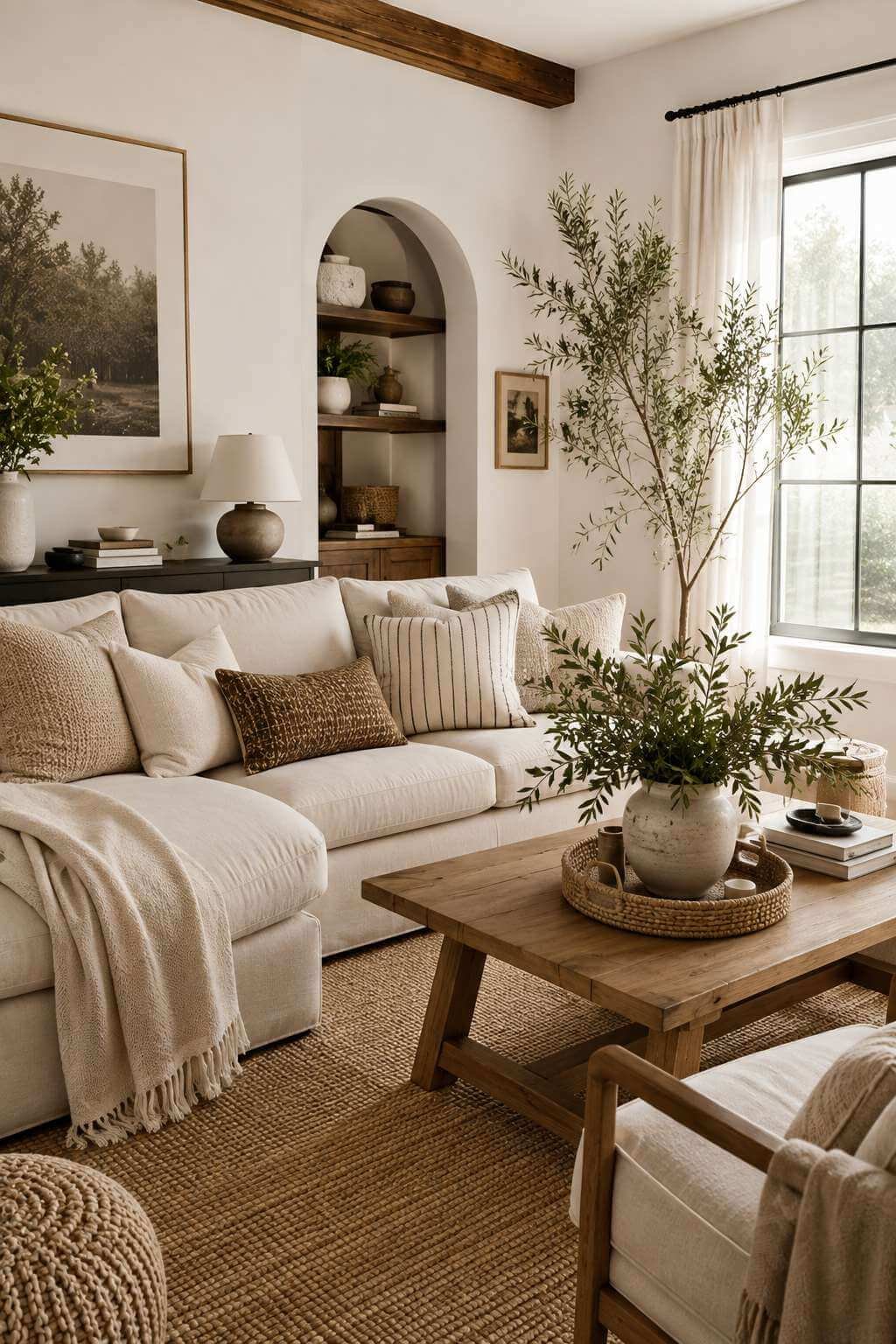
Plan & Assess the Room
Before buying anything, decide whether this room needs to host movie nights, dinner parties, remote work, or all three. The furniture and layout decisions that follow all trace back to this.
Write down wall lengths, window placement, and outlet locations before you shop. It’s the easiest way to avoid buying a sofa that won’t fit through the door or blocks a vent.
Most living rooms already have one — a fireplace, a picture window, or the wall where the TV makes sense. Arrange seating to face it instead of fighting it.
Decide roughly what you’ll spend on furniture versus decor before you start browsing, so a beautiful lamp doesn’t eat the money you need for the sofa.
A handful of saved photos in one place keeps your choices consistent as you shop over several weeks instead of one afternoon.
Foundation & Layout
Walk the path you’d actually take from the door to the kitchen or hallway, and make sure furniture doesn’t sit in the way. Our floor lamp vs table lamp comparison covers that decision in more depth.
A rug that’s too small makes furniture look like it’s floating — aim for at least the front legs of every seat to rest on it.
Pulling seating a few inches off the wall, even in a small room, creates a more intentional, lived-in layout than pushing everything flush to the perimeter.
Keep at least this much clearance in main walkways so the room feels open rather than obstacle-coursed.
A large sofa on one side doesn’t need a matching piece opposite it — a floor lamp, a plant, or a bookshelf can balance it just as well.
An oversized sectional in a small room — or a tiny loveseat in a large one — throws the whole space off. Measure floor space, not just what looks good in a showroom.
Furniture & Seating
This is usually the biggest single purchase in the room, so choose it first and build everything else around its size, shape, and color.
Chairs add seating for guests without demanding a second sofa, and they’re an easy way to bring in a different texture or color.
Leave roughly 14–18 inches of clearance between the coffee table and the sofa so it’s usable, not just decorative.
A side table within arm’s reach means no one has to lean over to set down a drink or a book.
Decide where the TV goes — or if it goes at all — before buying a console, since it determines how the seating faces.
An ottoman does double duty as a footrest, extra seat, or a coffee table topped with a tray. It’s a similar trade-off to deciding on coffee table vs ottoman elsewhere in the space.
A closed storage piece — basket, cabinet, or storage bench — keeps daily clutter out of sight without adding extra furniture.
Lighting
This is your base layer of light — an overhead fixture, or a bright floor lamp if there’s no ceiling fixture.
Add a lamp near any chair or sofa spot used for reading or laptop work so people aren’t relying on overhead light alone.
A small picture light or shelf-mounted light draws the eye to what you actually want noticed.
The same room feels completely different at full brightness versus dimmed in the evening — this is a cheap upgrade with an outsized effect.
Mixing floor, table, and overhead lighting creates a depth that a single overhead fixture never will.
Color, Texture & Layering
Use one dominant color for about 60% of the room, a secondary color for 30%, and an accent color for the remaining 10%.
Mixing two or three coordinating patterns and textures reads as intentional; a matched three-piece set reads as a hotel room.
Drape it over an arm or the back of a chair, rather than folded flat, to add movement to the seating area.
Mount curtain rods close to the ceiling rather than just above the window frame — it makes ceilings look taller and windows look larger.
A smaller textured rug layered over a larger flat-weave rug adds depth in a reading nook or beside a chair.
A wood tray, rattan basket, or linen cushion keeps an all-upholstered room from feeling flat.
Wall Decor & Art
Hang art so its center sits roughly 6–8 inches above the top of a sofa or console, not up near the ceiling.
Both work, but mixing a large statement piece with a cluster of small frames on the same wall usually looks unplanned.
Position a mirror to reflect a window or light source, which bounces natural light deeper into the room.
Leave visible breathing room between grouped objects — a shelf packed edge-to-edge reads as storage, not styling.
Not every wall needs decor — a deliberately bare wall gives the eye a place to rest.
Finishing Touches & Styling
Even one large plant in a corner softens hard furniture lines and adds color that doesn’t rely on paint or fabric.
A tray on the coffee table keeps small items from looking scattered and makes the surface easy to clear in seconds.
Group two or three candles at different heights rather than spacing single candles around the room.
A small, practical detail that also doubles as a styling object when left in a tray or small dish.
Groups of three tend to look more natural and less staged than pairs.
Take a photo of the finished room with your phone — clutter and awkward gaps that your eye skips over in person usually show up immediately in a photo.
Pro Tips
- ✓Buy the sofa first — everything else’s scale and color follows from it.
- ✓Sit in a chair before you buy it, not just look at it in a photo.
- ✓Use painter’s tape on the floor to mock up furniture footprints before anything arrives.
- ✓Round up on rug size if you’re torn — going bigger almost always looks better than going smaller.
- ✓Stick to warm white (2700K–3000K) bulbs throughout the room for a cohesive feel.
- ✓Buy decor last, not first — it’s the easiest category to adjust once the furniture is in place.
- ✓Repeat one color at least three times around the room so it feels intentional rather than random.
- ✓Leave a little breathing room in your budget for finishing touches — they punch above their price.
- ✓Test paint or fabric swatches in the room at different times of day before committing.
- ✓Renting? Favor floor lamps and freestanding shelving over anything that requires wall modifications.
Common Mistakes
- ✕Buying a rug too small for the seating area. Size it so the front legs of the sofa and chairs sit on it.
- ✕Pushing every piece of furniture against the wall. Pull the seating group in a few inches to create a defined conversation area.
- ✕Relying on a single overhead light. Add at least two lamps at different heights.
- ✕Hanging art too high. Keep the center of the piece at eye level, just above the furniture below it.
- ✕Buying a matching three-piece pillow set. Mix two or three coordinating patterns instead.
- ✕Ignoring scale. Measure the room and the furniture before buying, not after it arrives.
- ✕Skipping a budget. Set rough category limits before shopping so decor doesn’t eat the furniture budget.
- ✕Styling shelves edge-to-edge. Group objects with visible negative space between them.
- ✕Hanging curtains that stop short of the floor. Mount rods close to the ceiling and let panels graze the floor.
- ✕Decorating without a focal point in mind. Identify the room’s natural anchor first and arrange around it.
Supplies & Tools
Want a version you can print and take with you? The free printable checklist condenses all 40 items into simple checkboxes, grouped by the same seven sections, so you can carry it to the furniture store or tape it inside a closet door while you work.
Download the Free Printable Living Room Decorating ChecklistFAQ
What order should I decorate my living room in?
Plan and measure first, then layout, then furniture, then lighting, then color and texture, then wall decor, then finishing touches. Working in that order keeps you from buying pieces that don’t fit the space or the plan.
How much does it cost to decorate a living room?
Budgets commonly range from around $500 for a light refresh using existing furniture to $5,000 or more for a full furniture and decor overhaul. The biggest cost driver is usually the sofa or sectional.
What size rug should I buy for my living room?
Size the rug so at least the front legs of your sofa and chairs rest on it. In most living rooms that means an 8×10 or larger rug rather than a 5×7.
How many lighting sources should a living room have?
Aim for at least three: one ambient source, one task lamp, and one accent light, placed at different heights around the room.
What are the living room decorating essentials?
At minimum: a sofa, a coffee table, an area rug, at least two lighting sources, and window treatments. Everything past that is layering and personalization.
How do I arrange furniture in a small living room?
Float furniture slightly off the walls, choose a smaller-scale sofa or loveseat, and use a rug to define the seating area so the room doesn’t feel like one big open box.
Should furniture be pushed against the walls?
Not necessarily. Pulling seating a few inches away from the walls, even in a small room, usually creates a more defined and intentional layout.
How high should I hang art above a sofa?
Center the artwork roughly 6 to 8 inches above the top of the sofa back, with the middle of the piece landing around eye level.
How do I decorate a living room on a budget?
Prioritize furniture and lighting first, shop secondhand for anchor pieces, and treat decor like pillows, art, and plants as the last, most flexible category.
What’s the 60-30-10 color rule?
Use one dominant color for about 60% of the room, a secondary color for 30%, and an accent color for the remaining 10%. It’s a simple ratio that keeps a color scheme from feeling chaotic.
A finished living room isn’t the one with the most in it — it’s the one where every piece is doing a job. Work through this checklist section by section, adjust anything that doesn’t fit your space or your life, and don’t rush the finishing touches — they’re what turn a furnished room into one that actually feels like yours.

