


Standing in the lighting aisle trying to decide between a floor lamp and a table lamp usually comes down to one real question: are you trying to fill an empty corner, or light one specific spot? A floor lamp is the better pick for renters, small apartments, and dim seating areas that need broad, ambient light without adding another piece of furniture. A table lamp wins when you need focused light next to a bed, desk, or reading chair and you already have the surface for it. Below, we break down real cost ranges, brightness, space needs, and room-by-room verdicts so you can pick with confidence instead of guessing.
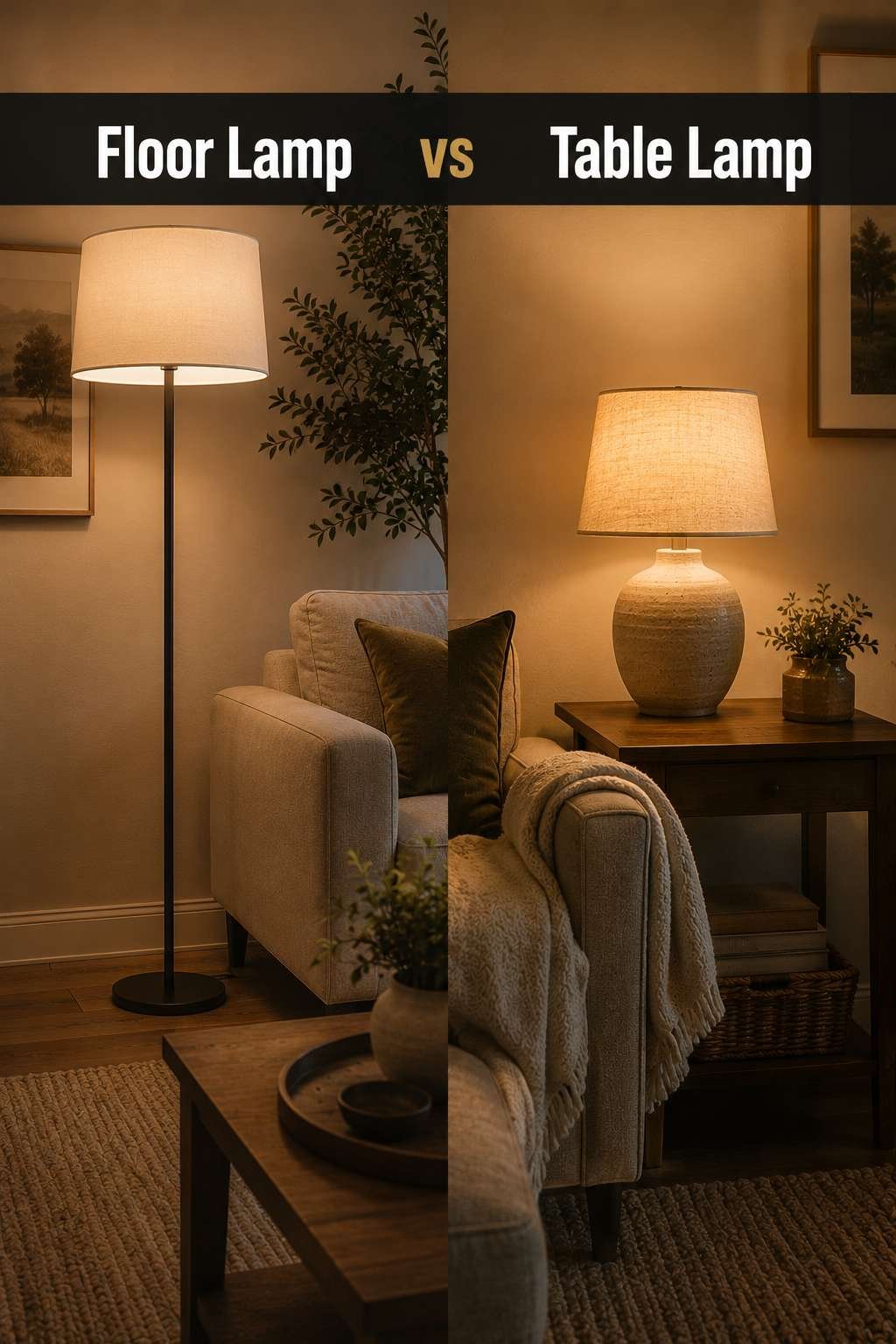
Floor Lamp vs Table Lamp: The Master Comparison
| Criteria | Floor Lamp | Table Lamp |
|---|---|---|
| Average Cost | $40 to $250, depending on style and materials | $20 to $150, depending on shade and base material |
| Brightness | 800 to 1,600 lumens — good for whole-corner ambient light | 450 to 800 lumens — better suited to focused task light |
| Space Needed | 1 to 2 sq ft of floor space, plus swing clearance | A stable surface at least 10 to 14 inches wide |
| Maintenance | Occasional dusting of shade and pole; bulb swaps every 1 to 2 years | Quick wipe-down of base and shade; easy to reposition for cleaning |
| Install Effort | Low — no tools needed, just unfold and plug in | Low, though it needs an existing table or surface first |
| Style Flexibility | Fills empty corners and anchors a seating area | Layers light on a console, desk, or nightstand |
| Rental-Friendly | Yes — fully freestanding, no wall mounting required | Yes, but only if you already have a suitable surface |
The numbers tell a simple story: floor lamps trade a bit more floor space for more light coverage and zero dependency on other furniture, while table lamps trade some brightness for precision, a lower price tag, and double duty as a styling piece. Neither is objectively “more light” in the way that matters most — it depends on whether you need to light a whole seating area or one specific task. Our wooden floor ideas has more inspiration along these same lines.
Quick Look: Floor Lamp vs Table Lamp at a Glance
Floor Lamp
A tall freestanding light that fills empty corners and works in almost any room without extra furniture.
View on Amazon →Table Lamp
A compact light for a desk, console, or nightstand that adds a warm glow exactly where you need it.
View on Amazon →Deep Dive: Floor Lamp
A floor lamp is the right call when you’re trying to fix a dim corner, light a whole seating area, or avoid buying extra furniture just to have somewhere to put a lamp. It’s also the default pick for renters who can’t mount anything to the walls, since it needs nothing but an outlet. Our how to decorate living room corner guide covers this in more detail.
Pros
- Fills empty corners and anchors a seating area without needing extra furniture
- Fully freestanding — ideal for renters and no-drill apartments
- Higher typical brightness, better for lighting a whole seating area
- Easy to move between rooms during a rearrange
Cons
- Takes up more floor space, which can crowd small rooms
- Cord placement can be tricky in open floor plans
- Less effective as focused, close-range task light for reading fine print
- Taller profile can tip more easily in high-traffic homes with kids or pets
Real cost range: $40–$250, with a solid, sturdy option realistically landing around $70–$130.
Deep Dive: Table Lamp
A table lamp is the right call when you need light in one specific spot — beside a bed, on a desk, or next to a reading chair — and you already have the surface to put it on. It’s also the more budget-friendly starting point for most rooms.
Pros
- Provides focused task light exactly where you’re working or reading
- Compact footprint, ideal for small rooms and tight layouts
- Doubles as a decor accent on a console or shelf
- Lower average cost for a solid entry-level option
Cons
- Requires an existing side table, desk, or console — an added cost if you don’t have one
- Lower typical brightness, not ideal for lighting a whole room alone
- Cord and outlet placement is limited by where the surface sits
- Takes up usable surface space you might want for other items
Real cost range: $20–$150, with a solid, sturdy option realistically landing around $35–$70.
Which One Wins in Your Room?
Small Apartment Living Room
Tight on furniture but need real ambient light for the whole seating area.
Floor Lamp winsReading Nook / Home Office
Needs precise, close-range light for a desk or a favorite reading chair.
Table Lamp winsShared Bedroom, No Nightstand Space
No room for a side table, but still needs a warm reading glow near the bed.
Floor Lamp winsRental, No Wall Mounting Allowed
Lease terms rule out drilling or mounting anything to the walls or ceiling.
Floor Lamp winsHigh-Traffic Family Room
Kids and pets pass through often, so a low, stable profile matters most.
Table Lamp winsProfessional Tips
- Pair one floor lamp with one table lamp in the same room instead of picking only one — designers rarely light a room with a single fixture.
- Skip the regret spot: buying a floor lamp for a room that’s too small, making it feel more cluttered than the dark corner it was meant to fix.
- For resale or staging, a warm dimmable bulb in either style photographs better than the lamp itself — don’t overspend on the fixture if the bulb is a low-end white light.
- Check the cord length and UL listing before buying either style, since a too-short cord is one of the most common return reasons for both lamp types.
- If you’re on the fence for a small space, choose the table lamp — it’s easier to size down or move later than a floor lamp taking up permanent floor footprint.
Shop the Winner
If you’re leaning toward the Floor Lamp, here’s what to get started with:
Best Overall
A neutral linen drum shade paired with a warm 2700K LED bulb kit sized for a floor lamp’s larger harp, giving soft, even light across a seating area.
Best Budget
A simple white fabric shade with a basic dimmable LED bulb — an easy swap that instantly refreshes an older floor lamp.
Best Premium
A tapered pleated shade with a smart, app-dimmable LED bulb kit, letting you adjust warmth and brightness by time of day.
If you’re leaning toward the Table Lamp, here’s what to get started with:
Best Overall
A compact drum shade with a warm 2700K LED bulb kit sized for a smaller table lamp harp, ideal for reading or desk work.
Best Budget
A simple cylinder shade with a basic dimmable LED bulb — a low-cost way to modernize an older table lamp.
Best Premium
A fabric bell shade with a smart, app-dimmable LED bulb kit for adjustable task and ambient light.
Frequently Asked Questions
Which is better for reading, a floor lamp or a table lamp?
A table lamp is usually better for reading because it sits close to the page and delivers focused task light. A floor lamp can work if it has an adjustable arm positioned right beside your chair, but most floor lamps are built for broader ambient light rather than close-range reading.
Are floor lamps more expensive than table lamps?
On average, yes. Floor lamps typically run $40 to $250 depending on size and materials, while a solid table lamp can be found for $20 to $150. The gap narrows at the premium end, where designer pieces in both categories cost similarly.
Do table lamps need a side table?
Yes, a table lamp needs a stable surface at least 10 to 14 inches wide, such as a side table, console, desk, or nightstand. If you don’t already have that surface, factor its cost into your decision.
Can I use a floor lamp instead of an overhead light?
A single floor lamp can supplement overhead lighting well, especially one with a wide shade that bounces light off the ceiling, but it typically isn’t bright enough to fully replace an overhead fixture in a larger room on its own.
How many lumens do I need for reading?
For close reading, aim for a light source delivering at least 450 lumens positioned near the page. Most table lamps fall in this range, while floor lamps often run higher but are positioned farther from the page.
Is a floor lamp safe with kids and pets?
Floor lamps can tip more easily than table lamps in high-traffic areas, so choose a weighted base and keep it out of direct walking paths if you have young kids or active pets.
Which lamp is better for small apartments?
A floor lamp is usually the better fit for small apartments because it fills an empty corner without requiring extra furniture, whereas a table lamp needs a surface you may not have room for. Our guide on how to fill empty space in living room walks through this step by step.
Do floor lamps take up a lot of space?
A floor lamp needs about 1 to 2 square feet of floor space plus clearance for anyone walking nearby, which is more footprint than a table lamp but still modest compared to most furniture.
Can I use a floor lamp in a rental without drilling?
Yes, floor lamps are fully freestanding and only need a nearby outlet, making them one of the easiest lighting upgrades for rentals where wall mounting isn’t allowed.
Which lamp style is more energy efficient?
Neither style is inherently more efficient — it comes down to the bulb. An LED bulb in either a floor lamp or table lamp uses a similar amount of energy for a comparable brightness level.
How long do floor lamps and table lamps typically last?
A well-made lamp of either style can last 10 years or more structurally. The bulb is usually the first thing to need replacing, typically every 1 to 2 years of regular use for standard LED bulbs.
Which is better for a home office desk?
A table lamp is the better choice for a home office desk since it delivers focused task light exactly where you’re working, without taking up floor space near your chair.
Can I mix floor lamps and table lamps in the same room?
Yes, and most well-lit rooms actually use both. Designers typically layer a floor lamp for ambient corner light with a table lamp for task light near a chair or desk.
Are table lamps easier to move around?
Table lamps are generally easier to relocate since they’re smaller and lighter, though they’re limited to wherever you have a suitable surface. Floor lamps are just as portable but need floor space at the new spot.
Which is better next to a bed, floor lamp or table lamp?
A table lamp on a nightstand is the traditional choice, but if your bedroom doesn’t have nightstand space, a slim floor lamp positioned beside the bed works well as a space-saving alternative.
Do floor lamps provide enough ambient light for a whole room?
A single floor lamp with a wide shade can light a small to medium seating area well, but larger open rooms usually need it paired with another light source for even coverage.
What’s the average cost of a good floor lamp?
A solid, sturdy floor lamp realistically costs $70 to $130, with budget options starting around $40 and designer pieces climbing toward $250 or more.
What’s the average cost of a good table lamp?
A solid, sturdy table lamp realistically costs $35 to $70, with budget options starting around $20 and designer pieces climbing toward $150 or more.
Which lamp is easier to clean and maintain?
Table lamps are slightly easier to maintain since they’re easy to lift and wipe down fully. Floor lamps just need occasional dusting of the shade and pole, which is still a quick task.
Which lamp adds more resale or staging value to a room?
Floor lamps tend to add more visual impact when staging a room because they fill vertical space and read as a design statement, while table lamps add value more through their light quality than their presence.
Final Verdict
If you need to fill an empty corner, light a whole seating area, or you’re renting and can’t drill into anything, the floor lamp is the stronger pick. If you’re lighting one specific spot — a desk, a nightstand, a reading chair — and you already have the surface for it, the table lamp wins on cost and precision. Most well-lit rooms actually use both, layered rather than chosen exclusively — but if you can only buy one, match it to the job you actually need it to do.

