Standing in a room trying to decide between an area rug and wall-to-wall carpet usually comes down to one real question: do you want the flexibility of a piece you can swap, clean, or take with you, or the wall-to-wall warmth and cohesion of full carpet coverage?
Neither one is universally “better” — an area rug tends to suit renters, hardwood-forward rooms, and anyone who likes to change their style without a contractor, while carpet earns its keep in bedrooms, basements, and homes that want maximum warmth and sound absorption underfoot. The short version of our verdict: if you’re furnishing a living space over good flooring, lean rug; if you’re outfitting a bedroom, basement, or media room from scratch, lean carpet. Here’s the full breakdown so you can make the call room by room.
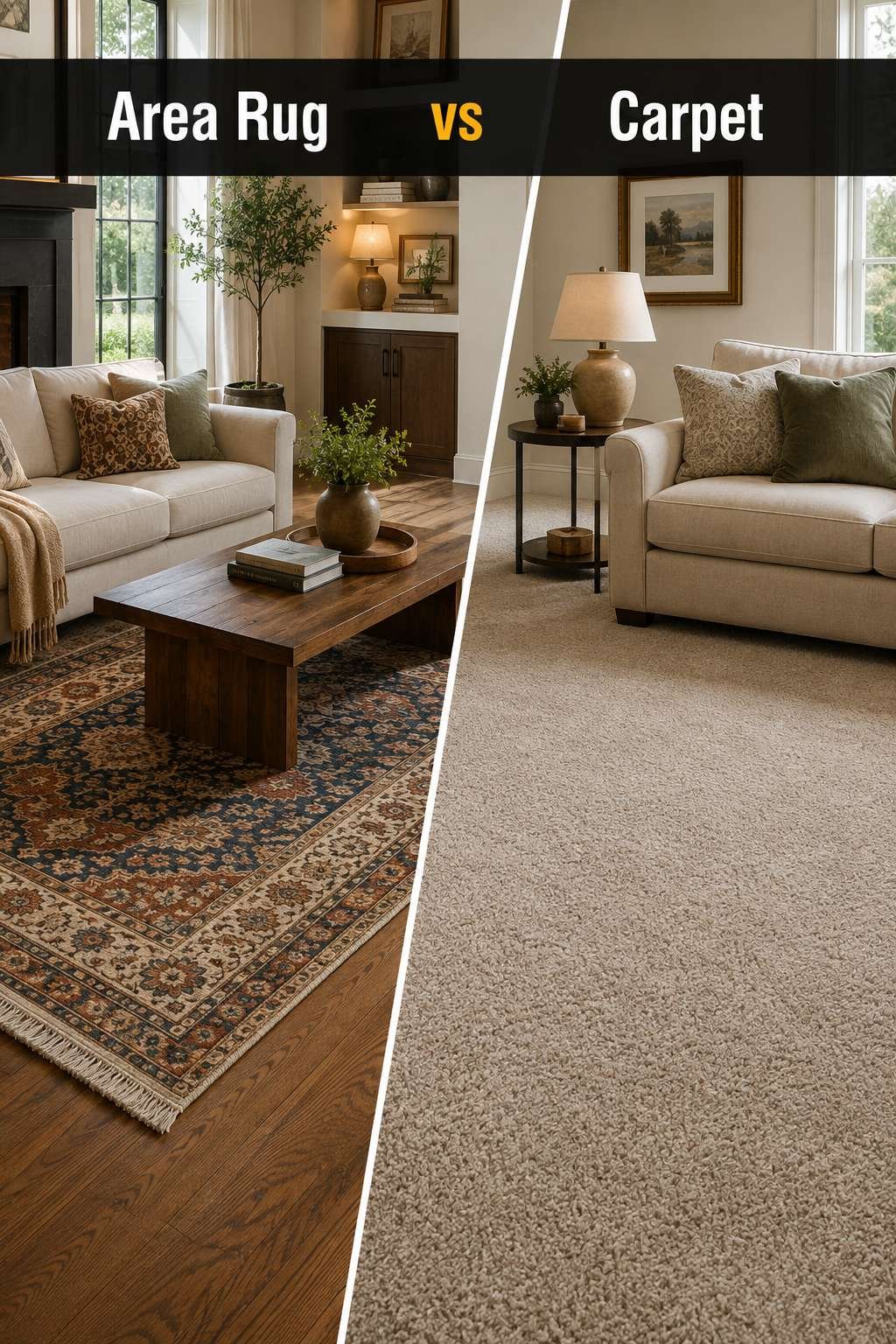
Area Rug vs Carpet: The Master Comparison Chart
| Criteria | Area Rug | Carpet |
|---|---|---|
| Average Cost | $2–$19 per sq ft, depending on material | $3–$11 per sq ft installed, including padding and labor |
| Durability & Lifespan | 5–15 years depending on material and traffic | 8–10 years, less in high-traffic homes |
| Maintenance | Vacuum regularly, deep clean or wash as needed | Regular vacuuming plus professional cleaning every 12–18 months |
| Installation | No installation — lay it and go | Professional installation required, typically 1–2 days |
| Comfort & Warmth | Moderate — warms the area it covers | High — insulates and cushions the whole floor |
| Allergy-Friendliness | Better — can be removed, washed, or aired out | Lower — fibers trap dust, dander, and allergens |
| Style Flexibility | High — swap styles anytime without a contractor | Low — full replacement needed to change the look |
| Resale Value | Neutral — doesn’t factor into appraisals directly | Positive — fresh carpet reads as move-in ready |
| Best For | Renters, hardwood rooms, frequent style changes | Bedrooms, basements, whole-room comfort |
What the Chart Actually Means in a Real Home
The numbers above translate to something pretty concrete once you picture them in your own space. “Moderate comfort” for an area rug means the rug itself feels great underfoot, but step off it onto bare hardwood or tile and the temperature difference is immediate — that’s fine in a living room where you’re mostly seated, less fine in a bedroom where you’re getting out of bed onto a cold floor. Carpet’s “high comfort” rating is a floor-to-floor experience with no cold edges, which is exactly why it still wins bedrooms even in homes that have moved everything else to hard flooring.
The maintenance gap matters more than most people expect. An area rug’s real advantage isn’t that it never gets dirty — it’s that when it does, you have options a stuck-down carpet doesn’t: shake it out, spot-clean it, roll it up and send it out, or replace it without touching the floor underneath. That flexibility is why rugs consistently score better for allergy-prone households, even though a new carpet feels perfectly clean on day one.
Quick Look: Area Rug vs Carpet at a Glance
Area Rug
Flexible, swappable, and easy on the wallet for partial coverage — the go-to choice for renters and anyone layering over hardwood or tile.
View on Amazon →Carpet
Wall-to-wall warmth, cushioning, and sound absorption — the default pick for bedrooms, basements, and full-comfort rooms.
View on Amazon →Deep Dive: Area Rug
An area rug is the right call when you want warmth and texture without committing the whole room to one surface — especially over flooring worth showing off, like hardwood or natural stone. It’s the natural choice for anyone who rearranges furniture often, rents rather than owns, or wants to update a room’s look without a renovation budget.
Pros
- Portable — takes it with you when you move
- Easy to swap styles without a contractor
- Can be removed for deep cleaning or washing
- Lets you showcase hardwood or stone flooring
- Lower upfront cost for partial-room coverage
- Lease-friendly, no landlord approval needed
Cons
- Doesn’t insulate or warm the full room
- Can slip or bunch without a quality rug pad
- Large, high-quality rugs get expensive fast
- Leaves visible flooring at the edges of the room
- Needs occasional repositioning in high-traffic spots
Deep Dive: Carpet
Wall-to-wall carpet is the right call when the goal is maximum comfort and consistency across an entire room — no cold edges, no visible flooring gaps, just one continuous soft surface. It’s still the strongest option for bedrooms, media rooms, and finished basements where warmth and sound absorption matter more than flexibility.
Pros
- Warms and cushions the entire floor, edge to edge
- Strong sound absorption between floors
- Hides subfloor imperfections completely
- Cohesive, move-in-ready look for buyers
- Cheaper per square foot at builder grade for full rooms
Cons
- Traps dust, dander, and allergens in the fibers
- Stains and odors can reach the padding and subfloor
- Expensive and disruptive to replace
- Shorter realistic lifespan under heavy traffic
- Moisture risk in basements without proper padding
Real Room Scenarios: Which Wins Where
Small Apartment / Rental
Portable, lease-friendly, no landlord approval needed.
Winner: Area RugBudget Renovation
Stretches a tight budget across more than one room.
Winner: Area RugLuxury Living Room Build
Showcases premium hardwood; easy to refresh over time.
Winner: Area RugHigh-Traffic, Kids & Pets
Cushions the whole floor and hides no-carpet gaps.
Winner: CarpetFinished Basement
Adds warmth and sound absorption below grade.
Winner: CarpetProfessional Tips & Common Regrets
- The most common regret: skipping the rug pad. A rug without a pad slips, wears faster, and can even damage hardwood finishes over time — always budget for one.
- Designer tie-breaker: when a room has flooring worth showing off, use a rug. When the subfloor or existing flooring isn’t attractive, carpet solves that problem completely.
- Resale reality-check: fresh carpet can help a dated bedroom show better, but buyers increasingly prefer hard flooring with rugs in main living areas — know your local market before you commit either way.
- Basement caution: if you go with carpet below grade, confirm a proper vapor barrier and moisture-resistant padding are in place first, or an area rug over sealed flooring may be the safer call.
- Maintenance reality-check: carpet needs professional cleaning every 12–18 months no matter how careful you are — factor that recurring cost in before assuming carpet is the cheaper long-term option. Our guide on how to arrange living room furniture walks through this step by step.
Shop the Winner
If you’re leaning toward an area rug, here’s what to get started with — three tiers to fit different budgets and rooms:
Best Overall
A durable, tightly woven rug in a versatile neutral tone that holds up to daily foot traffic without sacrificing style. Our neutral living room ideas has more inspiration along these same lines.
Best Budget
A synthetic-blend flatweave that delivers most of the look and comfort of a pricier rug at a fraction of the cost.
Best Premium
A hand-finished wool or natural-fiber rug built to last well over a decade with proper care.
If you’re leaning toward carpet, most carpet installs still leave at least one adjoining space — an entryway, kitchen, or hard-flooring hallway — that benefits from its own rug to tie the look together:
Best Overall
A low-profile entry rug that pairs cleanly with a fresh carpet install in the rooms leading into it.
Best Budget
An affordable runner-style rug for hallways and transitions between carpeted and hard-floor rooms.
Best Premium
A higher-end accent rug for a kitchen or entry that complements a premium carpet upgrade elsewhere in the home.
Frequently Asked Questions
Is an area rug cheaper than carpet?
It depends on the size and material. A small to mid-size area rug is usually cheaper upfront than installing wall-to-wall carpet across a whole room, but a large, high-quality rug in wool or a designer weave can cost more per square foot than mid-grade carpet. For partial coverage in one room, an area rug is almost always the lower-cost option. See our small living room decor ideas for more direction in this style.
Which is better for allergies, area rug or carpet?
An area rug is generally better for allergy sufferers because it can be removed, deep cleaned, or professionally washed far more easily than wall-to-wall carpet. Carpet fibers trap dust, pet dander, and allergens throughout the pile and padding, and that buildup is harder to fully remove with routine vacuuming.
Can you put an area rug on top of carpet?
Yes, layering an area rug over low-pile carpet is a common way to define a seating area or add pattern, though it works best over a flatter carpet rather than a thick plush pile. Use a thin non-slip pad underneath to keep the rug from shifting.
How long does carpet last compared to an area rug?
Wall-to-wall carpet typically lasts 8 to 10 years, less in high-traffic homes with kids or pets. A quality area rug can last 5 to 15 years or longer depending on material and traffic, and because it can be rotated or moved to a lower-traffic room, its usable life is often easier to extend.
Is carpet or an area rug better for a bedroom?
Wall-to-wall carpet is usually the better fit for a bedroom because it warms the entire floor underfoot and adds sound insulation between floors. An area rug can still work well in a bedroom over hardwood, especially placed under and around the bed, if full wall-to-wall softness isn’t a priority.
Do area rugs work well in high-traffic areas?
Yes, as long as you choose a durable, tightly woven material like a synthetic blend or flatweave and use a quality rug pad to prevent slipping and premature wear. For very high-traffic zones like entryways and hallways, a lower-pile, stain-resistant rug will hold up better than a thick, plush one.
Is carpet bad for basements?
Carpet can work well in a finished basement for warmth and sound absorption, but basements are more prone to moisture, so it’s important to use a moisture-resistant pad and confirm the space has a proper vapor barrier before installing. Without those precautions, carpet in a basement is more prone to mold and mildew than it would be above grade.
How do I stop an area rug from sliding or bunching?
A quality rug pad sized slightly smaller than the rug itself solves nearly all sliding and bunching issues. Choose a grip pad for hard flooring and a slightly thinner non-slip pad if layering over carpet, and re-square the rug every few weeks in high-traffic spots.
Which adds more resale value, area rug or carpet?
Fresh wall-to-wall carpet tends to read as move-in ready to buyers and can make a dated bedroom or media room feel instantly finished, which can be a small positive at resale. An area rug doesn’t factor into an appraisal directly, but it does let a home showcase hardwood or other higher-value flooring underneath, which buyers often value more long-term.
What size area rug do I need for a living room?
As a general rule, aim for a rug large enough that at least the front legs of your major furniture pieces sit on it, which usually means an 8×10 or 9×12 rug for a standard living room. A rug that’s too small will make the seating area look disconnected and smaller than it is.
Is wall-to-wall carpet out of style?
Wall-to-wall carpet isn’t out of style, but it’s more selectively used today, mainly in bedrooms, basements, and media rooms rather than throughout an entire home. Hard flooring paired with area rugs has become the more common choice for main living spaces.
How often should carpet be professionally cleaned?
Most manufacturers and cleaning professionals recommend a deep professional clean every 12 to 18 months, with more frequent cleaning in households with kids, pets, or allergy concerns. Regular vacuuming in between is still necessary to prevent dirt from breaking down the fibers.
Can renters install carpet?
Most leases don’t allow permanent wall-to-wall carpet installation, which is one of the main reasons renters lean toward area rugs instead. An area rug delivers similar warmth and sound dampening without violating a lease or requiring a landlord’s approval.
What’s the difference between broadloom carpet and an area rug?
Broadloom carpet is manufactured in wide rolls and installed wall-to-wall, permanently attached to the floor with tack strips and padding. An area rug is a separate, finished piece made to its own size and edge-bound, and it simply sits on top of the existing flooring without installation.
Are area rugs easier to clean than carpet?
Generally yes. An area rug can be shaken out, spot-cleaned, or removed entirely for a deep wash or professional cleaning, while wall-to-wall carpet has to be cleaned in place and stains can work down into the padding and subfloor.
What’s the best flooring under an area rug?
Hardwood, engineered wood, tile, and vinyl plank all work well under an area rug, as long as you use a rug pad suited to that surface to prevent scratching and slipping. A rug pad also adds cushioning that makes hard flooring more comfortable underfoot.
Is a rug pad necessary?
Yes, a rug pad is worth adding in almost every case. It prevents slipping and bunching, protects the flooring underneath from scratches, adds cushioning, and can meaningfully extend the rug’s lifespan by reducing friction wear on the backing.
How much does it cost to install wall-to-wall carpet?
Installed wall-to-wall carpet typically runs $3 to $11 per square foot including padding and labor, depending on the carpet grade. Builder-grade carpet sits at the lower end of that range, while premium or high-pile options push toward the top.
Which is warmer, area rug or carpet?
Wall-to-wall carpet is warmer overall because it insulates the entire floor edge to edge, with no exposed hard flooring around the edges. An area rug only warms the area it covers, so the rest of the room’s floor stays at the temperature of the flooring underneath.
Can pets damage carpet more than an area rug?
Pets can damage both, but accidents and stains are often more manageable on an area rug since it can be removed and professionally cleaned or replaced without redoing the whole room. Wall-to-wall carpet stains and pet odor can work into the padding and subfloor, which is a bigger and more expensive fix.
The Final Verdict
If you’re furnishing a living room, dining room, or any space over flooring you want to keep visible — go with an area rug. It’s the more flexible, more budget-friendly, and easier-to-maintain choice for rooms where style changes over time.
If you’re outfitting a bedroom, finished basement, or media room from scratch — go with carpet. The full-room warmth, cushioning, and sound absorption are worth the higher upfront cost and lower flexibility in those specific spaces.
Renters and anyone on a tight budget should default to an area rug nearly every time. Buyers prepping a home for resale should reserve carpet for bedrooms and basements only, and let hard flooring plus rugs carry the main living areas. There’s no single universal winner here — but for most rooms in most homes, the rug wins on flexibility, and carpet wins on comfort where it matters most.