


Standing in a furniture showroom trying to decide between a sectional sofa and a regular sofa usually comes down to one real question: which one actually fits how you live in your room? A sectional wins on lounging space and seating capacity, especially in open-concept homes, while a classic sofa wins on flexibility, easier moves, and fitting rooms that aren’t built around one big furniture footprint. Below, we break down the real cost per seat, the space each one needs, and exactly which option makes sense for your room shape, household size, and budget — so you can buy with confidence instead of guessing.
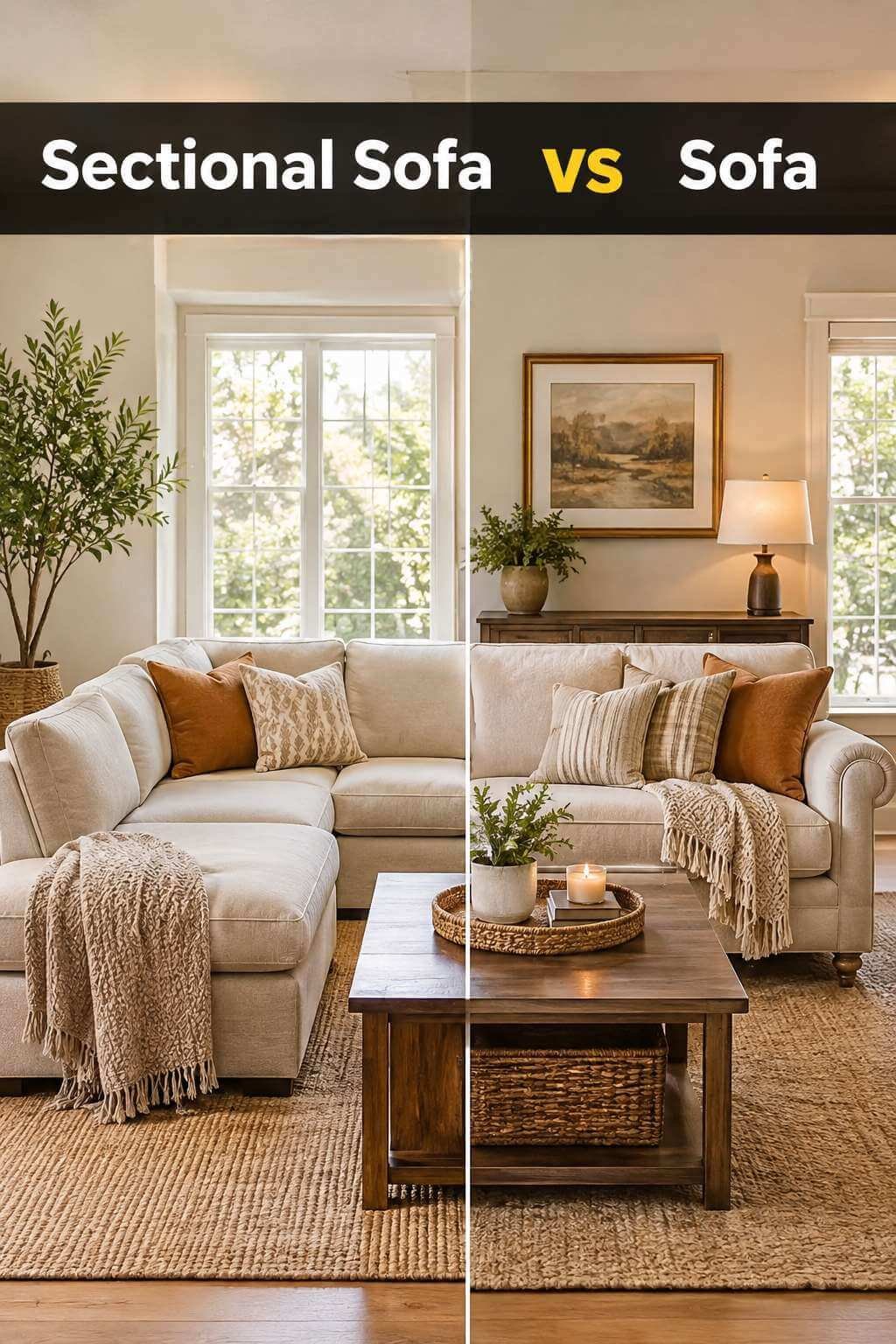
Sectional Sofa vs Sofa: Full Comparison Chart
| Criteria | Sectional Sofa | Sofa |
|---|---|---|
| Cost per Seat | $150–$350 per seat, depending on configuration | $150–$450 per seat, depending on quality |
| Space Required | 8–10 ft of wall or an open corner, plus walk-around clearance | About 6–7 ft of wall space; fits tighter rooms |
| Seating Capacity | 5–8 people, depending on configuration (L-shape, U-shape, chaise) | 3 people typically, up to 4 on a larger frame |
| Style Flexibility | Fixed shape once placed; modular versions can be reconfigured with effort | Easy to rearrange, pair with accent chairs, or move to another room |
| Ease of Moving/Resale | Difficult — bulky sections may not clear doorways, hallways, or stairwells | Easier — single piece, fits through most standard doorways |
| Best-Fit Room Type | Open-concept living rooms, media rooms, larger family rooms | Small living rooms, formal rooms, rentals, apartments |
| Maintenance | Spot-clean cushions individually; matching wear across sections takes care | Simpler to clean, reupholster, or replace as one consistent piece |
In real terms: a sectional earns its keep when a room is large enough to let it breathe, giving you a genuine lounging surface instead of just extra seats. A sofa earns its keep by being the piece that adapts — to a smaller room, a future move, or a layout you haven’t settled on yet. Neither option is universally “better”; the room decides. Our small living room decor ideas has more inspiration along these same lines.
Quick Look: Sectional Sofa vs Sofa at a Glance
Sectional Sofa
The go-to choice for open-concept rooms and families who want maximum lounging space in one piece.
View on Amazon →Deep Dive: Sectional Sofa
A sectional makes the most sense when your living room is built around one big seating zone — an open-concept great room, a media room, or a family room where several people gather regularly. The chaise or lounge end also gives it an edge for anyone who wants to stretch out fully rather than just sit upright.
Pros
- Seats more people per square foot in open layouts
- Chaise or lounge end is genuinely comfortable for stretching out
- Visually anchors large or open-concept rooms
- Modular versions can be reconfigured over time
Cons
- Harder to move through doorways, hallways, and stairwells
- Can overwhelm a small or boxy room
- Matching wear and cleaning across sections takes extra care
- Premium modular pieces can get expensive quickly
Real cost range: $900–$3,500 for a solid mid-range sectional; premium modular configurations can exceed $5,000.
Deep Dive: Sofa
A sofa is the safer default when you’re not fully sure what your room will look like in a few years, or when you want a piece that can move with you. It’s also the stronger pick for smaller, formal, or rented spaces where flexibility matters more than maximum seating.
Pros
- Easier to move, rearrange, or take to a new home
- Fits almost any room shape, including small or oddly laid out spaces
- Pairs easily with accent chairs for flexible extra seating
- Generally stronger resale and secondhand market
Cons
- Seats fewer people for the same floor footprint
- Often needs a second piece to match a sectional’s total capacity
- Less dedicated lounging space than a chaise sectional
- Can look sparse on its own in a very large room
Real cost range: $600–$2,200 for a quality three-seat sofa.
Which One Fits Your Room? Real Scenarios
Small Apartment Living Room
Limited square footage, one main seating wall.
Verdict: Sofa wins
Open-Concept Family Room
Large shared living and dining space.
Verdict: Sectional wins
Formal / Rental-Friendly Room
Polished look, needs to move out easily.
Verdict: Sofa wins
Media / Movie-Night Room
Deep lounging seating facing a screen.
Verdict: Sectional wins
Starter Home on a Budget
Modest room, cost-conscious first purchase.
Verdict: Sofa wins
Professional Tips
What a Designer Would Tell You
- Designer tie-breaker: for medium-sized, roughly square rooms where either option could work, measure your main walking path first — if a sectional would cut across it, choose the sofa.
- The most common regret: buying a sectional too large for the room. It’s the single most frequent mistake — always leave at least 30–36 inches of clearance on every walking side.
- Resale-value note: if you expect to move again within a few years, a sofa is the lower-risk buy — it’s easier to sell, donate, or take with you.
- Maintenance reality-check: both options need the same fabric care, but sectionals are harder to keep looking uniform since one heavily used section can wear or fade faster than the rest.
Shop the Winner
If you’re leaning toward the Sectional Sofa, here’s what to get started with — protector covers sized for larger sections and chaise ends:
Best Overall
A stretch-fit sectional cover set that wraps each section individually, so wear and cleaning stay even across the whole piece.
Best Budget
A simple slip-on cover for the most-used section, ideal if you only need to protect the main sitting area right now.
Best Premium
A quilted, water-resistant cover set built for households with kids or pets that need daily-use durability.
If you’re leaning toward the Sofa, here’s what to get started with — protector covers sized for a standard three-seat frame:
Best Overall
A form-fitting three-seat cover that stays snug through daily use without bunching or slipping.
Best Budget
An affordable stretch cover that’s easy to remove and machine wash between guests or seasons.
Best Premium
A tailored, textured cover designed to look like reupholstery rather than a slipcover.
Frequently Asked Questions
Is a sectional sofa cheaper than buying a sofa and a chair separately?
Not always. A mid-range sectional typically runs $900 to $3,500, while a quality sofa paired with a matching accent chair often lands in a similar or slightly lower range. The real savings come from getting more seats in one purchase rather than a lower price per piece.
How much floor space does a sectional sofa need compared to a regular sofa?
A sectional generally needs 8 to 10 feet of wall or an open corner plus walking clearance around it, while a standard three-seat sofa fits in about 6 to 7 feet of wall space. This makes sofas the safer choice for smaller or more boxy rooms. Our how to decorate living room corner guide covers this in more detail.
Can a sectional sofa fit in a small living room?
It can, but only if you choose a compact configuration and measure your doorways, hallways, and room dimensions carefully first. In most small apartments, a standard sofa or loveseat is the more comfortable fit.
Is it hard to move a sectional sofa to a new house?
Yes, this is one of the most overlooked downsides. Large sectional sections can be too bulky to fit through narrow doorways, tight hallways, or stairwells, sometimes requiring the piece to be disassembled or left behind.
Which is more comfortable, a sectional or a sofa?
Comfort is largely a matter of preference, but sectionals with a chaise end offer more lounging and stretch-out space, while sofas offer more upright, structured seating that some people find better for posture and everyday sitting.
How many people can a sectional sofa seat compared to a sofa?
A sectional typically seats 5 to 8 people depending on its configuration, while a standard sofa comfortably seats 3, occasionally 4 on a larger frame.
Do sectionals go out of style faster than sofas?
Sectionals tend to be more tied to current open-concept trends, while classic sofa silhouettes have stayed in style for decades. Choosing a neutral fabric and simple frame on either option helps it age well. Our neutral living room ideas has more inspiration along these same lines.
Is a sectional sofa harder to clean than a regular sofa?
Cleaning itself is similar, but matching wear and fading across multiple sections over time can be trickier with a sectional than with a single-piece sofa.
Can you rearrange a sectional sofa into different shapes?
Many modular sectionals can be reconfigured into an L-shape, U-shape, or straight line, which gives you flexibility if you move or redesign the room. Non-modular sectionals are fixed once assembled.
Which holds its resale value better, a sectional or a sofa?
Sofas generally resell more easily because they fit more buyers’ spaces and are simpler to transport. Large sectionals have a smaller pool of buyers with rooms big enough to take them.
Is a sectional sofa a good choice for an apartment?
It depends on the apartment. A compact sectional can work in a larger open-plan unit, but in most standard apartment living rooms, a sofa or loveseat leaves more usable floor space.
How do I know if my room is big enough for a sectional?
As a general rule, leave at least 30 to 36 inches of walking space around the sectional and measure your largest doorway or hallway to confirm the pieces can actually be delivered inside.
What is the average lifespan of a sectional sofa versus a sofa?
Both typically last 7 to 15 years with quality construction and normal use. Lifespan depends more on frame material, cushion fill, and fabric than on whether it is a sectional or a sofa.
Are sectionals good for families with kids and pets?
Sectionals can work well for busy households since they offer more total seating and lounging room, but look for stain-resistant, performance fabric on either option if kids or pets are part of daily life.
Can a sectional sofa go through a standard doorway?
Most individual sectional sections are designed to fit through a standard 32 to 36 inch doorway, but larger corner or chaise pieces sometimes cannot, so always check the manufacturer’s dimensions before buying.
Is a sofa a better choice for a formal living room?
Yes, a classic sofa paired with accent chairs typically reads as more polished and formal, while a sectional leans casual and family-oriented.
Do sectionals work in open-concept homes?
Open-concept layouts are one of the best environments for a sectional since the piece can help visually define the living area without needing walls to anchor it.
How much does a good quality sofa cost compared to a sectional?
A quality three-seat sofa typically ranges from $600 to $2,200, while a comparable-quality sectional ranges from $900 to $3,500 or more depending on size and configuration.
Should I choose a sectional or a sofa for a rental apartment?
A sofa is usually the safer choice for a rental since it is easier to move in and out, and more likely to fit whatever your next apartment’s living room looks like.
What is the biggest mistake people make when buying a sectional?
Buying a sectional that is too large for the room. Oversized sectionals block walking paths, crowd the space, and make a room feel smaller instead of more functional.
The Final Verdict
Choose the Sectional Sofa if: you have an open-concept layout, host movie nights or regular get-togethers, or need to comfortably seat five or more people at once.
Choose the Sofa if: you’re in an apartment, rental, or a smaller or more formal room, or you expect to move again in the next few years and want a piece that can move with you.
Either way, measure your doorways before you buy — that single step prevents the most common regret on both sides of this decision.

