


Pegboard and slatwall solve the same problem — a wall that actually holds your stuff — but they’re built for different jobs. Pegboard is the familiar grid of small holes you’ve probably seen in a grandparent’s garage: it’s cheap, fast to install, and forgiving for a first-time DIY project. Slatwall is the horizontal groove-and-bracket system used in retail stores and serious workshops: more expensive per square foot, but built to hold real weight and rearrange without a single new hole.
If you’re organizing hand tools and craft supplies on a budget, pegboard is probably the easier win. If you’re hanging bikes, power tools, or setting up a display wall, slatwall earns its higher price tag. Here’s the full breakdown, room by room.
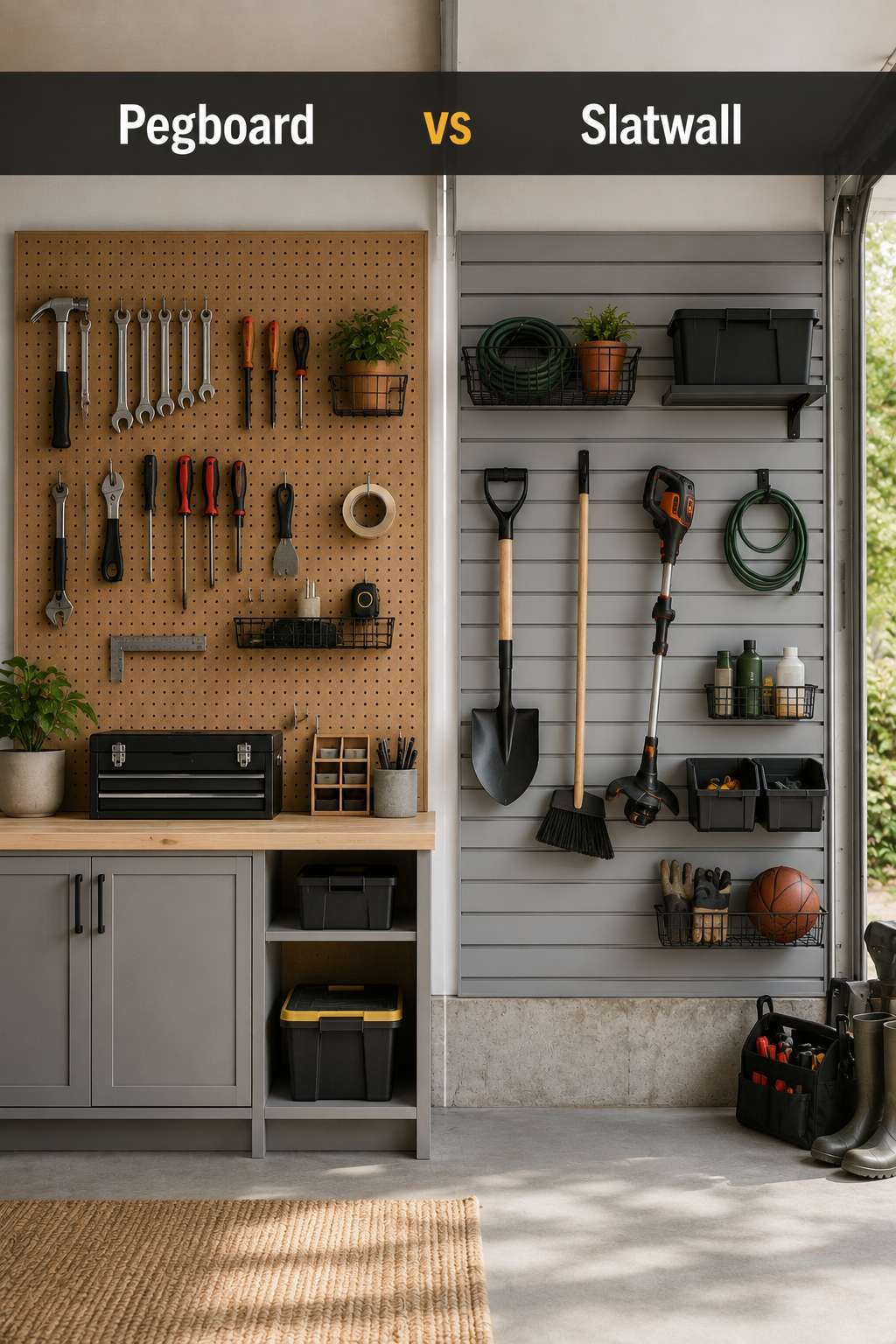
Pegboard vs Slatwall: The Full Comparison
| Criteria | Pegboard | Slatwall |
|---|---|---|
| Installed Cost | $3–$6 per sq ft, including basic hooks and mounting hardware | $8–$15 per sq ft, including panels and bracket hardware |
| Weight Capacity | Roughly 5–30 lbs per hook, and holes can wear or crack under repeated heavy use | Roughly 25–75 lbs per bracket, with weight spread evenly along the groove |
| Durability | Holes can widen, crack, or chip after years of heavy pegs and knocks | Grooves resist wear well and brackets lock securely in place |
| Install Difficulty | Simple — mount to furring strips, doable in an afternoon | Moderate — panels need precise leveling and solid backing |
| Reconfigurability | Move pegs freely, but heavy items eventually need a fresh hole | Slide brackets anywhere along the groove with zero new holes |
| Aesthetic Finish | Utilitarian look with visible holes across the whole panel | Polished, retail-grade finish that reads as an intentional design choice |
| Best For | Light-to-medium tools, craft supplies, budget-conscious projects | Heavy tools, bikes, high-traffic walls, and showroom-style displays |
What these numbers mean in practice: if you’re hanging hammers, screwdrivers, and a few craft bins, pegboard’s lower weight capacity is never going to be a problem, and its lower cost makes it the easy default. But once a bike, a circular saw, or a fully loaded bin makes it onto the wall, pegboard’s small holes start doing more work than they’re built for — that’s when slatwall’s higher weight capacity and evenly distributed brackets start to matter more than the extra upfront cost.
Quick Look: Pegboard vs Slatwall at a Glance
Pegboard
The budget-friendly classic — quick to install and perfect for light tools and craft supplies.
View on Amazon →Slatwall
The heavy-duty upgrade — built to hold more weight and rearrange without new holes.
View on Amazon →Pegboard: Best-Fit Scenarios, Pros & Cons
Pegboard is the right call when you’re organizing light-to-medium tools, craft supplies, or a kids’ playroom on a real budget, and you want something you can install yourself in an afternoon without special tools. It’s also the more forgiving choice if you’re not totally sure yet how you want the wall laid out, since pegs are cheap to buy in bulk and easy to move around as you figure out what works. Our guide on how to style dining room shelves walks through this step by step.
Pros
- Low upfront material cost
- Easy DIY install in a weekend
- Widely available at any hardware store
- Simple to customize the hole pattern with hooks and bins
- Lightweight material that’s easy to cut and mount
Cons
- Lower weight capacity per hook
- Holes can crack or widen after years of heavy use
- Pegs can pop loose if the wall gets bumped
- Less polished, more utilitarian look
- Standard sheets show wear — dents and chipped edges — over time
Real cost range: expect $3 to $6 per square foot installed, which typically puts a full garage wall project in the $150–$400 range including hooks and basic hardware.
Slatwall: Best-Fit Scenarios, Pros & Cons
Slatwall makes the most sense when you’re storing heavier items — bikes, power tools, loaded bins — or when the wall needs to look genuinely finished, like a small retail counter or a workshop you actually show people. It’s also the better pick if you know your layout will keep changing, since brackets slide along the groove with no new holes required.
Pros
- Higher weight capacity per bracket
- Rearrange the layout without drilling new holes
- Polished, retail-grade finish
- Grooves resist wear better than pegboard holes
- Well suited to displays that change often
Cons
- Higher upfront material cost
- Installation needs more precise leveling
- Heavier panels can be trickier for a solo DIY install
- Fewer ultra-budget product options
- Bracket hooks cost more individually than pegboard hooks
Real cost range: expect $8 to $15 per square foot installed, which typically puts a full garage wall project in the $400–$900+ range depending on panel finish and bracket count.
Pegboard vs Slatwall by Room
Garage Workshop
Bikes, power tools, and loaded bins need more weight capacity than a hook grid can reliably offer.
Craft / Sewing Room
Thread, small bins, and hand tools are light enough that pegboard’s lower cost wins out easily.
Kitchen Pantry Wall
A small panel of hooks for jars, utensils, and a shallow bin doesn’t need slatwall’s extra strength or cost.
Small Business Retail Display
Customers see this wall — slatwall’s finished look and easy rearranging fit a retail counter better.
Rental-Friendly Apartment
A small, cheap panel that’s easy to remove and patch when you move out beats a bigger investment.
Professional Tips
- Designer tie-breaker: if cost and weight needs are basically a wash for your project, pick based on how often you’ll actually rearrange the wall — slatwall wins that tie every time. Our guide on how to decorate open kitchen shelves walks through this step by step.
- Common regret mistake: buying thin 1/8 inch pegboard for anything beyond very light items. It sags and wears out fast; 1/4 inch board holds up far better for a modest cost difference.
- Resale-value note: a finished slatwall wall reads as a builder-grade upgrade in garage or workshop listings, while pegboard is neutral and cheap enough that buyers won’t factor it in either way.
- Maintenance reality check: unsealed hardboard pegboard can warp in a humid garage or laundry room; slatwall’s PVC or laminate finish holds up to moisture noticeably better.
Shop the Winner
If you’re leaning toward pegboard, here’s what to get started with:
Best Overall
A 1/4 inch hardboard pegboard kit with a mixed hook assortment, sized for a standard garage or craft-room wall.
Best Budget
A basic 1/8 inch pegboard sheet paired with a simple metal peg hook set for light tools and supplies.
Best Premium
A powder-coated metal pegboard panel built to resist sagging, warping, and years of heavy daily use.
If you’re leaning toward slatwall, here’s what to get started with:
Best Overall
A laminate slatwall panel kit with an assortment of bracket hooks and a small shelf, sized for a garage or shop wall. Our how to decorate a kitchen shelf guide covers this in more detail.
Best Budget
A single MDF slatwall panel paired with a basic bracket hook set, ideal for a smaller starter wall.
Best Premium
A PVC moisture-resistant slatwall system with heavy-duty brackets rated for bikes and power tools.
See our full Best Garage Wall Organization Accessory Kits guide for the complete lineup of hooks, bins, and brackets that fit both systems.
See the Full Buying Guide →Frequently Asked Questions
Is pegboard or slatwall better for a garage?
It depends on what you’re storing. Pegboard is fine for hand tools and light gear on a budget. Slatwall is the better choice if you’re hanging bikes, power tools, or anything heavier, since it holds more weight and holds up longer.
How much weight can slatwall hold?
A single slatwall bracket typically holds roughly 25 to 75 pounds, depending on the bracket style and how the load is distributed across the groove. Panels mounted to solid backing can support significantly more spread across multiple brackets.
How much weight can pegboard hold?
A single pegboard hook usually holds around 5 to 30 pounds. Standard 1/8 inch hardboard sags under heavier concentrated loads, so heavier tools need thicker board and closer support behind the panel.
Is slatwall more expensive than pegboard?
Yes. Slatwall typically runs $8 to $15 per square foot installed, compared to $3 to $6 per square foot for pegboard, mainly because of the panel material and bracket hardware.
Can I mix pegboard and slatwall on the same wall?
Yes, and many garages do. A common layout uses slatwall for heavier items like bikes or power tools and pegboard for small parts, hand tools, and craft supplies.
Does pegboard work well in a humid garage?
Standard hardboard pegboard can warp or swell in a consistently humid garage unless it’s sealed or painted first. Metal pegboard or a sealed panel handles moisture better.
Do slatwall panels need special mounting?
Slatwall panels need to be mounted level and secured into wall studs or a plywood backing, since the groove system relies on a flat, sturdy surface to hold weight properly.
Which is better for renters, pegboard or slatwall?
Pegboard is usually the more practical choice for renters because it costs less, comes in smaller panel sizes, and is easy to remove and patch when you move out.
Can pegboard hold power tools?
Lighter power tools like a drill or sander can work on pegboard with the right hooks, but heavier tools are better suited to slatwall, which distributes weight more evenly.
What thickness of pegboard should I buy?
1/4 inch pegboard is a safer choice than the thinner 1/8 inch standard for anything beyond very light items, since the thicker board resists sagging and hole wear better.
Are slatwall hooks universal across brands?
Most slatwall hooks follow a standard groove spacing and fit across brands, but it’s worth checking the groove profile before buying, since a few specialty panels use a nonstandard size.
How do I clean and maintain a slatwall panel?
A slatwall panel just needs an occasional wipe-down with a damp cloth. PVC and laminate finishes hold up well; unfinished MDF panels should be sealed to prevent moisture damage.
Is pegboard easier to install than slatwall?
Yes, pegboard is generally the easier DIY install. It just needs furring strips and screws, while slatwall benefits from more precise leveling and sometimes a track mounting system.
Can I paint pegboard or slatwall?
Pegboard takes paint well and is commonly painted to match a room. Slatwall panels usually come pre-finished in laminate or PVC, so painting isn’t typically needed or recommended.
What’s the difference between MDF and metal pegboard?
MDF or hardboard pegboard is cheaper and easier to cut but can wear or warp over time. Metal pegboard costs more but resists sagging, moisture, and hole wear much better.
Do slatwall panels come in different colors/finishes?
Yes, slatwall panels come in a range of laminate colors and wood-look finishes, which is part of why they’re common in retail displays where appearance matters.
How far apart should pegboard holes be spaced?
Standard pegboard uses holes spaced 1 inch apart on a grid, which is the spacing most off-the-shelf hooks and accessories are designed to fit.
Can slatwall be used outdoors or in a shed?
Slatwall can work in a dry, covered shed, but standard panels aren’t built for direct weather exposure. Look for a moisture-resistant PVC panel if humidity or dampness is a concern.
Which option is better for a small business retail display?
Slatwall is the standard choice for retail displays because of its polished look, higher weight capacity, and ability to rearrange merchandise without drilling new holes.
How long does pegboard or slatwall typically last?
A well-maintained slatwall panel can last well over a decade with minimal wear. Pegboard typically lasts several years under normal use, though the holes and edges tend to show wear sooner under heavy loads.
Final Verdict
Choose pegboard if you’re organizing light-to-medium tools or craft supplies, working with a tight budget, renting your space, or just want something you can install yourself this weekend without a second thought.
Choose slatwall if you’re storing anything genuinely heavy — bikes, power tools, loaded bins — setting up a wall customers or clients will actually see, or you know your layout is going to keep changing and don’t want to drill a new hole every time it does.
For most home garages, that means starting with pegboard for the small stuff and adding a slatwall section once the heavier gear needs a real home.

