


Deciding between a folding door and a sliding door usually comes down to one question: do you need the doorway to open completely, or just to close it out of the way? Folding (bifold or accordion) doors stack neatly against the wall and let you open an entire opening at once — ideal for patios, room dividers, and anywhere you want a wide-open feel. Sliding doors glide flat along a track without swinging into the room, trading a fully open doorway for a simpler, lower-maintenance mechanism. Below, we break down the real costs, the space each one actually needs, and which wins in five common rooms, so you can pick with confidence instead of guessing.
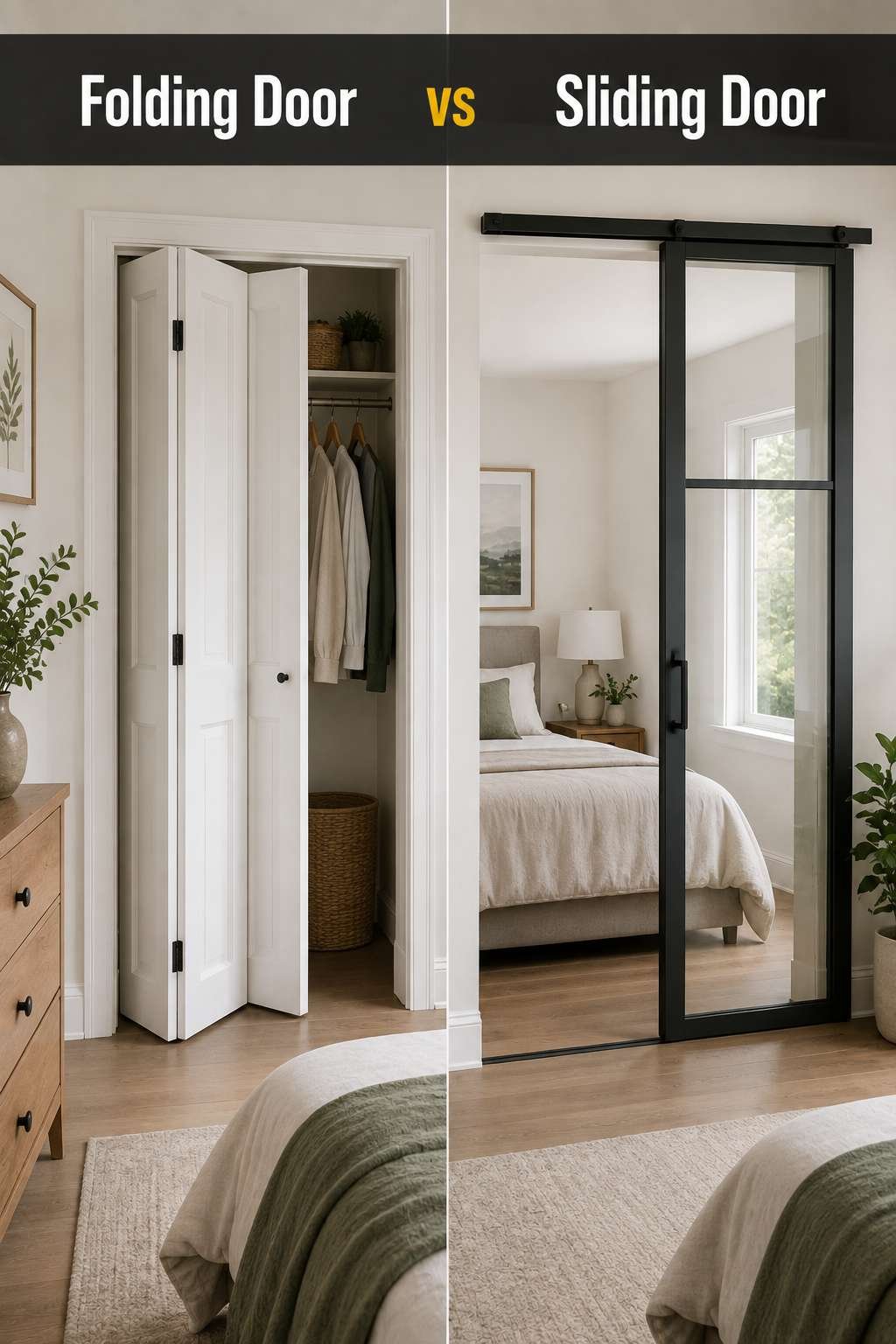
Folding Door vs Sliding Door: At a Glance
| Criteria | Folding Door | Sliding Door |
|---|---|---|
| Cost (installed) | $150–$600 per opening (standard); $2,000+ for glass patio systems | $200–$500 (standard); $700–$1,200+ for glass patio doors |
| Space to Operate | Needs swing/fold clearance, roughly half the door width | None — glides flat along the wall, never enters the room |
| Maintenance | More hinges to lubricate and tighten over time | Track needs periodic cleaning to clear dust and debris |
| Install Difficulty | Moderate; DIY-friendly for closets, hinge alignment matters | Moderate to hard; track must be perfectly level |
| Noise / Draft Sealing | Multiple seams can let in more draft and sound | Single continuous panel seals tighter when closed |
| Lifespan | 10–15 years with standard hardware | 15–20+ years with quality track hardware |
| Aesthetic Flexibility | Folds flat; clean modern or farmhouse styles | Wide range, from minimalist glass to rustic barn-style |
| Resale Value | Neutral to positive in closets and pantries | Strong positive for patio and great-room openings |
What These Numbers Actually Mean in a Real Room
On paper, the numbers above look close. In a real room, they aren’t. A folding door needs roughly half its own width as swing clearance to fold back against the wall — for a 30-inch closet door, that’s about 15 inches of floor space you can’t put furniture in front of. A sliding door needs zero swing clearance, but because one panel always stays parked in front of part of the opening, your usable walk-through width is cut by close to half. Neither one is free of a trade-off — you’re choosing between giving up floor space near the door, or giving up doorway width. Our sliding door ideas has more inspiration along these same lines.
Quick Look: Folding Door vs Sliding Door
Folding Door
Folds flat against the wall for a fully open doorway — best when you want the whole opening usable, like a patio or room divider.
View on Amazon →Sliding Door
Glides flush along a track with zero swing clearance — best for tight spaces where floor room matters more than a full opening.
View on Amazon →Deep Dive: Folding Door
Best-fit scenarios: patio openings and indoor-outdoor living spaces, wide closets and pantries that benefit from a fully open front, room dividers for a home office or playroom, and anywhere a wide-open sightline matters more than tight floor space.
Pros
- Opens the entire doorway width at once, no panel blocking the view
- Folds compactly and stacks flat against the wall or into a pocket
- Wide range of styles, from glass accordion patio doors to simple louvered closet doors See our glass door ideas for more direction in this style.
- Strong fit for entertaining spaces that benefit from an open indoor-outdoor flow
Cons
- Needs real swing and fold clearance near the door, awkward in a tight hallway
- More hinges and moving parts mean more long-term adjustment and lubrication
- Multiple panel seams can let in more draft and noise than a single sliding panel
- Cheap hardware can feel flimsy or rattle over time; quality hardware costs more
Real cost range: $150–$600 per opening for standard bifold closet doors with mid-range hardware; full accordion patio door systems in glass and aluminum framing can run well past $2,000–$5,000 installed.
Deep Dive: Sliding Door
Best-fit scenarios: small bedrooms and studio apartments where floor space is tight, laundry closets and bathrooms, patio and great-room openings prioritizing a tight seal and low maintenance, and rental units where simple hardware matters.
Pros
- Needs zero swing clearance, the door never enters the room
- Fewer moving parts than a folding door, generally less maintenance
- A single continuous panel seals more tightly against drafts and noise when closed
- Wide range of finishes, from minimalist glass to rustic barn-style hardware Our barn door ideas has more inspiration along these same lines.
Cons
- One panel always covers part of the opening, the doorway never fully opens
- Track can collect dust, hair, and debris that need periodic cleaning
- Track must be installed dead level or the door will drift or stick
- Wider or heavier glass panels usually need professional installation
Real cost range: $200–$500 for a standard interior sliding closet or barn-style door with hardware; sliding glass patio doors typically run $700–$1,200+ installed depending on size and glass quality.
Which Door Wins, Room by Room
Small Studio Apartment
Sliding door wins. Zero swing clearance keeps every square foot near the door usable.
Reach-In Closet
Folding door wins. Opens the entire closet front at once so nothing is blocked from view.
Patio / Outdoor Access
Folding door wins. Fully opens the wall for true indoor-outdoor living and entertaining.
Home Office Room Divider
Sliding door wins. Seals out noise for calls while taking up zero floor space when closed.
High-Traffic Family Entryway
Sliding door wins. Fewer moving parts and a tighter seal hold up better against constant daily use.
Professional Tips
- Measure your actual swing/fold clearance before falling in love with a folding door online — a 36-inch door needs roughly 18 inches of clear floor space to fold back completely.
- The most common regret with sliding doors is undersized, budget track hardware. Spend a little more on the track and rollers; they take the most wear.
- For resale value, sliding glass doors on a patio or great room tend to outperform folding doors in most markets, while folding doors add more character (and a slight premium) in a closet or pantry.
- Every 6–12 months, vacuum the sliding door track and re-check bifold hinge screws — both fail slowly from neglect, not all at once.
Shop the Winner
If you’re leaning toward a folding door, here’s what to get started with:
Best Overall
A mid-range bifold hardware kit with heavy-duty pivot hinges and a smooth-glide track, sized to your door width and panel count.
Best Budget
A basic bifold hinge and track kit that covers the essentials for a closet or pantry door without an upgraded glide mechanism.
Best Premium
A soft-close bifold hardware system built for wider accordion or patio-style panels that see daily use.
If you’re leaning toward a sliding door, here’s what to get started with:
Best Overall
A standard sliding door track kit with nylon rollers and an adjustable stop, sized for interior closet or barn-style doors.
Best Budget
A basic top-mount sliding track kit that handles lighter doors without soft-close or anti-jump features.
Best Premium
A soft-close, anti-jump sliding track system rated for heavier glass or solid-core panels in high-traffic areas.
Frequently Asked Questions
What is the difference between a folding door and a sliding door?
A folding door has hinged panels that fold flat against the wall, opening the entire doorway width at once. A sliding door has one or more flat panels that glide along a track and never swing into the room, but one panel always covers part of the opening.
Which is cheaper, a folding door or a sliding door?
A standard interior folding closet door typically costs $150 to $600 installed, similar to a basic interior sliding door at $200 to $500. Costs rise sharply for glass patio versions of either style, often reaching $700 to $5,000 depending on size and materials.
Do folding doors save more space than sliding doors?
It depends on which space you mean. Folding doors need swing clearance to fold back, using floor space near the door. Sliding doors need zero swing clearance but permanently cover part of the doorway width with a parked panel.
Are sliding doors more energy efficient than folding doors?
Generally yes. A sliding door’s single continuous panel seals more tightly against drafts than a folding door’s multiple hinged seams, though high-quality weatherstripping narrows the gap on both.
Can I install a folding door myself?
A standard bifold closet door is a manageable DIY project for most homeowners. Wider accordion or glass patio versions usually require professional installation due to weight and precise alignment needs.
Can I install a sliding door myself?
A basic interior sliding or barn-style door is DIY-friendly if the track is mounted dead level. Sliding glass patio doors are heavier and typically need a professional for a proper seal and safe handling.
Which door is better for a small bedroom closet?
A folding (bifold) door usually wins for a reach-in closet because it opens the entire closet front at once, making it easier to see and reach everything inside without a panel blocking part of the opening.
Which door is best for a patio opening?
A folding accordion door is generally best for a patio because it opens the full wall width for true indoor-outdoor living, though a sliding glass door is a solid lower-maintenance alternative.
Do folding doors let in more drafts than sliding doors?
Yes, typically. The multiple hinged seams on a folding door create more potential gaps for air to pass through compared to a sliding door’s single continuous sealing edge.
How long do folding doors typically last?
A folding door with standard hardware typically lasts 10 to 15 years before hinges or track rollers need replacing, though quality hardware and regular maintenance can extend that.
How long do sliding doors typically last?
A sliding door with quality track hardware typically lasts 15 to 20 years or more, since it has fewer moving parts than a folding door’s multiple hinges.
Are folding doors noisier than sliding doors?
Folding doors can be noisier over time as hinges loosen, and their multiple seams transmit more sound than a sliding door’s single sealed panel, especially with budget hardware.
Which door type is better for a rental apartment?
Sliding doors tend to suit rentals better, since they have fewer moving parts to maintain and simpler hardware that’s less likely to need landlord-covered repairs.
Do sliding doors add more resale value than folding doors?
For patio and great-room openings, sliding glass doors generally add more resale value. For closets and pantries, the resale difference between the two styles is minor and comes down to condition and style.
What maintenance do folding doors need?
Check and tighten hinge screws every 6 to 12 months, lubricate the pivot points, and inspect the top and bottom track guides for wear or debris buildup.
What maintenance do sliding doors need?
Vacuum or wipe out the track every few months to remove dust, hair, and debris, and periodically check that rollers move freely and the track remains level.
Can folding doors be used outdoors on a patio?
Yes, accordion-style folding doors are a popular choice for patios and are specifically designed with weatherproof glass and aluminum framing for outdoor-facing openings.
Are pocket doors better than both folding and sliding doors?
Pocket doors disappear fully into the wall, saving both swing clearance and visible track space, but they require wall modification to install and aren’t a fit for every renovation budget or timeline.
Which door is safer for homes with kids and pets?
Sliding doors are generally safer around kids and pets since there’s no swinging panel that can pinch fingers or catch paws, though both styles should use soft-close hardware in high-traffic homes.
What hardware do I need to install a folding or sliding door?
A folding door needs a top track, pivot and guide hinges, and often a bottom guide bracket. A sliding door needs a top track, rollers, and an adjustable floor or wall guide to keep the panel aligned.
Final Verdict
If your priority is opening a doorway completely — a patio, a wide closet front, a statement room divider — a folding door earns its extra swing clearance and slightly higher maintenance. If your priority is saving floor space, cutting down on moving parts, and keeping a tighter seal against drafts and noise, a sliding door is the safer pick for small bedrooms, laundry closets, and busy family entryways. For most single-room retrofits on a tight budget, we lean sliding door; for a genuine indoor-outdoor patio upgrade, the folding door wins outright.

