


Curtains and blinds solve the same problem in completely different ways, and picking the wrong one for a given room is an easy way to end up re-shopping in a year. Curtains bring warmth, softness, and flexibility — they layer beautifully and hide a multitude of window flaws. Blinds bring precision: exact light control, a cleaner line, and better odds against moisture and grease. Neither wins every room in the house, but by the end of this guide you’ll know exactly which one wins yours.
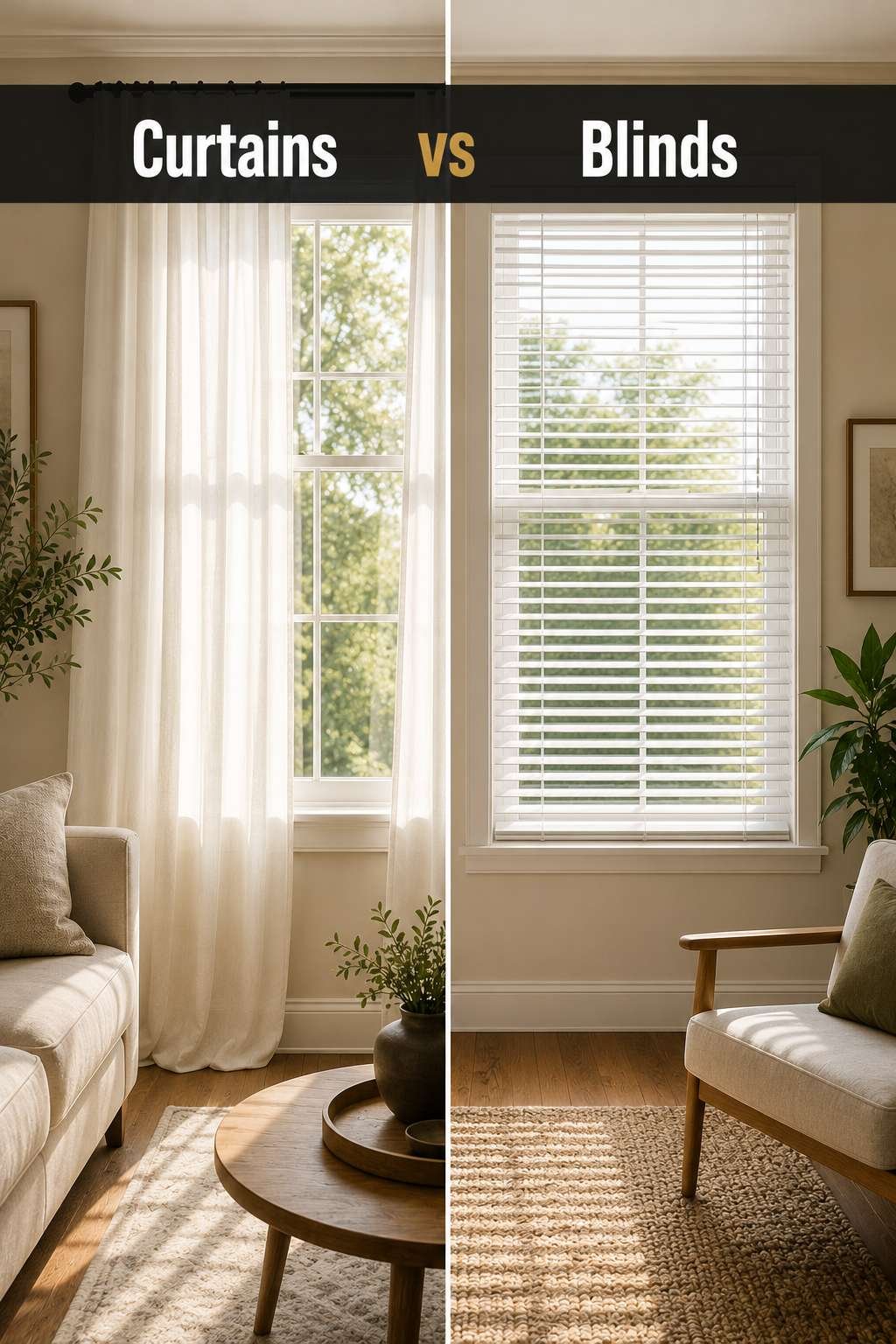
Curtains vs Blinds: The Master Comparison
| Criteria | Curtains | Blinds |
|---|---|---|
| Installed Cost | $30–$300+ per window (fabric, lining & hardware) | $25–$200+ per window (material dependent) |
| Light Control | Sheer to blackout, depending on fabric choice | Precise — adjust slat angle for exact control |
| Privacy | Full privacy only when fully closed | Full or adjustable partial privacy via slat angle |
| Insulation | Good with thermal lining, traps heat well | Moderate, some gaps let drafts through |
| Maintenance | Needs regular washing or dry cleaning | Wipe or dust slats every one to two weeks |
| Install Difficulty | Easy — rod and rings, minimal tools needed | Moderate — precise mounting brackets required |
| Child & Pet Safety | Safe by default, no dangling cords | Safe only in cordless models |
| Aesthetic Flexibility | Wide range of fabrics, colors and layering options | Clean, streamlined look with fewer style variations |
| Rental-Friendliness | Easy to install and remove with a tension rod | Often pre-installed, harder to remove without marks |
Translating that chart into real terms: if you’re on a tight timeline and want something up in an afternoon with zero tools, curtains on a tension rod win. If your priority is not thinking about your windows again for years — wipe, adjust, done — blinds win. The “insulation” row matters more than people expect: a lined curtain can noticeably cut a drafty older window’s heat loss, while blinds alone barely touch it. And the safety row isn’t a minor footnote — if you’re buying for a home with toddlers or pets, it should outweigh almost everything else on this list. Our guide on how to organize your room walks through this step by step.
Quick Look: Curtains vs Blinds at a Glance
Curtains
Soft, layerable, and flexible — the go-to pick for warmth, blackout bedrooms, and rooms that need to feel finished, not just functional.
View on Amazon →Blinds
Precise, low-maintenance, and moisture-resistant — the practical pick for kitchens, bathrooms, and anyone who wants exact light control.
View on Amazon →Deep Dive: Curtains
Curtains are the right call when the room needs to feel warm and finished, not just covered. They’re the natural choice for bedrooms that need real blackout and insulation, living rooms where you want texture and layering, and any room in a rental where you need something up and down without a toolbox.
Pros
- Wide range of fabrics, colors, and layering options
- Better insulation and draft reduction with thermal lining
- Softens echo and outside noise better than hard slats
- No-tool install with a tension rod in rentals
- Adds warmth and texture blinds can’t replicate
Cons
- Needs regular washing or dry cleaning to stay fresh
- Traps dust and allergens between washes
- Can feel bulky in very small or tight spaces
- Less precise light control unless layered with blinds
Real cost range: $30–$300+ per window installed, depending on fabric quality, lining, and hardware.
Deep Dive: Blinds
Blinds earn their keep in rooms where moisture, glare, or precise control matter more than softness. Kitchens and bathrooms are the obvious fit, but they also work well in home offices fighting screen glare and in rentals where mounts are already in place.
Pros
- Precise light control by adjusting the slat angle
- Wipes clean in seconds — resists moisture and grease
- Streamlined, modern look that suits most interiors
- Often less overall cost than a fully dressed curtain
- Long lifespan with wood or faux-wood materials Our how to style orange wood floors guide covers this in more detail.
Cons
- Dust collects in the slat grooves over time
- Corded versions pose a real child and pet safety risk
- Can feel cold or impersonal without a fabric pairing
- Light still leaks in around the edges of the frame
Real cost range: $25–$200+ per window installed, depending on material and whether the blinds are motorized.
Which One Wins Your Room?
Small Bedroom
Curtains win
Floor-to-ceiling panels hung high make a small room read taller and softer.
Rental Apartment
Curtains win
A tension rod goes up and comes down damage-free — ideal for a security deposit.
Kitchen
Blinds win
Grease and steam wipe off slats in seconds — fabric can’t compete here.
Nursery / Kids Room
Curtains win
Cordless blackout curtains give true darkness with zero cord risk.
Large Living Room Windows
Blinds win
Precise slat control tames glare across big glass expanses better than fabric alone.
Professional Tips
- Layer both when you can. Cordless blinds underneath sheer or lightweight curtains give you precise daytime light control and a soft, finished look at night — it’s the designer move that ends most curtains-vs-blinds arguments.
- Avoid the common regret. Going full blackout blinds in a small room with no fabric softening it tends to read cold, like an office, not a home — add even a narrow curtain panel to warm it up.
- Think about resale. Neutral curtains are easy for future owners or the next tenant to swap out; well-kept neutral blinds show clean in listing photos but read as more “fixed” to the space.
- Budget the real maintenance time. Blinds need a five-minute dust every week or two; curtains need a wash cycle every few months. Neither is zero-effort — pick the rhythm that fits your routine.
Shop the Winner
If you’re leaning toward curtains, here’s what to get started with:
Best Overall
A mid-weight blackout curtain and rod bundle with rings included, sized for standard windows and easy same-day install.
Best Budget
A basic adjustable tension rod and ring set that goes up in minutes with zero drilling, ideal for rentals.
Best Premium
A motorized curtain track kit with app and voice control for hands-free open and close on schedule.
If you’re leaning toward blinds, here’s what to get started with:
Best Overall
A cordless faux-wood blind kit with mounting brackets included, safe for homes with kids or pets.
Best Budget
A basic mounting bracket and valance kit that fits most standard aluminum or vinyl blinds.
Best Premium
A smart motorized blind kit with scheduling and remote control for precise, hands-free light management.
Frequently Asked Questions
Are curtains or blinds better for privacy?
Both give full privacy when fully closed. Blinds have an edge for adjustable partial privacy, since you can angle the slats to let light in while still blocking a direct view inside.
Which is cheaper, curtains or blinds?
Blinds are usually cheaper up front, typically $25 to $200 or more per window depending on material. Curtains range from $30 to $300 or more per window once you add fabric, lining and hardware.
Do blinds block more light than curtains?
Blinds give more precise, adjustable light control since you can angle individual slats. Curtains can block just as much or more light in blackout fabric, but the control is less granular.
Are curtains or blinds better for insulation?
Curtains, especially with thermal lining, generally insulate better and reduce drafts more effectively than blinds because fabric traps a layer of air against the window.
Which is easier to clean, curtains or blinds?
Blinds are easier for quick maintenance since you can wipe the slats. Curtains need a full wash or dry clean cycle a few times a year, which takes more time but reaches embedded dust and odors blinds can’t.
Are blinds safer than curtains for kids and pets?
Only cordless blinds are considered safe around young children and pets. Traditional corded blinds carry a strangulation risk, while curtains have no cords by default, making them the safer choice unless you specifically buy a cordless blind.
Can you use curtains and blinds together?
Yes, layering blinds underneath sheer or lightweight curtains is a common designer move. It gives you the precise light control of blinds with the softness and framing of curtains.
Which window treatment is better for a small bedroom?
Curtains generally work better in small bedrooms. Hanging them floor to ceiling and close to the ceiling line makes the room feel taller, and soft fabric adds warmth that blinds can’t replicate.
Are blinds a good choice for a rental apartment?
Blinds are often already installed in rentals, but if you need to add your own, curtains on a tension rod are usually the better renter-friendly option since they require no drilling and remove without damage.
Do curtains make a room look smaller?
Bulky, floor-length curtains hung too low or too narrow can make a room feel smaller. Hung correctly, wide and floor to ceiling, curtains actually make a room look larger and windows appear bigger.
Which window treatment lasts longer, blinds or curtains?
Quality wood or faux-wood blinds often outlast fabric curtains, which can fade, thin, or wear out with repeated washing. Curtains are easier and cheaper to refresh or replace when they do wear.
Are blackout curtains better than blackout blinds?
Blackout curtains generally block more light overall because they cover the full window frame with no side gaps, while blackout blinds can still let light leak in around the edges unless paired with side channels.
What is the average cost to install curtains vs blinds?
Expect $30 to $300 or more per window for curtains including hardware, and $25 to $200 or more per window for blinds depending on material and whether they’re motorized.
Which is better for a kitchen window, curtains or blinds?
Blinds are the better choice for kitchen windows. They resist grease, steam and moisture better than fabric, and wipe clean in seconds near the stove or sink.
Do blinds reduce noise better than curtains?
Thick, lined curtains generally dampen outside noise better than blinds, since soft fabric absorbs sound while hard slats reflect it.
Are curtains better for a modern minimalist home?
Blinds usually suit a minimalist aesthetic better with their clean, streamlined lines. Curtains can still work in a minimalist space if you choose a simple solid fabric with minimal fullness.
Can blinds increase home resale value?
Neutral, well-maintained blinds can help a home show well since they’re low-maintenance and modern, but curtains are just as staging-friendly and are easier for new owners to swap for their own style.
How often should you clean blinds vs curtains?
Dust blinds every one to two weeks with a microfiber cloth or duster. Curtains typically need a full wash or dry clean every three to six months, more often in high-traffic or high-dust rooms.
Which is better for a nursery, curtains or blinds?
Cordless blackout curtains are generally the safest and most effective choice for a nursery, combining true darkness for naps with no cord risk. If you choose blinds, only use a cordless model.
Should I choose cordless blinds over corded blinds?
Yes, cordless blinds are strongly recommended, especially in homes with young children or pets, since corded models carry a documented strangulation risk that cordless designs eliminate.
The Verdict
If you’re furnishing a bedroom, a rental, or any room where warmth and flexibility matter more than precision, curtains win. If you’re dressing a kitchen, a bathroom, or any window where moisture, glare, or hands-off maintenance is the priority, blinds win. For large living room windows and anyone who can’t decide, layering cordless blinds under sheer curtains gives you both wins at once — and it’s the single upgrade most homes end up making eventually anyway.

