


Balcony and terrace get used almost interchangeably in real estate listings, renovation plans, and everyday conversation — but they’re not the same thing, and the difference matters a lot more than it sounds. One is a small elevated platform bolted onto the side of your building. The other is a full outdoor room with its own structural support, whether that’s the ground beneath it or a reinforced roof. That difference drives everything from how much furniture you can fit to how much the space will cost you over time. Here’s the short version: balconies win on cost, availability, and low maintenance; terraces win on space, privacy, and entertaining. The rest of this guide breaks down exactly why, and which one actually fits your situation.
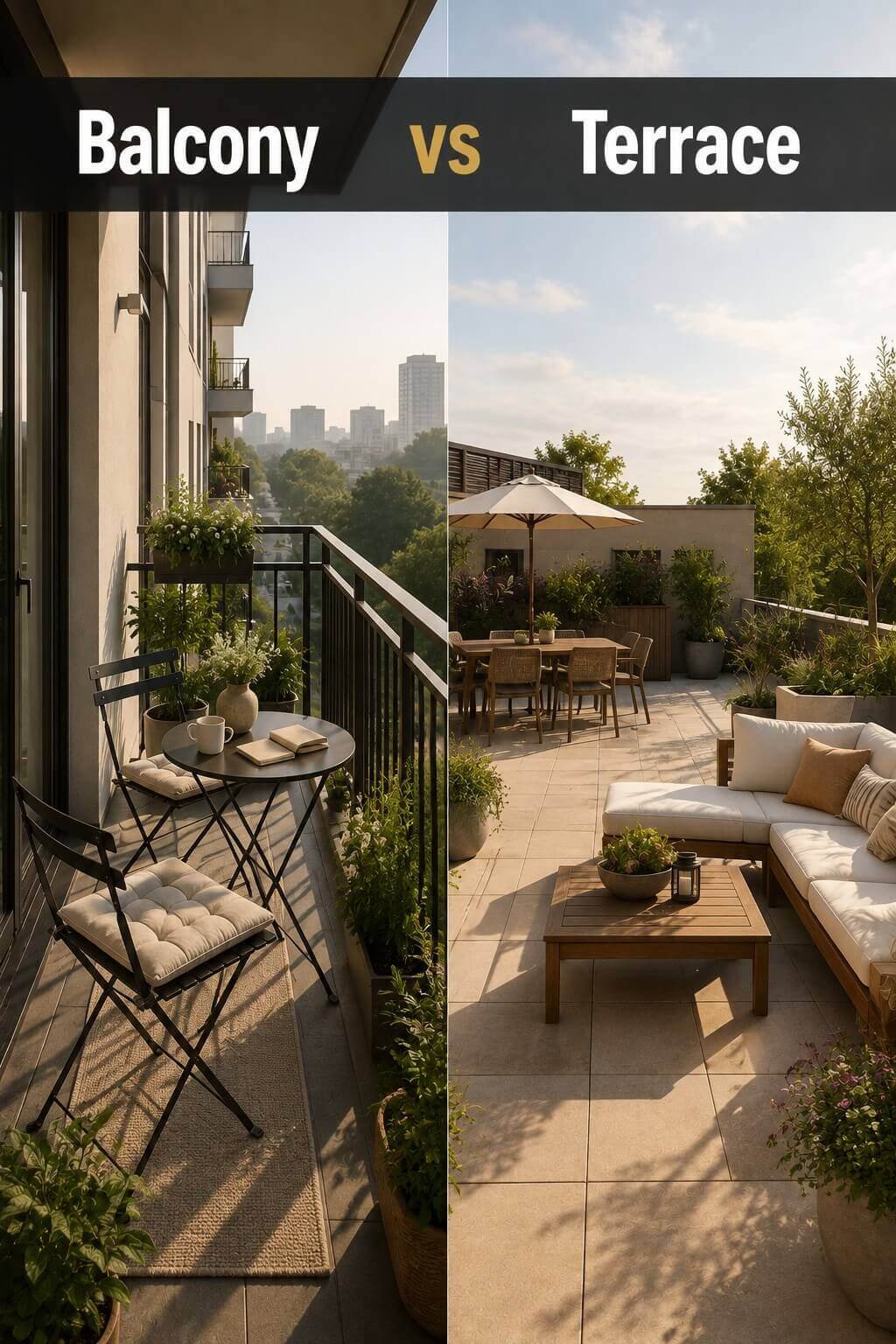
Balcony vs Terrace: Master Comparison Chart
| Criteria | Balcony | Terrace |
|---|---|---|
| Typical Size | 30–60 sq ft | 150–400+ sq ft |
| Structural Position | Cantilevered off the building, elevated above ground | Ground-level or rooftop, structurally supported from below |
| Privacy | Low — often visible to neighbors or the street | Moderate to high — can be walled, fenced, or landscaped |
| Furniture Flexibility | Limited by weight restrictions — compact or foldable pieces only | Full furniture sets, dining tables, even a fire pit or pergola |
| Maintenance | Low — occasional cleaning and minor railing upkeep | Moderate to high — waterproofing membrane resealing every 1–2 years on rooftop terraces, plus drainage checks |
| Build / Reno Cost | $500–$3,000 to furnish or lightly upgrade an existing balcony | $40–$150+ per sq ft installed for a ground-level terrace; $150–$300+ per sq ft for a rooftop terrace |
| Weather Exposure | Fully exposed; upper-floor balconies catch more wind | Exposed, but easier to add shade structures or pergolas |
| Resale Value Impact | Modest bump — an expected feature in most condos and apartments | Stronger bump, especially for rooftop or entertaining-ready terraces |
What the Chart Actually Means in a Real Home
The structural difference is the whole story. Because a balcony is cantilevered — essentially a shelf bolted to the building with nothing holding it up from underneath — its weight limit is fixed and non-negotiable. That’s why you can’t put a hot tub, a stone planter wall, or a crowd of ten people out there. A terrace, by contrast, is either sitting on solid ground or on a roof structure engineered to carry real load, which is why it can support full dining sets, built-in seating, or even a small garden. That same structural difference is also why terraces cost more: building or reinforcing something to carry that load, and keeping water out of whatever’s underneath it, is real construction work. A balcony just needs furniture. Our balcony decor ideas has more inspiration along these same lines.
Balcony
A small, budget-friendly elevated platform — best for compact seating, container plants, and low-commitment upgrades.
View on Amazon →Terrace
A full, ground-supported outdoor room — built for real furniture, entertaining, and long-term outdoor living.
View on Amazon →Deep Dive: Balcony
A balcony makes the most sense for renters, small households, and anyone in an apartment or condo where a full outdoor room simply isn’t an option. It’s also the right call if you want an outdoor spot without a major investment or long-term commitment. Pair this with our balcony decorating checklist to stay on top of the rest.
Pros
- Lower cost to add or furnish
- Available in nearly any apartment or condo, even upper floors
- Minimal maintenance
- Great for small-space city living
- Renter-friendly — usually no permit needed for furniture-only upgrades
Cons
- Limited square footage
- Weight limits rule out big furniture, planters, or hot tubs
- Less privacy, especially in high-rises
- Fully exposed to wind on upper floors
- Rarely fits a full dining or lounge set
Real cost range: $500–$3,000 to furnish and lightly upgrade an existing balcony — furniture, a privacy screen, planters, and lighting. Adding a structural balcony to a building that doesn’t have one runs far higher and requires an engineer and permits.
Deep Dive: Terrace
A terrace makes sense when you have the ground-level space or roof structure to support it, and you want a genuine outdoor living room — not just a spot for a chair and a plant.
Pros
- Significantly more usable space
- Room for real furniture, dining sets, even a fire pit
- Easier to add privacy with walls, fencing, or landscaping
- Bigger resale and entertaining value
- Can support a pergola or shade structure
Cons
- Higher build-out cost, especially rooftop
- Requires waterproofing and ongoing membrane maintenance
- Not available in every building or unit
- Structural work usually needs permits and engineering sign-off
- More surface area to clean and maintain long-term
Real cost range: $40–$150+ per sq ft installed for a ground-level terrace, and $150–$300+ per sq ft for a rooftop terrace once structural support and waterproofing are factored in.
Which One Wins for Your Space?
Small Apartment Balcony
A compact bistro set and vertical planters make the most of 30–60 sq ft without any structural changes.
Balcony winsRental-Friendly Balcony
Renters get the most value from low-commitment upgrades — a rug, clip-on lighting, container plants — with no permanent changes.
Balcony winsLuxury Rooftop Terrace Build
New construction or a major renovation is exactly where a rooftop terrace earns its higher cost, with room for lounge and dining space plus skyline views.
Terrace winsGround-Floor Walkout Terrace
A garden-level home with direct yard access makes a ground terrace the natural extension of the house, not an afterthought.
Terrace winsHigh-Traffic Entertaining Terrace
Frequent hosting needs the square footage a terrace provides — a balcony simply can’t fit a crowd comfortably.
Terrace winsProfessional Tips
- Don’t undersize (or oversize) balcony furniture — a table too big to walk around gets used less than a smaller one you’ll actually sit at. Our small patio ideas has more inspiration along these same lines.
- Budget for a waterproofing inspection every 1–2 years on any rooftop terrace — skipping it is the single most common regret homeowners report.
- A “terrace” in a rental listing isn’t always ground-level — confirm structural type before assuming you can add a grill or heavy planters.
- For resale, a terrace typically adds more value than a balcony, but only if it’s genuinely usable — an unfinished or poorly drained terrace can hurt a listing instead of helping it.
- Privacy is the easiest factor to overlook: a terrace can be screened with plantings or a low wall for relatively little cost, while balcony privacy options are limited by weight and building rules.
Shop the Winner
Whichever way you’re leaning, here’s where to start. These three tiers work for furnishing a balcony or building out a full terrace — see our full Best Balcony & Terrace Furniture Sets guide for the complete breakdown.
Best Overall
A weather-resistant bistro-to-lounge set that scales from a small balcony to a mid-size terrace.
Best Budget
A compact folding set built for balconies and rental-friendly setups with no permanent install.
Best Premium
A full modular lounge and dining collection sized for a rooftop or entertaining-ready terrace.
Frequently Asked Questions
Is a balcony the same as a terrace?
No. A balcony is a platform cantilevered off the outside of a building at an elevated level, while a terrace sits directly on the ground or on a roof structure with its own support, giving it more space and different maintenance needs.
What legally counts as a terrace vs a balcony?
Building codes generally define a balcony as an unenclosed platform projecting from an exterior wall with no supports below, while a terrace is a paved or decked outdoor area supported at ground level or by a roof structure below it. Definitions vary by local code, so check with your building department.
Can a balcony be turned into a terrace?
Not usually in the structural sense. A balcony can be upgraded and furnished to feel more like a terrace, but converting it into a true ground-supported terrace would require major structural changes that are rarely feasible.
Why do real estate listings call small balconies terraces?
Marketing language often stretches the term terrace to make a small outdoor space sound larger or more upscale. Always ask for square footage and structural type rather than relying on the listing’s wording.
Which is cheaper to build, a balcony or a terrace?
A balcony is almost always cheaper since it typically already exists as part of the building structure and just needs furnishing, while a terrace usually involves new construction, drainage, and waterproofing.
Do terraces add more resale value than balconies?
In most markets, yes. A well-built, usable terrace tends to add more resale value than a balcony because of the extra square footage and entertaining potential, though a poorly maintained terrace can offset that gain.
Can you put a hot tub on a balcony?
Rarely. Most balconies aren’t rated to hold the weight of a filled hot tub, and doing so without an engineer’s approval is a serious safety risk. A ground-level terrace is a much safer fit.
How much weight can a balcony hold?
It depends entirely on the building’s structural rating, but many residential balconies are designed for roughly 40 to 60 pounds per square foot of live load. Always confirm with your building or an engineer before adding heavy furniture or planters.
Is a rooftop terrace the same as a roof deck?
They’re closely related and often used interchangeably, though roof deck sometimes refers specifically to a wood or composite decking surface, while rooftop terrace implies a more finished, furnished outdoor living space.
What’s the average size of a balcony vs a terrace?
A typical apartment balcony runs about 30 to 60 square feet, while terraces commonly range from 150 square feet up to several hundred, depending on the home and lot.
Do balconies need waterproofing?
Yes, though typically less intensive than a terrace. Most balconies have a sealed membrane or coating under the surface finish, and it should be checked periodically for cracks or wear.
Are terraces more private than balconies?
Generally yes, since terraces are easier to enclose with walls, fencing, or landscaping, while balconies are limited by weight restrictions and building rules on what can be attached to the railing.
Can renters make permanent changes to a balcony?
Usually not without landlord approval. Most leases prohibit drilling, painting, or structural changes, which is why renter-friendly upgrades like rugs, clip-on lighting, and container plants are the safest route.
What furniture fits a small balcony?
Compact bistro sets, foldable chairs, wall-mounted or railing planters, and slim vertical shelving make the best use of a small balcony’s limited footprint.
Do HOAs regulate balcony and terrace changes?
Very often, yes. Many HOAs have specific rules about what can be installed, attached, or built on both balconies and terraces, so it’s worth checking the covenant before purchasing furniture or planning any renovation.
Is a terrace ground-level or can it be on a roof?
Both. The defining feature of a terrace is that it’s structurally supported from below, which can mean it sits at ground level or on top of a roof structure engineered to carry it.
How do you maintain a terrace long-term?
Regular maintenance includes checking and resealing the waterproofing membrane every one to two years, keeping drains clear, and inspecting for cracking or ponding water, especially on rooftop terraces.
What’s a Juliet balcony?
A Juliet balcony is a railing or guard installed in front of a door or window with little to no actual standing platform. It’s decorative and safety-focused rather than a usable outdoor space.
Can you build a terrace over a garage?
Yes, this is a common way to add a terrace to a home, though it requires structural reinforcement and proper waterproofing since the garage below needs to stay dry.
Which is better for small dogs or pets?
A terrace generally offers more room for pets to move around safely, though a balcony can work for small dogs as long as railings are pet-safe and there’s no gap large enough for them to slip through.
Final Verdict
If you’re renting, working with a tight budget, or living in a small apartment, a balcony is the smarter, lower-commitment choice — it costs less, needs almost no maintenance, and fits nearly any building. If you’re building new, renovating a home with room to grow, or you entertain often, a terrace is worth the extra cost for the space, privacy, and resale value it adds. There’s no universal winner here — but for your specific situation, one of these clearly outperforms the other, and now you know which.

