


Shopping for bedroom furniture and stuck on whether you need a nightstand or a bedside table? The two names get used almost interchangeably, but they’re not always the same thing. A nightstand is typically built with drawers or shelves for storage, while a bedside table is a broader term that can mean anything from a matched storage piece to a repurposed stool or vintage side table with no storage at all. Below, we break down the real cost, storage, and style differences, walk through five real bedroom scenarios, and give you a straight answer for which one fits your space.
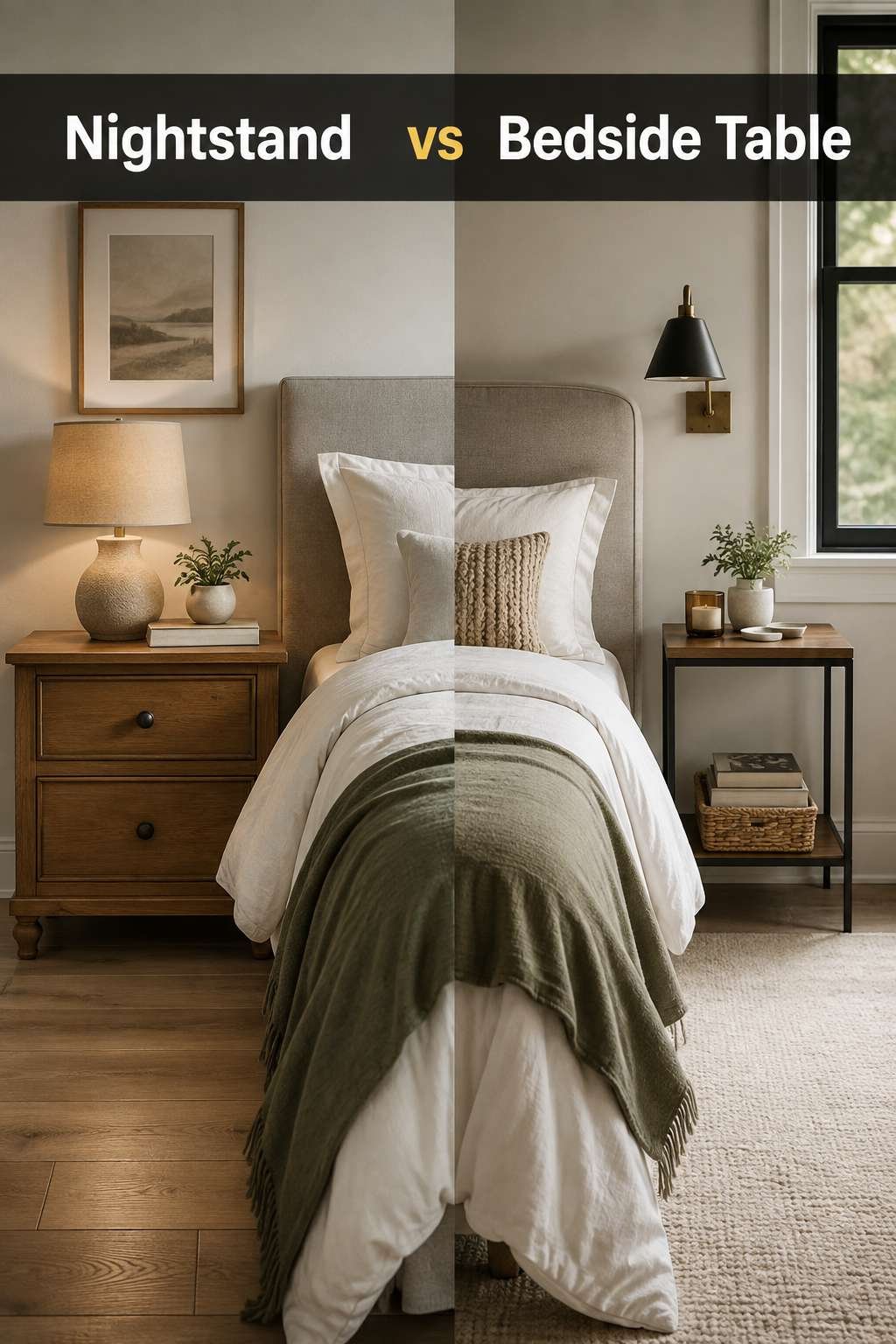
Nightstand vs Bedside Table: Full Comparison
| Criteria | Nightstand | Bedside Table |
|---|---|---|
| Cost | $50–$1,200+ depending on material and drawer count | $20–$500+, with wide swings for vintage or designer pieces |
| Storage | Drawers or shelves are standard | Often open — storage isn’t guaranteed |
| Footprint & Size | Typically 16–20 in. wide, boxier | Typically 12–16 in. wide, slimmer profile |
| Durability | High with solid wood or quality laminate | Varies widely depending on the piece used |
| Maintenance | Low — occasional dusting and drawer-glide checks | Low, though repurposed pieces may need upkeep |
| Install / Assembly | Some assembly usually required | Often none, especially with found or vintage pieces |
| Aesthetic Flexibility | Moderate — tends to match a bedroom set | High — easy to mix vintage, modern, or eclectic styles |
| Resale Value | Solid wood holds value well | Depends heavily on the piece’s condition and style |
In practice, the chart comes down to a trade-off: a nightstand earns its floor space with dedicated storage and a sturdier, more matched look, while a bedside table trades that storage for a smaller footprint and far more design freedom. Neither one is objectively “better” — it depends on whether your bedroom needs more organization or more personality. Our 29 clever bedroom storage ideas has more inspiration along these same lines.
Quick Look: Nightstand vs Bedside Table at a Glance
Nightstand
A compact storage piece built with drawers or shelves to keep chargers, glasses, and bedtime essentials within reach.
View on Amazon →Bedside Table
An open, flexible surface — from vintage stools to slim accent tables — chosen more for style than built-in storage.
View on Amazon →Deep Dive: Nightstand
A nightstand is the right call for anyone who wants dedicated, out-of-sight storage next to the bed — primary bedrooms, anyone managing medication or glasses at night, and matched bedroom sets all favor a real nightstand over an open table. Check our bed size chart if you want exact numbers before you shop.
Pros
- Built-in drawer or shelf storage
- Keeps small essentials organized and out of sight
- Widely available in matching bedroom sets
- Sturdy, stable footprint for lamps and alarm clocks
Cons
- Bulkier footprint eats more floor space
- Higher cost for solid wood or designer options
- Matched-set styling can look mass-produced
- Fewer style surprises than a curated bedside piece
Deep Dive: Bedside Table
A bedside table makes more sense in small bedrooms, eclectic or vintage-styled rooms, and rentals where you can’t drill or mount anything. It’s also the better fit if you’re repurposing a stool, plant stand, or side table you already own. Our small walk in closet ideas has more inspiration along these same lines.
Pros
- Design flexibility — works with vintage, modern, or mixed styles
- Smaller footprint, easier in tight bedrooms
- Can be genuinely inexpensive if repurposed
- Lightweight and easy to move or swap out
Cons
- Often lacks any built-in storage
- Repurposed pieces can wobble or feel less sturdy
- Height may not match the bed without extra effort
- Less practical for meds, chargers, or nighttime reading stacks
Which One Wins in Your Room?
Small Bedroom / Studio
Every inch counts and a boxy nightstand crowds the walkway.
Winner: Bedside TableGuest Room
Drawer storage keeps visiting guests’ items tidy and out of the way.
Winner: NightstandPrimary / Luxury Suite
Matched nightstand pairs with real storage read as intentional, finished design.
Winner: NightstandKids’ Room
Rounded, enclosed storage keeps small items and nightlights safely contained.
Winner: NightstandRental-Friendly
No assembly, no drilling, and easy to move at lease-end.
Winner: Bedside TableProfessional Tips
- Follow the height-matching rule: keep the table surface within about 2 inches of your mattress top so a lamp or alarm clock stays within easy reach.
- Do the drawer-vs-open-shelf reality check: if you manage medication or want tech tucked out of sight, prioritize drawers over a purely decorative bedside table.
- Think about resale and staging: matched nightstand pairs tend to photograph better for listings than a single mismatched bedside table.
- Measure before you buy: the most common regret is a table that’s noticeably too short or too tall relative to the mattress — measure first, shop second.
Shop the Winner
If you’re leaning toward a Nightstand, here’s what to get started with:
Best Overall
A two-drawer wood veneer nightstand that balances sturdy storage with a price that works for most bedrooms.
Best Budget
A simple one-drawer laminate nightstand that covers the essentials without stretching the budget.
Best Premium
A solid wood nightstand with soft-close drawers, built to last and hold its resale value long-term.
If you’re leaning toward a Bedside Table, here’s what to get started with:
Best Overall
A slim open-shelf accent table sized to fit tight bedrooms without sacrificing surface space.
Best Budget
A lightweight stool-style table that works as a no-assembly bedside surface in a rental or first apartment.
Best Premium
A designer accent table with a brass or stone finish, chosen for standout style over storage.
Frequently Asked Questions
Is a nightstand the same thing as a bedside table?
They overlap, but not always. A nightstand typically refers to a piece of bedroom furniture built with drawers or shelves for storage. A bedside table is a broader term that can include anything placed next to a bed, including open-shelf pieces, stools, or vintage accent tables with no storage at all.
What’s the actual difference between a nightstand and a bedside table?
The main difference is storage and structure. A nightstand is purpose-built furniture with drawers or shelves. A bedside table is a more general term that can be any small surface next to a bed, often prioritizing style and flexibility over built-in storage.
Do all nightstands have drawers?
Most do, but not all. Some nightstands use open shelving instead of drawers. What sets a nightstand apart is that it’s designed as dedicated bedroom storage furniture, whether that storage is enclosed or open.
Can I use a regular side table as a bedside table?
Yes. Any stable, appropriately sized table can work as a bedside table, including a vintage side table, a stool, or a plant stand repurposed for the bedroom. Just check the height matches your mattress and that it’s sturdy enough for a lamp.
What height should a nightstand or bedside table be?
Aim for a surface within about 2 inches of your mattress top, either slightly above or slightly below. This keeps a lamp, phone, or alarm clock within easy reach without straining to see or grab it at night.
How much does a good nightstand cost?
Budget laminate nightstands run about $50 to $150. Mid-range wood veneer options run $150 to $400. Solid wood or designer nightstands can run $400 to $1,200 or more.
Is it OK to have mismatched bedside tables?
Yes, and it’s a popular styling choice in eclectic or vintage-inspired bedrooms. Mismatched bedside tables work best when they share a similar height, tone, or material so the pairing still feels intentional rather than accidental.
What size nightstand fits a small bedroom?
Look for a nightstand under about 16 inches wide, or consider a slim bedside table instead. A narrow profile with a single drawer or open shelf gives you storage without eating into limited floor space.
Do I need storage in my bedside table?
It depends on what you keep nearby at night. If you manage medication, chargers, glasses, or other small items, built-in storage is genuinely useful. If your nightstand top stays mostly empty, an open bedside table works just as well.
What’s the best material for a nightstand — wood, laminate, or metal?
Solid wood offers the best durability and resale value but costs more. Laminate is budget-friendly and low-maintenance but wears faster. Metal frames are durable and modern-looking but can feel colder in a cozy bedroom.
Can a stool work as a bedside table?
Yes, a stool is one of the most common bedside table substitutes. It works especially well in small or eclectic bedrooms, though it typically offers no storage and should be checked for stability before use.
How many drawers should a nightstand have?
One or two drawers is standard and enough for most bedrooms. A single drawer keeps the footprint compact, while two drawers give more organization for people who keep more items within reach.
Should my nightstand match my bed frame?
It’s not required, but a matched wood tone or finish creates a cohesive, finished look, especially in primary bedrooms. In more eclectic spaces, an intentionally mismatched nightstand or bedside table can work just as well.
What’s the best nightstand for small spaces?
A slim nightstand under 16 inches wide, or a wall-mounted floating nightstand, works well in small bedrooms. Both free up floor space while still offering a place for a lamp and a drawer or shelf for storage.
Do bedside tables need to be the same height as the mattress?
They don’t need to match exactly, but staying within about 2 inches of the mattress top makes reaching a lamp or alarm clock far more comfortable, especially at night.
Is a floating nightstand better for small rooms?
Floating nightstands can be a great fit for small rooms since they free up visible floor space and make the room feel more open, though they require wall mounting, which isn’t always possible in rentals.
What’s the difference between a nightstand and an end table?
A nightstand is designed specifically for bedroom use next to a bed, usually with storage in mind. An end table is designed for living room use next to a sofa, though the two are similar enough in size that either can sometimes substitute for the other.
How far should a nightstand be from the bed?
Keep it close enough to reach without stretching, typically within a couple of inches of the mattress edge, so a lamp, phone, or glass of water stays within easy arm’s reach.
Are bedside tables out of style?
No. Bedside tables remain popular, especially in eclectic, vintage, and minimalist bedroom styles, because they offer more visual flexibility than a matched nightstand pair.
What should I keep on my nightstand or bedside table?
A lamp, a phone or charger, and a small item like a book or a glass of water are the most common essentials. Keeping the surface mostly clear makes the space feel calmer and easier to use at night.
Final Verdict
If storage, organization, and a finished matched-set look matter most to you — get a nightstand. It’s the better choice for primary bedrooms, guest rooms, and kids’ rooms, and it holds up better for anyone managing medication, chargers, or nighttime reading stacks.
If you’re working with a small bedroom, renting, or want more design freedom to mix vintage and modern pieces — a bedside table wins. It costs less to get right, takes up less floor space, and never requires assembly or drilling.
Either way, the real mistake isn’t picking the “wrong” one — it’s picking a height that doesn’t match your mattress. Measure first, then choose the option that fits your room and your routine.

