Picking between wood countertops and quartz comes down to one honest question: do you want a low-maintenance surface that just works, or a warmer material you’re willing to look after? Quartz suits busy, high-traffic kitchens where durability and resale value matter most. Wood suits kitchen islands, farmhouse and organic-modern homes, and budget-conscious renovations where character and a lower price point win out over zero upkeep. Both are excellent choices — the right one just depends on which kitchen you actually live in.
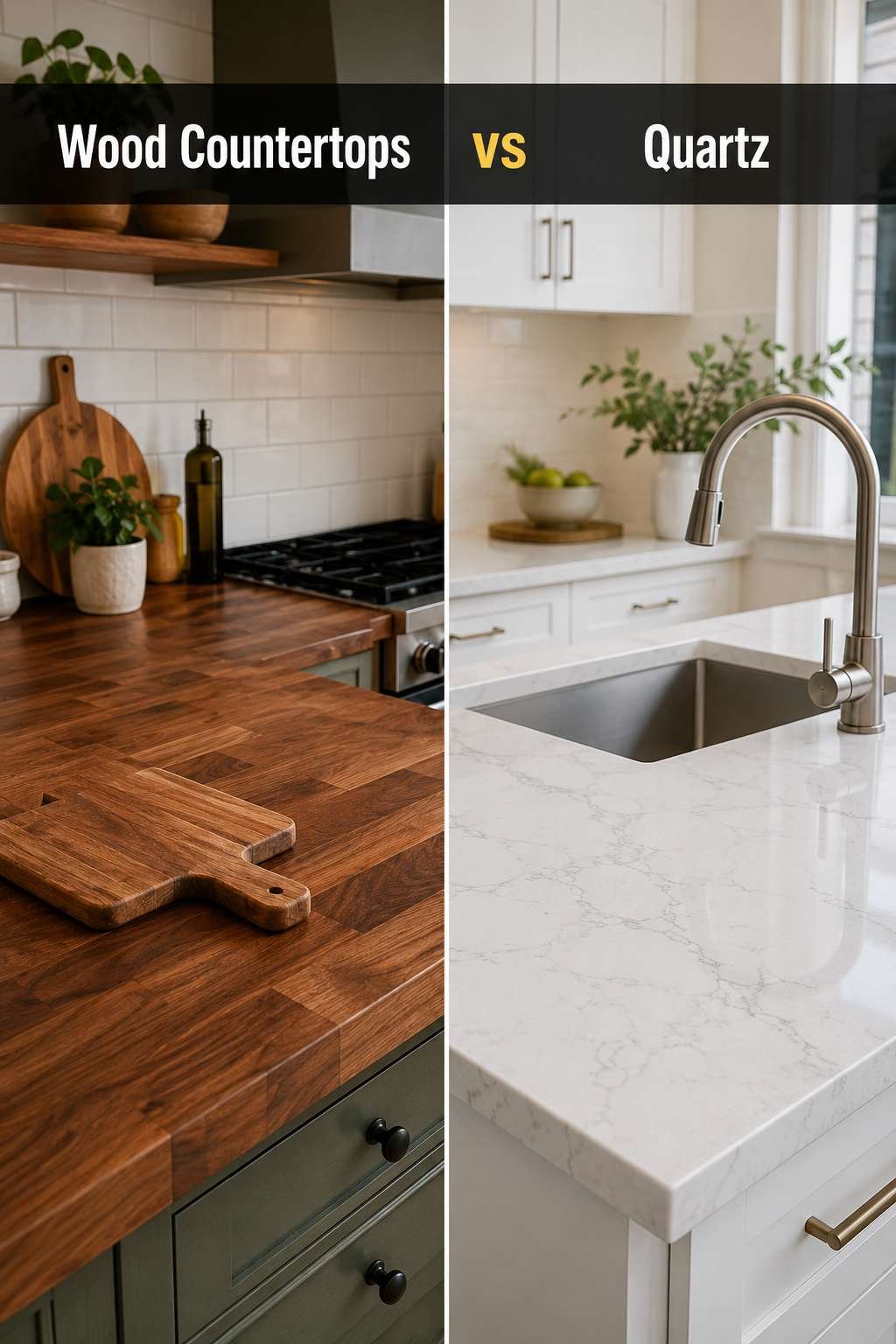
Wood Countertops vs Quartz: The Full Comparison
Here’s how the two materials stack up across the criteria that actually decide a renovation — cost, durability, upkeep, and how long each one realistically lasts. Our guide on how to decorate a kitchen shelf walks through this step by step.
| Criteria | Wood Countertops | Quartz Countertops |
|---|---|---|
| Installed Cost | $35–$75 per sq ft, varies by wood species | $50–$120 per sq ft, varies by brand and edge profile |
| Durability | Shows knife marks and dents, but they sand out | Highly scratch and dent resistant, doesn’t sand out |
| Heat Resistance | Scorches under direct hot pans; always use a trivet | Handles brief heat, but sustained direct heat can crack or discolor it |
| Water Resistance | Needs regular oiling to resist rings and swelling | Naturally non-porous; handles daily splashes with no sealing |
| Maintenance | Re-oil every 1–3 months in heavy-use areas | Wipe down with soap and water; no sealing or oiling ever |
| Lifespan | 15–25 years with routine care, longer if resurfaced | 25+ years, rarely needs replacing |
| Repairability | Can be sanded and refinished repeatedly | Chips and cracks need a pro patch; can’t be resurfaced |
| Resale Value | Adds character, but appeals to a narrower buyer taste | Broadly appealing; often boosts appraised value |
| Aesthetic Range | Warm natural grain that patinas and deepens with age | Wide range of colors and patterns, consistent forever |
In real terms: wood is the cheaper, warmer, more forgiving-of-mistakes option as long as you’re willing to oil it on a schedule. Quartz costs more upfront but essentially removes maintenance from your to-do list for the next 25 years — the trade-off is that once it’s damaged, it’s damaged for good, while a scratched or stained wood counter can be sanded back to like-new.
Quick Look: Wood Countertops vs Quartz at a Glance
Wood Countertops
Warm, natural, and budget-friendly — best for islands and character-driven kitchens, if you’re willing to keep it oiled. See our kitchen island ideas for more direction in this style.
View on Amazon →Quartz Countertops
Durable, consistent, and nearly maintenance-free — best for busy kitchens and resale value, at a higher upfront cost.
View on Amazon →Wood Countertops: Best-Fit Scenarios, Pros & Cons
Wood makes the most sense when you want a kitchen that feels warm and personal, not showroom-perfect. It’s especially strong for kitchen islands, farmhouse and Scandinavian-style homes, and renovators who’d rather spend on cabinetry or appliances than on the countertop itself.
Pros
- Lower installed cost than quartz, especially for DIY installs
- Can be sanded and refinished instead of replaced
- Warm, natural look that ages into a rich patina
- Naturally antimicrobial when properly oiled
- Easy to cut into for custom edges, sinks, or islands
Cons
- Needs re-oiling every 1–3 months in heavy-use spots
- Vulnerable to water rings and swelling near sinks
- Shows knife marks and dents from daily use
- Can’t take a hot pan directly without a trivet
- Narrower resale appeal than a neutral engineered surface
Real cost range: expect roughly $35–$75 per square foot installed for oiled hardwood butcher block, depending on the wood species (maple and birch run cheaper; walnut and teak run higher).
Quartz Countertops: Best-Fit Scenarios, Pros & Cons
Quartz makes the most sense when your kitchen sees heavy daily use and you want one less thing to maintain. It’s the strongest choice for busy family households, rental properties, and any renovation where resale value is part of the calculation.
Pros
- Virtually no maintenance — no sealing or oiling, ever
- Highly resistant to scratches, stains, and daily wear
- Non-porous, so it’s naturally hygienic for food prep
- Consistent color and pattern across the whole slab
- Broad buyer appeal that supports resale value
Cons
- Higher installed cost than wood
- Sustained direct heat can crack or discolor the surface
- Can’t be sanded or refinished once damaged
- Seams can be visible on very large islands
- Reads as cooler and less personal to some homeowners
Real cost range: expect roughly $50–$120 per square foot installed, depending on the brand, slab thickness, and edge profile you choose (a waterfall edge adds noticeably to the total).
Which One Wins in Your Kitchen? Real Room Examples
Busy Family Kitchen
Kids, daily cooking, and constant traffic call for a surface that won’t need babying.
Quartz wins.
Farmhouse or Scandinavian Island
Warm grain and visible texture are the whole point of this look.
Wood wins.
Budget-Conscious DIY Renovation
Every dollar matters, and labor savings from a DIY install add up fast.
Wood wins.
Luxury Custom Build
Resale value and a flawless, consistent finish matter more than character.
Quartz wins.
Wet Prep Zone Beside the Sink
Constant water exposure is the fastest way to damage an unsealed surface.
Quartz wins.
Designer Tips & Common Regrets
Mix materials instead of choosing just one
A wood island paired with quartz perimeter counters is one of the most popular current layouts — you get the warmth of wood where it’s lower-risk (away from the sink) and the durability of quartz where spills and heat happen most.
The most common regret
Installing wood directly beside the sink without committing to a real oiling routine, or choosing a stark white quartz that shows every crumb and water spot in a heavy-use kitchen. Match the material to your actual habits, not just the photo you liked.
Resale reality-check
If you’re renovating with resale in mind and expect to sell within five years, quartz is the safer bet — it reads as updated and low-maintenance to nearly every buyer, while wood is more of a personal style statement.
Maintenance reality-check
Be honest with yourself about whether you’ll actually re-oil a wood countertop on schedule. If a maintenance routine is likely to slip, quartz removes that risk entirely.
Shop the Winner
If you’re leaning toward quartz, here’s what to get started with:
Best Overall
A gentle, pH-balanced quartz cleaner and polish that lifts everyday grease and water spots without dulling the finish.
Best Budget
An affordable everyday spray cleaner that covers the basics for a quartz counter in daily use.
Best Premium
A cleaner-and-sealant combo with UV protection, built to keep a light-colored quartz counter looking new for years.
If wood’s warmth is calling you instead, here’s your starter kit:
Best Overall
A food-grade mineral oil and beeswax conditioner that restores shine and reseals the grain in one application.
Best Budget
A simple, no-frills mineral oil that covers the basics for routine monthly conditioning.
Best Premium
A board cream and oil duo built for heavy daily use, designed to deepen the wood’s natural color over time.
Wood Countertops vs Quartz: Frequently Asked Questions
Are wood countertops sanitary for food prep?
Yes, as long as they’re properly oiled. A well-maintained, oiled wood countertop is naturally antimicrobial and safe for food prep; the risk comes from letting the wood dry out and crack, which creates hiding spots for bacteria. Keep it oiled and it stays food-safe.
Is quartz more expensive than wood countertops?
Usually, yes. Quartz typically runs $50–$120 per square foot installed, while wood (butcher block) runs roughly $35–$75 per square foot depending on the species. Wood is generally the more budget-friendly starting point, especially for DIY installs.
How often do wood countertops need to be oiled?
In heavy-use areas like a busy kitchen, plan on re-oiling every 1–3 months. Lower-traffic sections can often go longer. Skipping this is the single biggest cause of premature wood countertop damage.
Can quartz countertops crack from hot pans?
Yes. Quartz can handle brief contact with warm cookware, but a pan straight off a hot burner set down and left can crack the surface or discolor the resin binder. Always use a trivet or hot pad.
Do wood countertops scratch easily?
Wood does show knife marks and dents more readily than quartz, but that’s part of the trade-off — those marks can be sanded out and the surface refinished, which quartz can’t do.
Is quartz countertop maintenance-free?
Nearly. Quartz is non-porous, so it never needs sealing or oiling — a simple wipe-down with mild soap and water keeps it looking new. It’s about as close to maintenance-free as a countertop gets.
Can you install a wood countertop yourself?
Yes, wood countertops are one of the more DIY-friendly options, especially pre-fabricated butcher block sections. Quartz slabs, by contrast, are heavy and typically require professional templating and installation.
How long do wood countertops last?
With routine oiling, expect 15–25 years, and often longer since a heavily worn wood countertop can be sanded down and refinished rather than replaced.
How long do quartz countertops last?
Quartz commonly lasts 25 years or more with virtually no maintenance, and many homeowners never need to replace it for the life of the kitchen.
Can wood countertops go near a sink?
They can, but it’s the highest-risk zone for wood — standing water causes rings, swelling, and warping faster than anywhere else in the kitchen. If you want wood near a sink, commit to a strict oiling schedule or consider quartz for just that section.
Does quartz stain?
Quartz resists staining far better than natural stone because it’s non-porous, but pigmented liquids like wine or turmeric left to sit for a long time can occasionally leave a faint mark. Wiping up spills promptly avoids this entirely.
Can you refinish or resurface a quartz countertop?
No. Once quartz is chipped, cracked, or burned, it can’t be sanded or refinished like wood — repairs are a professional patch job at best, and significant damage usually means replacing that section.
Can you sand and refinish a wood countertop?
Yes, this is one of wood’s biggest advantages. A worn, stained, or scratched wood countertop can be sanded back to bare wood and re-oiled to look new again, often more than once over its lifetime.
Which countertop adds more resale value, wood or quartz?
Quartz tends to have broader buyer appeal and is more likely to show up positively in an appraisal, since it reads as low-maintenance and modern to most buyers. Wood adds character but appeals to a narrower taste, so it’s more of a style choice than a value-add.
Is quartz heavier than wood, and does it need extra cabinet support?
Yes, quartz slabs are significantly heavier than wood and standard cabinetry is built to support them, but very large islands or waterfall edges may need reinforced support — your installer will confirm this during templating.
What’s cheaper to install, wood or quartz?
Wood (butcher block) is typically cheaper both in material cost per square foot and in labor, especially if you install it yourself. Quartz costs more upfront but avoids the ongoing cost of oil and sealants over the years.
Can wood countertops be used outdoors?
Standard interior wood countertops aren’t built for outdoor exposure — sun and rain will warp and degrade them quickly. If you want a wood look outdoors, look for teak or another marine-grade hardwood rated for exterior use instead.
Does quartz come in warm/wood-like colors?
Yes, most quartz manufacturers now offer warm taupe, cream, and wood-toned patterns alongside classic white and gray, so you can get some of that warmth without the maintenance wood requires.
What’s the best way to clean a wood countertop daily?
Wipe with a damp cloth and mild soap, dry it immediately, and avoid letting water pool on the surface. Skip harsh chemical cleaners, which can strip the protective oil finish faster than normal wear.
Can I mix wood and quartz countertops in the same kitchen?
Absolutely, and it’s one of the most popular current layouts — a wood island paired with quartz perimeter counters gives you the warmth of wood in a lower-risk spot and the durability of quartz where spills and heat happen most.
Final Verdict: Which Should You Actually Choose?
Choose quartz if you’re renovating a busy family kitchen, care about resale value, or simply don’t want maintenance on your to-do list — it’s the safer, lower-risk choice for most everyday households.
Choose wood if you’re building a kitchen island, leaning into a farmhouse or organic-modern style, or working with a tighter renovation budget and don’t mind an oiling routine — the character and lower cost are worth the upkeep for the right homeowner.
Still torn? Go quartz everywhere except the island, and put wood there instead. It’s the combination that gives you the best of both without compromising on either.