Choosing between a recliner and an accent chair usually comes down to one honest question: do you want your living room to feel like a place to sink into, or a place that looks put-together the moment someone walks in? A recliner wins on comfort — full recline, footrest, sometimes power controls or heat. An accent chair wins on style and space, slotting into small rooms and formal layouts where a recliner would look out of place. Neither one is universally “better.” The right pick depends on your room, your daily habits, and whether you’re furnishing a media room or a reading corner. Here’s how the two actually compare, room by room.
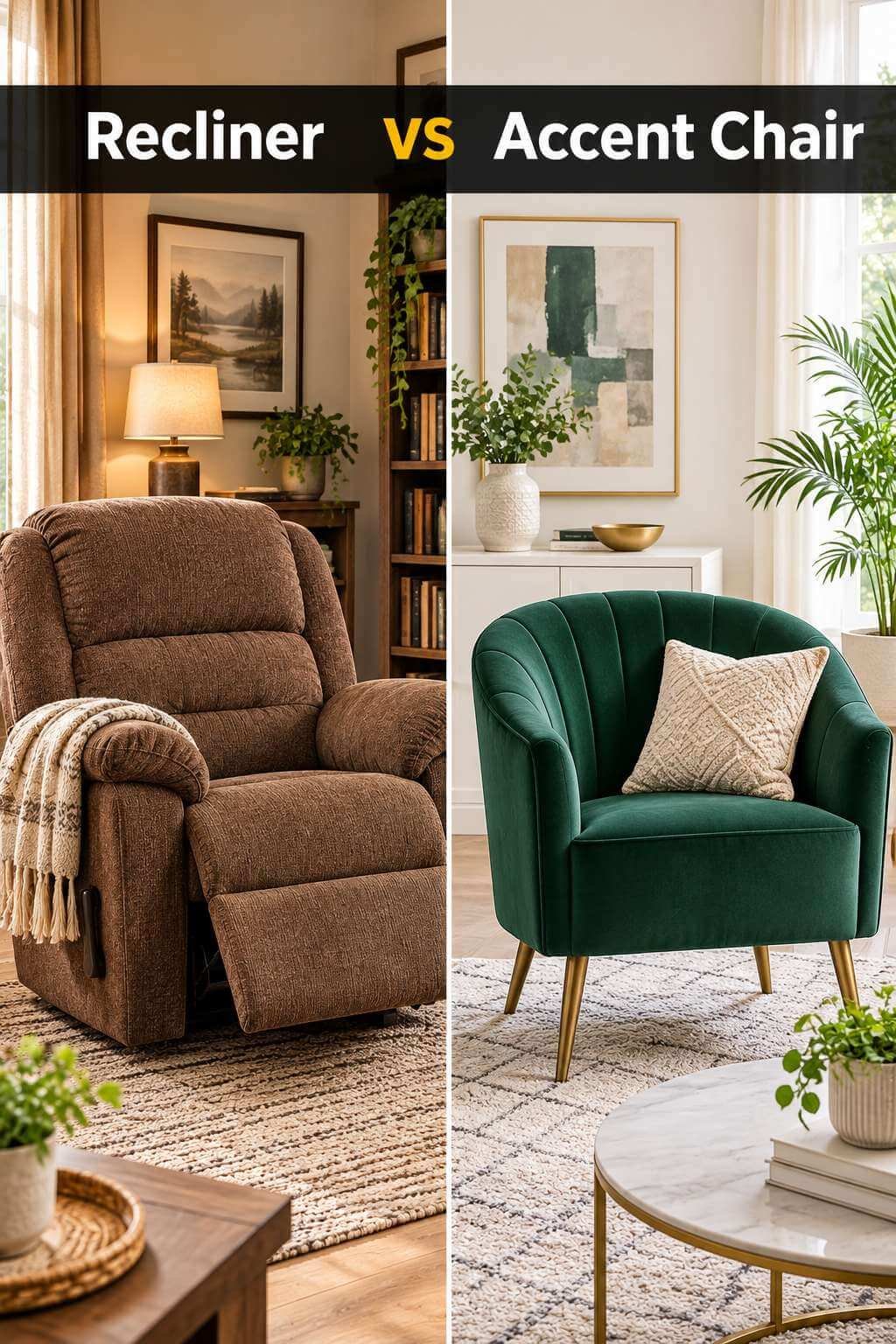
Recliner vs Accent Chair: Full Comparison
| Criteria | Recliner | Accent Chair |
|---|---|---|
| Comfort | Excellent — full recline, footrest, often power or heat/massage options | Good for short sits — supportive posture, less ideal for hours-long lounging |
| Style / Aesthetic Flexibility | Limited — bulkier shapes can clash with sleek or formal decor | High — wide range of colors, silhouettes, and fabrics to match any room |
| Space / Footprint | Large — needs 4 to 6 inches of wall clearance to recline fully | Compact — fits tight corners and rooms with no clearance to spare |
| Price Range | $300 – $2,500+ | $150 – $1,800+ |
| Maintenance | Moderate — mechanical parts may eventually need servicing | Low — mostly routine fabric or leather care |
| Durability / Lifespan | 7–15 years, depending on mechanism quality and use | 10–20+ years with a solid hardwood frame |
| Best For | Daily lounging, media rooms, long TV or reading sessions | Small spaces, formal rooms, style-first buyers |
The numbers only tell part of the story. In practice, the comfort gap is the biggest real-world difference: a recliner is built for hours of continuous sitting, while an accent chair is built for good posture during shorter stretches — reading, conversation, a quick coffee. The footprint gap matters just as much. A recliner needs real clearance behind and beside it to recline fully, which is why it struggles in small apartments and rentals, while an accent chair can sit flush against a wall and still do its job. Our small living room decor ideas has more inspiration along these same lines.
Quick Look: Recliner vs Accent Chair at a Glance
Recliner
Built for maximum comfort and full-body recline during long lounging sessions.
View on Amazon →Accent Chair
A compact, style-forward seat that upgrades a room’s look without eating up space.
View on Amazon →Deep Dive: Recliner
A recliner is the right call for anyone who spends real time in their living room chair — nightly TV, long reading sessions, or simply wanting a dedicated spot to fully unwind. It shines in media rooms, dens, and any household where comfort outranks a showroom look.
Pros
- Full recline and footrest support hours of comfortable sitting
- Many models offer power controls, heat, or massage functions
- Excellent pressure relief for backs, hips, and legs during long use
Cons
- Bulky footprint requires real wall clearance to recline
- Can look dated or out of place in formal or minimalist rooms
- Power mechanisms add long-term repair or replacement risk
Real cost range: roughly $300 to $2,500+, depending on mechanism type (manual vs power), upholstery, and brand.
Deep Dive: Accent Chair
An accent chair earns its place in small apartments, formal living rooms, and any space where style and flexibility matter more than marathon comfort. It’s the better pick for guest-facing rooms, rentals, and reading nooks that don’t need a recline function.
Pros
- Wide range of styles, fabrics, and silhouettes to match any decor
- Compact footprint fits small rooms and tight corners easily Our how to decorate living room corner guide covers this in more detail.
- Lightweight and easy to move, rearrange, or take with you when you move
Cons
- Less ergonomic support for long, hours-long sitting sessions
- No recline or footrest function for true lounging
- Lower-end models may feel firm or shallow for taller readers
Real cost range: roughly $150 to $1,800+, depending on frame construction, fabric, and designer pedigree.
Real Room Scenarios: Which One Actually Wins
Small Apartment Living Room
Accent chair wins — its compact footprint fits tight layouts without blocking walkways.
Family / Media Room
Recliner wins — built for the long TV sessions this room is designed around.
Home Office Reading Corner
Accent chair wins — upright support suits reading and short breaks better than a full recline.
Rental-Friendly Living Room
Accent chair wins — lighter, easier to move, and doesn’t need permanent wall clearance.
Formal / Luxury Living Room
Accent chair wins — a tailored silhouette reads as intentional design, not a lounge chair.
Professional Tips
Designer tie-breaker: if you truly can’t decide, measure your room’s daily traffic pattern first. Rooms people pass through often favor an accent chair; rooms people settle into favor a recliner.
Common regret mistake: buying a recliner without checking wall clearance in-store — many buyers discover only after delivery that it can’t fully recline against their wall.
Resale-value note: a well-chosen accent chair in a neutral fabric tends to hold resale value better than a recliner, which buyers often view as a personal-fit item. Our neutral living room ideas has more inspiration along these same lines.
Maintenance reality check: fabric recliners need the same vacuuming and spot-cleaning as any upholstered chair, but the reclining mechanism itself should be inspected yearly if it sees daily use.
Shop the Winner
If you’re leaning toward the recliner, here’s what to get started with:
Best Overall
A well-reviewed power recliner with a sturdy frame, easy-clean upholstery, and a reliable reclining mechanism for everyday use.
Best Budget
A manual recliner that covers the essentials — solid recline and footrest support — without the cost of power controls.
Best Premium
A top-tier power recliner with heat, adjustable lumbar support, and premium leather-look upholstery built to last for years.
If you’re leaning toward the accent chair but still want a touch of recliner-level comfort in a smaller footprint, here’s what to look at first:
Best Overall
A slim-profile power recliner designed for smaller rooms, needing less wall clearance without sacrificing recline range.
Best Budget
A compact manual recliner that fits tighter layouts while still delivering real footrest and recline support.
Best Premium
A tailored, space-saving power recliner with a wall-hugger design and upholstery that reads more like a statement chair.
Frequently Asked Questions
Is a recliner or accent chair more comfortable for everyday use?
A recliner is more comfortable for extended, everyday use because it supports full-body recline and a footrest, while an accent chair is better suited to shorter sitting sessions.
Can an accent chair recline?
Most accent chairs do not recline. A small number of hybrid models offer a slight tilt, but true full recline is a recliner-specific feature.
How much space does a recliner need behind it?
Most recliners need roughly 4 to 6 inches of clearance behind and to the side to fully recline, though wall-hugger models need less.
Are accent chairs good for back support?
Accent chairs offer solid upright support for short to moderate sitting, but they lack the adjustable lumbar and recline support a recliner provides for longer use.
What’s the average cost of a power recliner?
Power recliners typically range from about $600 to $2,500 or more, depending on brand, upholstery, and added features like heat or massage.
What’s the average cost of a good accent chair?
A solidly built accent chair typically runs from about $300 to $1,800, depending on frame quality and fabric.
Do recliners work in small apartments?
Recliners can work in small apartments, but only if you confirm wall clearance and doorway width before buying, since bulkier models struggle in tight layouts.
Which is better for a home office: recliner or accent chair?
An accent chair is generally better for a home office reading corner, since it offers upright support suited to shorter breaks rather than full recline.
Do accent chairs come in swivel styles?
Yes, swivel accent chairs are a popular style, especially in open-concept rooms where the ability to turn toward different parts of the space is useful.
How long does a recliner mechanism typically last?
A quality recliner mechanism typically lasts 7 to 15 years with regular use, though power mechanisms may need servicing sooner than manual ones.
Is a recliner a good fit for a formal living room?
A recliner is usually not the best fit for a formal living room, since its bulkier profile tends to clash with more tailored, style-focused decor.
Can you use an accent chair as your main TV-watching chair?
You can, but it won’t offer the same lounging comfort as a recliner for long sessions, since it lacks a footrest and full recline.
What’s the difference between a wingback chair and an accent chair?
A wingback chair is one specific style of accent chair, identified by its tall back and side panels, or ‘wings,’ that originally helped block drafts.
Do recliners come in fabric or only leather?
Recliners come in both fabric and leather, along with leather-look synthetic upholstery, so there’s no need to choose leather for the recline function itself.
Which is easier to move: a recliner or an accent chair?
An accent chair is easier to move, since it’s typically lighter and doesn’t include the bulkier internal mechanism found in most recliners.
Are power recliners worth the extra cost over manual recliners?
Power recliners are worth the extra cost for anyone who wants effortless one-touch adjustment, but a manual recliner delivers the same core comfort for less money.
What’s the best chair for a rental apartment?
An accent chair is usually the best fit for a rental, since it’s lighter, easier to move between apartments, and doesn’t require dedicated wall clearance.
How do I know if a recliner will fit through my doorway?
Check the recliner’s boxed or assembled width and height against your narrowest doorway and any hallway turns before ordering.
Which holds up better over time, a recliner or an accent chair?
A well-built accent chair often holds up longer overall, since it has no mechanical parts to wear out, while a recliner’s mechanism is the most common point of failure.
Should I buy a recliner or accent chair for a nursery or reading corner?
An accent chair — or a glider-style chair — is generally the better fit for a nursery or reading corner, since it supports upright posture without the bulk of a recliner.
Final Verdict
If your living room is built around long lounging sessions — a media room, a den, a household that spends real evening hours in one chair — the recliner wins. If your room is smaller, more style-driven, or guest-facing — a formal living room, a rental, a reading corner — the accent chair wins. Both are right choices for the right room; the mistake is picking based on looks alone without checking how the chair fits your actual daily habits and your actual floor plan.