


Japandi and Scandinavian design are often used interchangeably online, but stand them side by side and the differences are obvious immediately: one is warm, textured, and slightly moody; the other is bright, crisp, and unapologetically light. Scandinavian design is the older of the two, built for long Nordic winters — white walls, pale wood, and pops of cheerful color meant to maximize daylight and keep small spaces feeling open.
Japandi is the newer hybrid, blending that same Scandinavian restraint with Japanese wabi-sabi, trading some of the brightness for warmer walnut and oak tones, black accents, and a more grounded, lived-in feel. Neither style is objectively “better” — the right one depends on your light, your room size, your budget, and how cozy versus airy you actually want a space to feel. Short version: if your rooms run dark or you crave warmth, lean Japandi. If you’re working with a tight budget, a rental, or a naturally bright space, Scandinavian is usually the easier win.
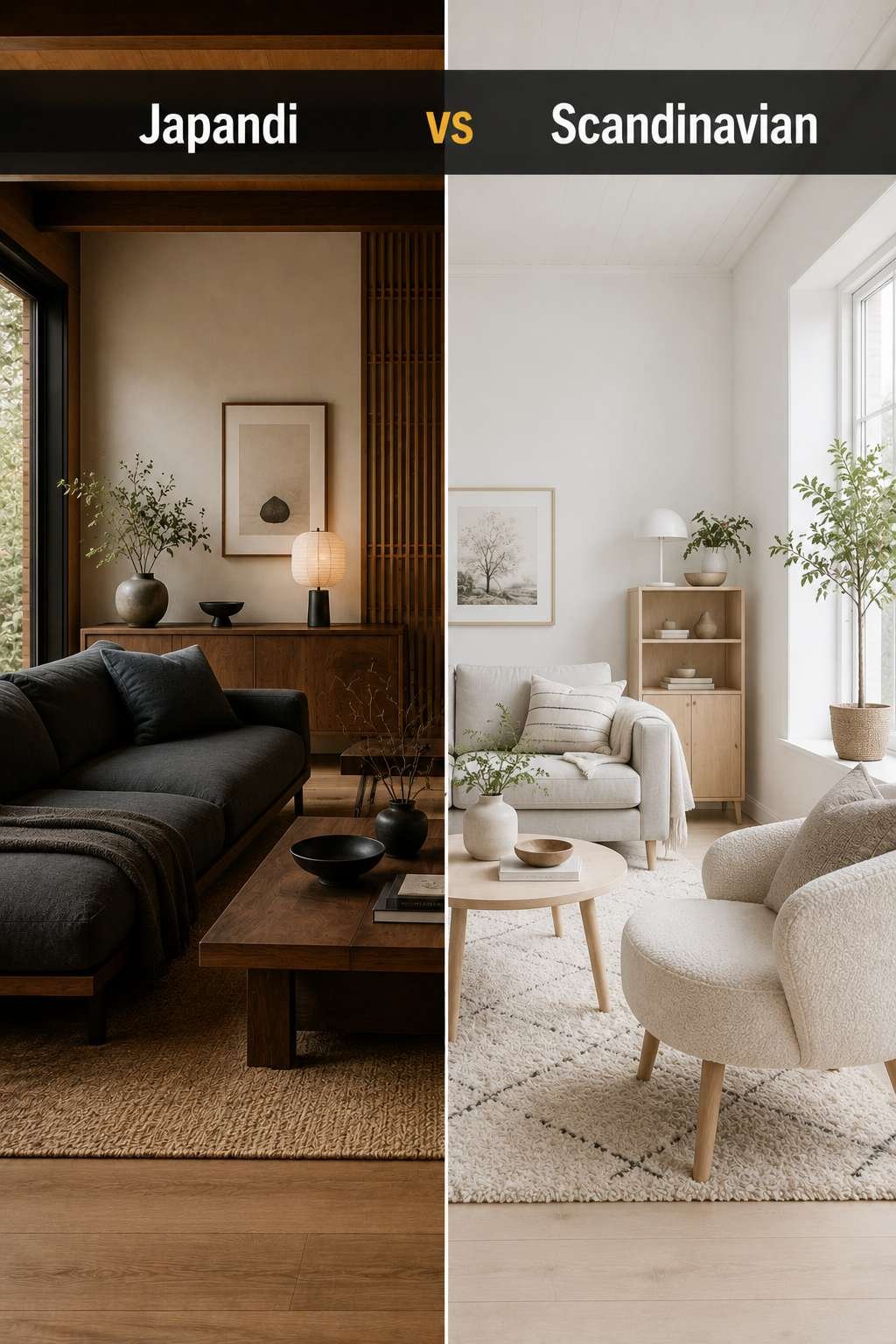
Japandi vs Scandinavian: The Master Comparison Chart
| Criteria | Japandi | Scandinavian |
|---|---|---|
| Cost to Achieve | Moderate to high — roughly $2,500 to $7,000+ per room for solid walnut or oak pieces | Low to moderate — roughly $1,200 to $4,000 per room using IKEA and mass-market retailers |
| Color Palette & Materials | Warm walnut and oak wood, black metal accents, charcoal and clay tones, linen and boucle textiles | White and off-white walls, pale ash and birch wood, cream and soft pastel textiles |
| Mood & Atmosphere | Calm, grounded, slightly moody — reads more “lived-in” than showroom | Bright, crisp, functional — reads open and airy, especially in small spaces |
| Maintenance | Moderate — dark wood hides scuffs well but shows dust and water rings more visibly | Higher — white surfaces and pale wood show scuffs, scratches, and stains more easily |
| Longevity / Trend Risk | Low — rooted in centuries-old wabi-sabi and Japanese minimalism, not a fast design fad | Moderate — the ultra-white “IKEA look” has cycled in and out of favor before |
| Resale & Buyer Appeal | Good, slightly niche — appeals strongly to design-forward buyers, less universal than Scandi | Excellent — broadly liked, low-risk for resale and rental listings |
What This Actually Looks Like in a Real Room
On paper, both styles sound similar: neutral walls, natural materials, no clutter. In person, the giveaway is temperature and contrast. Scandinavian rooms photograph almost monochrome-bright — white or off-white walls, blonde wood, and a single saturated color accent (mustard, dusty blue, forest green) doing all the visual work. Japandi rooms photograph warmer and higher-contrast — deep walnut against black metal, charcoal linen against a pale plaster wall, natural texture instead of a color pop. If a room looks like it could be in a Nordic apartment brochure, it’s Scandinavian. If it looks like a boutique ryokan crossed with a Copenhagen apartment, it’s Japandi.
Quick Look: Japandi vs Scandinavian at a Glance
Japandi
Warm, textured minimalism built on walnut wood, black accents, and Japanese wabi-sabi restraint.
View on Amazon →Scandinavian
Bright, functional Nordic minimalism built on white walls, pale wood, and everyday livability.
View on Amazon →Deep Dive: Japandi
Japandi is the better fit for low-light rooms, home offices and reading nooks that need warmth, buyers who want a space that feels grounded rather than sparse, and anyone renovating for the long term rather than chasing a fast trend.
Pros
- Warm tones hide daily wear — scuffs, pet hair, fingerprints — better than white surfaces
- Rooted in a genuinely old design tradition, so it resists feeling dated
- Natural materials like solid wood, linen, and stone tend to be higher quality and longer-lasting
- Works especially well in rooms with limited natural light, where all-white can feel flat
Cons
- Solid walnut or oak furniture costs meaningfully more than mass-market pale wood pieces
- Can tip into feeling heavy or “cave-like” if every material is dark with no contrast
- Fewer budget-friendly, ready-to-ship furniture options than Scandinavian mass retailers
- A half-hearted attempt can just look like plain brown furniture, not a designed room
Real cost range: Expect roughly $2,500–$7,000+ to furnish a single living room in genuine Japandi style, depending on how much solid wood versus veneer you use and whether you buy new or vintage. Our guide on how to decorate entrance of home walks through this step by step.
Deep Dive: Scandinavian
Scandinavian is the better fit for small apartments and studios that need to feel bigger, rentals where a big investment isn’t worth it, bright rooms with plenty of natural light, and first-time furnishing on a tighter budget.
Pros
- Widely available at every price point, especially through IKEA and other mass retailers
- Makes small or dim-adjacent rooms feel more open thanks to the light palette Our guide on how to make your room cute walks through this step by step.
- Broadly appealing style with strong resale and rental-listing value
- Easy to execute “well enough” even with budget furniture — the formula is forgiving
Cons
- Can read cold or sterile without deliberate warm accents like wood, texture, and plants
- White walls and pale wood show scuffs, scratches, and stains more visibly over time
- The ultra-white “catalog” version of the look has cycled in and out of style before
- Needs more frequent refreshing — repainting trim, replacing worn textiles — to stay crisp
Real cost range: Expect roughly $1,200–$4,000 to furnish a single living room in Scandinavian style using a mix of IKEA and mid-range retailers, less if you shop secondhand.
Which Style Wins Your Room?
Small Apartment / Studio
Scandinavian’s light palette visually expands a compact footprint.
Scandinavian winsBudget Renovation
Mass-market pale wood and white paint get you most of the look for less.
Scandinavian winsLuxury Whole-Home Build
Solid walnut millwork and considered materials read as custom and expensive.
Japandi winsRental-Friendly
Light, removable furniture and decor work around a rental’s white walls.
Scandinavian winsFamily / High-Traffic Household
Warmer, darker tones hide everyday scuffs, spills, and wear far better.
Japandi winsProfessional Tips & Common Regrets
Designer tie-breaker
Before committing, buy one real wood sample and one fabric swatch in your chosen style and hold them in your room at different times of day — Japandi’s walnut tones and Scandinavian’s pale ash can both look different than expected under your specific light. Our how to find your home decor style guide covers this in more detail.
The most common regret
It isn’t picking the wrong style — it’s committing halfway. An all-white room with zero warm accents reads sterile; an all-brown room with zero contrast reads heavy. Both styles need at least one deliberate contrast element — black metal in Japandi, a saturated color pop in Scandinavian — to actually work.
Resale-value note
If resale or rental turnover is a priority, Scandinavian’s broad appeal is the safer bet. Japandi appeals strongly to a design-forward buyer but is a narrower audience.
Maintenance reality-check
Neither style is as low-maintenance as “minimalist” implies — Scandinavian’s pale surfaces show every scuff, and Japandi’s matte black accents show every fingerprint and dust speck. Budget for upkeep either way.
Shop the Winner: Coffee Tables for Either Style
If you’re leaning toward Japandi, here’s what to get started with
Best Overall
A low, round solid walnut coffee table with visible natural wood grain and gently rounded edges.
Best Budget
A walnut-finish veneer coffee table from a mass retailer that mimics the tone without the solid-wood price.
Best Premium
A handcrafted solid wood coffee table paired with matte black metal legs for a higher-end, designer look.
If you’re leaning toward Scandinavian, here’s what to get started with
Best Overall
A round pale ash wood coffee table with simple turned legs, easy to fit into almost any small living room.
Best Budget
An IKEA-style light wood coffee table that delivers the core look at an accessible price point.
Best Premium
A Scandinavian design-house coffee table in solid oak or birch, built to last well beyond trend cycles.
For the full breakdown of specific picks, see our full Best Coffee Tables for Japandi & Scandinavian Homes guide.
See Our Full Coffee Table Guide →Frequently Asked Questions
What is the main difference between Japandi and Scandinavian design?
Scandinavian design uses white walls, pale wood, and bright color accents for an airy, functional look, while Japandi blends that same minimalism with Japanese wabi-sabi, using warmer walnut tones, black accents, and more texture for a cozier feel.
Is Japandi more expensive than Scandinavian style?
Generally yes. Japandi typically relies on solid walnut or oak furniture, which costs more than the pale, mass-market wood used in most Scandinavian pieces, so a full room usually runs higher in Japandi.
Can I mix Japandi and Scandinavian in the same home?
Yes, and many designers recommend it. A common approach is a Scandinavian base of white walls and pale wood, layered with Japandi’s black accents and one or two solid walnut furniture pieces.
Which style works better in a small apartment?
Scandinavian usually wins for small spaces because its light palette visually expands a compact room, while Japandi’s warmer, higher-contrast tones can make a tiny space feel more enclosed.
Does Scandinavian design feel cold or sterile?
It can, if executed without any warm accents. Adding natural wood texture, plants, and at least one saturated color pop keeps a Scandinavian room from feeling like an empty showroom.
What wood tones are used in Japandi vs Scandinavian?
Japandi favors darker, warmer woods like walnut and oak. Scandinavian favors pale, cooler-toned woods like ash and birch.
Is Japandi just a trend, or will it last?
Japandi draws on centuries-old Japanese wabi-sabi principles rather than a fast fashion cycle, so it carries lower trend risk than a purely aesthetic microtrend, though the specific “Japandi” label as marketed is newer.
What colors define a Scandinavian palette?
White and off-white walls, pale wood tones, and a single accent color such as mustard, dusty blue, or forest green.
What colors define a Japandi palette?
Warm walnut and oak browns, matte black, charcoal, and soft clay or stone tones, usually without a bright accent color.
Which style is better for a home office?
Japandi tends to suit a home office well, since its warmer, more grounded feel supports focus, especially in rooms with less natural light.
Can I achieve either look with IKEA furniture?
Scandinavian, easily — IKEA’s core catalog is built around that look. Japandi is harder to fully achieve with IKEA alone, since true Japandi relies on solid darker woods that mass retailers stock less of.
Which style is more family- and pet-friendly?
Japandi generally hides everyday wear better, since its warmer, darker tones camouflage scuffs, pet hair, and fingerprints more effectively than Scandinavian’s pale surfaces.
Does Japandi work in a bright, sunny room?
Yes — a bright room actually balances Japandi’s warmer tones nicely, preventing the space from feeling too dark or heavy.
Does Scandinavian design work in a low-light room?
It can feel flat or cold in a low-light room, since the style depends heavily on natural daylight to read as bright rather than plain white.
What’s the difference between Japandi and wabi-sabi?
Wabi-sabi is a broader Japanese philosophy of embracing imperfection and impermanence. Japandi is a specific interior design style that borrows wabi-sabi principles and blends them with Scandinavian minimalism.
How do I add warmth to a Scandinavian room?
Layer in natural wood texture, woven or jute textiles, warm lighting, and plants — small additions that soften the palette without abandoning the style.
How do I avoid an overly dark Japandi room?
Balance dark walnut and black accents with a lighter wall color, natural light, and at least one lighter textile, like a cream linen cushion or a pale rug.
Which style has better resale and broad buyer appeal?
Scandinavian generally has broader, safer resale appeal, since its bright, neutral look suits more buyer tastes than Japandi’s more specific, design-forward aesthetic.
What furniture pieces best signal each style?
A low, round walnut coffee table with black metal legs signals Japandi. A light ash or birch coffee table with simple turned legs signals Scandinavian.
Which style is easier to maintain long-term?
Neither is truly low-maintenance — Scandinavian’s pale surfaces show scuffs more visibly, while Japandi’s matte black accents show fingerprints and dust more easily.
The Verdict
If you had to pick blind: choose Scandinavian if you’re on a budget, in a rental, or furnishing a small or naturally dark space that needs more brightness. Choose Japandi if you have a bit more budget, a family or pet-heavy household that needs to hide wear, or a space with good natural light where warmth won’t feel heavy.
If you genuinely can’t decide, start with a Scandinavian base — white walls, pale wood — and layer in Japandi’s black accents and one or two solid walnut pieces. That combination, sometimes called “Japandi-Scandi” by designers, gives you the brightness of one style with the warmth of the other, and it’s far easier to walk back than starting fully committed to either extreme.

