If you’re standing in the shelving aisle trying to decide between floating shelves and brackets, the honest answer is that neither one is “better” in every situation — they’re built for different jobs. Floating shelves win on clean, minimalist looks and hidden hardware, while brackets win on raw strength, price, and how forgiving they are for a first-time DIYer. Below, we break down real cost ranges, weight limits, and five actual room scenarios so you can pick the option you won’t regret in a year, not just the one that looks nicest in a photo.
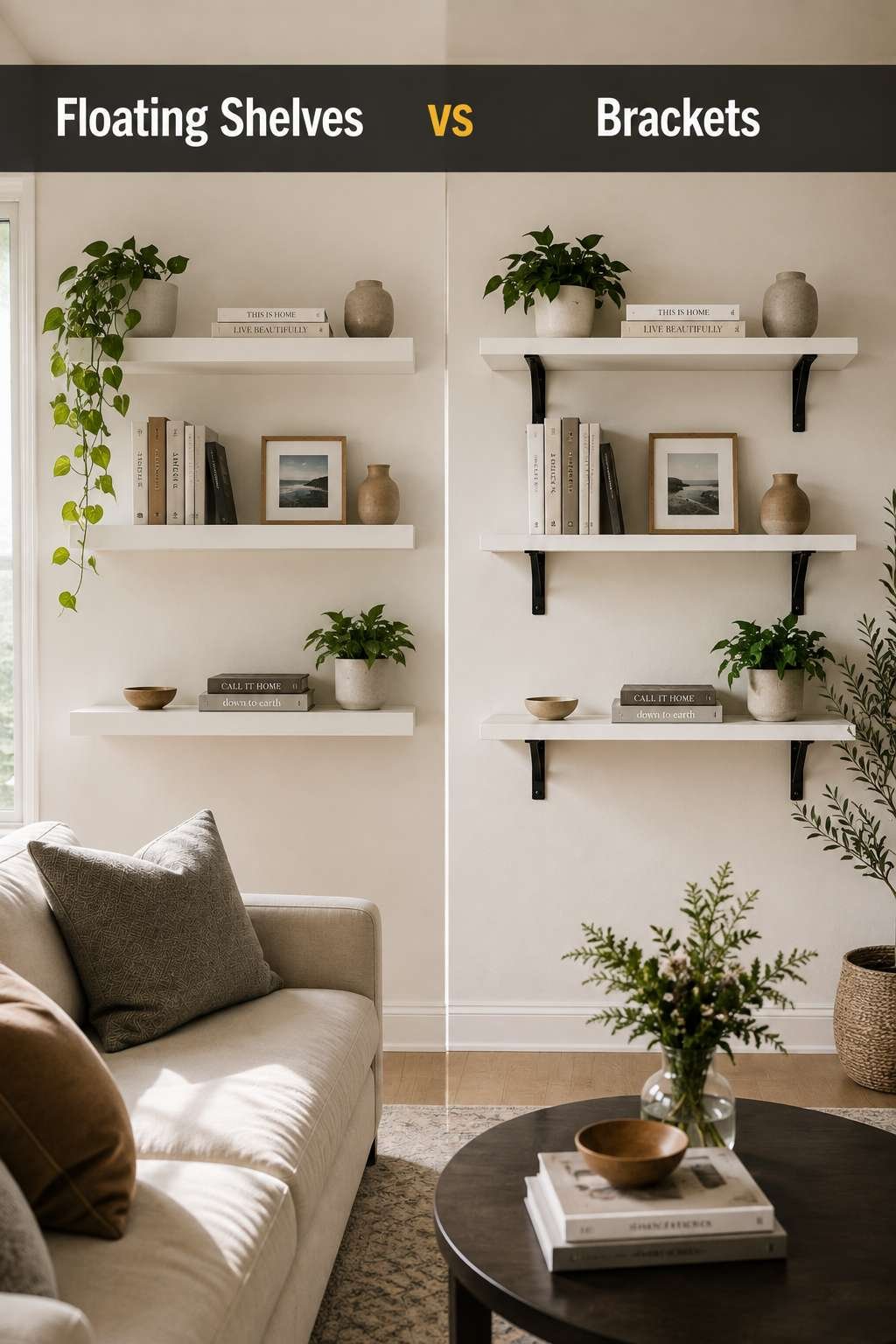
Floating Shelves vs Brackets: The Full Comparison
| Criteria | Floating Shelves | Brackets |
|---|---|---|
| Cost | $25–$120 per shelf, installed | $10–$40 per shelf, installed |
| Weight Capacity | 15–50 lbs per shelf (more with studs and heavy-duty anchors) | 30–75+ lbs per shelf, depending on bracket size |
| Installation Difficulty | Moderate to hard — needs precise leveling and often a stud or heavy-duty anchor | Easy — level, mark, screw in; forgiving for beginners |
| Aesthetic Flexibility | Sleek and minimalist; hardware stays hidden | Traditional to industrial; hardware is part of the look |
| Wall Damage & Reversibility | Larger mounting footprint; more work to patch invisibly | Small screw holes; quick and easy to patch |
| Versatility | Fixed once mounted; not easy to resize or move | Easy to add, remove, or reposition shelves later |
In practice, those numbers translate to real differences you’ll notice at home. A “15–50 lbs” floating shelf rating means it’s fine for a row of paperbacks, framed photos, or a small plant, but it starts to strain under a stack of hardcover cookbooks or a collection of vinyl records. Bracket shelves rated at “30–75+ lbs” have enough margin to hold cast-iron pans, a small TV, or a full shelf of textbooks without a second thought. The “installation difficulty” gap matters too — floating shelves punish an unlevel first attempt because the hardware disappears inside the wall, while a slightly crooked bracket is an easy five-minute fix. Our guide on how to style dining room shelves walks through this step by step.
Quick Look: Floating Shelves vs Brackets at a Glance
Floating Shelves
Seamless, hidden-hardware look that suits minimalist and modern rooms — best when mounted into studs.
View on Amazon →Brackets
Budget-friendly, fast to install, and strong enough for heavy everyday items in kitchens and garages.
View on Amazon →Floating Shelves: Is This the Right Choice for You?
Floating shelves are the right call when the wall itself is meant to look uncluttered — a gallery wall, a styled living room corner, a nursery where you don’t want sharp visible hardware. They’re at their best in stud-mounted installs holding light-to-moderate loads: books, framed art, plants, and small decor. Real cost range: $25–$120 per shelf, installed, depending on size, wood finish, and whether you spring for a heavy-duty rail kit. Our how to decorate a kitchen shelf guide covers this in more detail.
Pros
- Clean, seamless look with no visible mounting hardware
- Fits minimalist, modern, and Scandinavian-style rooms
- Available in enough finishes to blend into almost any wall
- Feels more “built-in” than an obviously hardware-mounted shelf
Cons
- Needs precise, level installation — mistakes are hard to hide
- Weaker without a stud or heavy-duty anchor
- Larger wall footprint makes patching harder when you move out
- Costs more per shelf than a comparable bracket setup
Brackets: Is This the Right Choice for You?
Brackets are the right call when strength, speed, or budget matters more than a hidden-hardware look — a kitchen holding cast iron, a garage wall of storage bins, or a first apartment where you want shelving up in an afternoon without overthinking it. Real cost range: $10–$40 per shelf, installed, with heavy-duty or decorative finishes landing at the higher end.
Pros
- Higher weight capacity for the same shelf size
- Fast, forgiving install — great for shelving beginners
- Easy to add, remove, or reposition later
- Lower cost per shelf
Cons
- Visible hardware can clash with a minimalist aesthetic
- Cheap or mismatched brackets can look dated fast
- Takes up slightly more visual “weight” on the wall
- Decorative or heavy-duty finishes narrow the savings gap
Which Wins in Your Room? 5 Real Scenarios
Small Bathroom / Entryway
Tight space, light loads — towels, toiletries, keys, a small tray.
Winner: Floating ShelvesBudget DIY Living Room
First shelving project, tight budget, want it up fast and level.
Winner: BracketsHeavy-Duty Kitchen / Garage
Cast iron, storage bins, tools — real weight, every day.
Winner: BracketsRental Apartment
Light loads, low commitment, needs to patch invisibly at move-out.
Winner: Floating Shelves (light-duty)Minimalist Gallery Wall
Design-forward display shelving where hidden hardware is the whole point.
Winner: Floating ShelvesDesigner Tips & Common Regret Mistakes
- The #1 regret: hanging a floating shelf into drywall alone and loading it with hardcovers. If it’s not going into a stud, keep it decorative-weight only.
- Mixed hardware is fine: designers often use brackets in kitchens and utility spaces, then switch to floating shelves in living areas — you don’t have to pick one style for the whole home. Our guide on how to decorate open kitchen shelves walks through this step by step.
- Resale/rental reality check: whichever style you choose, the size of the hole matters more than the style itself when it’s time to patch and repaint.
- Bracket finish matters: matte black or brass brackets read as intentional design; mismatched leftover hardware is what makes brackets look dated.
Shop the Winner
If you’re leaning toward Floating Shelves, here’s what to get started with:
Best Overall
A mid-size stud-mount floating shelf kit with a full internal steel rail, built for everyday decor and light books.
Best Budget
A compact floating shelf with basic hollow-wall anchors, ideal for a small entryway or bathroom.
Best Premium
A heavy-duty floating shelf kit with a reinforced rail rated for higher weight loads and a solid wood finish.
If you’re leaning toward Brackets, here’s what to get started with:
Best Overall
A matte black L-bracket set sized for standard 8–10 inch shelving, strong enough for daily kitchen use.
Best Budget
A simple steel bracket and board combo kit, ready to hang with just a level and a drill.
Best Premium
A decorative brass or industrial-finish bracket set built as a visible design feature, not just a support.
For the full breakdown of specific hardware kits, see our full Best Shelf Brackets & Floating Shelf Hardware guide.
See the Full Buying Guide →Frequently Asked Questions
Are floating shelves stronger than brackets?
Generally no. A bracket shelf spreads weight across two visible support arms, so it typically holds more per shelf than a floating shelf of the same size. Floating shelves can get close to bracket-level strength, but only when mounted into wall studs with the internal rail hardware fully secured.
How much weight can a floating shelf hold?
Most floating shelves hold 15 to 50 pounds per shelf when mounted correctly. Anchored into studs with a full-length internal rail, some heavy-duty kits can hold more; mounted into hollow drywall with anchors alone, expect the lower end of that range.
How much weight can bracket shelves hold?
Standard L-brackets typically hold 30 to 75 pounds or more per shelf, since the load sits directly on top of two solid metal arms instead of relying on a hidden internal rail. Heavier-duty brackets rated for garage or kitchen use can hold even more.
Do floating shelves need to be mounted into studs?
For anything beyond light decor, yes. Floating shelves rely on their internal rail gripping the wall, so mounting into at least one stud dramatically increases how much weight they can safely hold. Without a stud, you’re limited to heavy-duty hollow-wall anchors and lighter loads.
Can I install floating shelves without studs?
Yes, using rated toggle or heavy-duty hollow-wall anchors, but plan on lighter loads, roughly 10 to 20 pounds, and always check the anchor’s own weight rating before hanging anything.
Are floating shelves safe for heavy books?
Only if they’re stud-mounted or rated for heavy loads. A full row of hardcover books can easily weigh 30 pounds or more, which is at the upper limit of many standard floating shelf kits, so a heavy-duty kit or bracket shelf is the safer bet for a real bookshelf.
What’s cheaper, floating shelves or brackets?
Brackets are almost always cheaper. A basic bracket shelf setup runs about $10 to $40 per shelf, while floating shelf kits with their internal hardware typically run $25 to $120 per shelf depending on size and finish.
Do brackets look outdated?
Not anymore. Decorative metal brackets in matte black, brass, or industrial finishes are back as an intentional design feature in modern and transitional rooms. Visible hardware only reads as dated when it’s mismatched or overly ornate for the room’s style.
Are floating shelves harder to install than bracket shelves?
Generally yes. Floating shelves require precise level marking for the internal rail, hidden fasteners, and often stud location, while bracket shelves just need each bracket leveled and screwed to the wall, which is faster and more forgiving for a first-time DIYer.
Can renters install floating shelves without damaging walls?
Small, lightweight floating shelves can be hung with removable, damage-free mounting strips rated for a few pounds. For anything heavier, floating shelves still require drilling, so renters worried about wall damage should treat this as a case-by-case decision based on the shelf’s weight and the landlord’s rules.
Do bracket shelves damage walls more than floating shelves?
Usually less. Brackets need small screw holes that are easy to patch and repaint in minutes, while floating shelves often need a larger cutout or multiple anchor points for the internal rail, which takes more work to patch invisibly when you move out.
Which is better for a kitchen, floating shelves or brackets?
Brackets generally win for kitchen storage since they hold cookware, dishes, and jars more reliably. Floating shelves work well in a kitchen for lighter, decorative styling, like a few mugs or cookbooks, but aren’t the first choice for heavy daily-use items.
Which is better for a garage, floating shelves or brackets?
Brackets are the better fit for garage storage. Garages typically store heavier, bulkier items like tools and paint cans, and heavy-duty brackets are built to handle that load more consistently than most floating shelf kits.
Can I use floating shelves in a bathroom?
Yes, floating shelves work well in bathrooms for towels, toiletries, and small decor, since bathroom loads are usually light. Choose a moisture-resistant finish and, if the bathroom is humid, check that the internal hardware is rust-resistant.
How do I know if my wall can support a floating shelf?
Use a stud finder to locate at least one wall stud within the shelf’s mounting span. If no stud lines up, choose a floating shelf kit rated for hollow-wall anchors and stay within its published weight limit rather than guessing.
What tools do I need to install brackets?
A drill, a level, a pencil, a stud finder, and the mounting screws included with the brackets. Most bracket installs take under 30 minutes once the wall is marked and leveled.
What tools do I need to install floating shelves?
A drill, a level, a stud finder, a pencil, and either wall anchors or the lag screws needed to secure the internal rail into studs. Some kits also include a paper mounting template to speed up marking the holes.
Do floating shelves sag over time?
They can, especially if they were mounted into drywall anchors instead of studs, or if the shelf is consistently loaded near its maximum weight rating. Stud-mounted floating shelves within their rated load hold up well over time.
Can bracket shelves be adjusted or moved easily?
Yes, that’s one of their biggest advantages. Because the brackets are visible and separately mounted, you can unscrew and reposition them, add more shelves, or swap the shelf board itself without redoing the entire wall mount.
Which shelving style adds more resale value to a home?
Neither adds meaningful resale value on its own, since shelving is a cosmetic detail rather than a structural upgrade. What matters more to buyers is that the installation looks clean and intentional and that any wall damage from removed hardware has been properly patched.
The Verdict
Choose floating shelves if: you want a minimalist, design-forward look, you’re mounting into studs, and your load is books, decor, or plants rather than heavy cookware. This is the right call for gallery walls, bathrooms, entryways, and design-conscious living rooms.
Choose brackets if: you want the strongest option for the lowest cost, you’re a first-time DIYer, or the shelf needs to hold real weight in a kitchen or garage. This is the right call for budget renovations, heavy storage, and anywhere speed and strength matter more than hiding the hardware.
If you’re still torn, default to brackets — they’re cheaper, stronger, and easier to redo later if you decide you want the floating look once you’ve settled into the space.