


A small bedroom doesn’t have to feel cramped, cluttered, or impossible to keep tidy. Most small bedrooms aren’t actually short on storage — they’re short on a system. This checklist walks through every part of organizing a compact bedroom, starting with the decluttering pass most guides skip and ending with the small daily habits that keep the room from sliding back into chaos.
Whether you’re working with a studio apartment, a shared kids’ room, a dorm room, or a guest bedroom that’s doing double duty, the same core moves apply: clear out what doesn’t belong, claim your vertical space, choose furniture that pulls double duty, and give every item a specific home. Work through the checklist zone by zone rather than trying to tackle the whole room at once — a small bedroom is forgiving that way. By the end, you’ll have a room that not only looks organized but actually stays that way, because the system fits how you really live in the space, not just how it looks on moving day.
Declutter & Sort First
Start with a completely bare room. You can’t see what storage you actually need until every item is out in the open.
Anything that belongs in another room, like kitchen mugs or bathroom items, goes in the relocate pile right away so it stops taking up bedroom space.
If you haven’t worn it in the last twelve months and it isn’t seasonal or sentimental, it’s a strong donate candidate.
Keepsakes take the most emotional bandwidth to sort, so tackle practical categories first and save these for when you’re not rushed.
A cluttered floor makes even a well-organized room look chaotic, and you need the open space to test furniture placement.
For items you’re unsure about, box them and set a reminder. If you haven’t reached for anything after a month, donate the box unopened.
Maximize Vertical Space
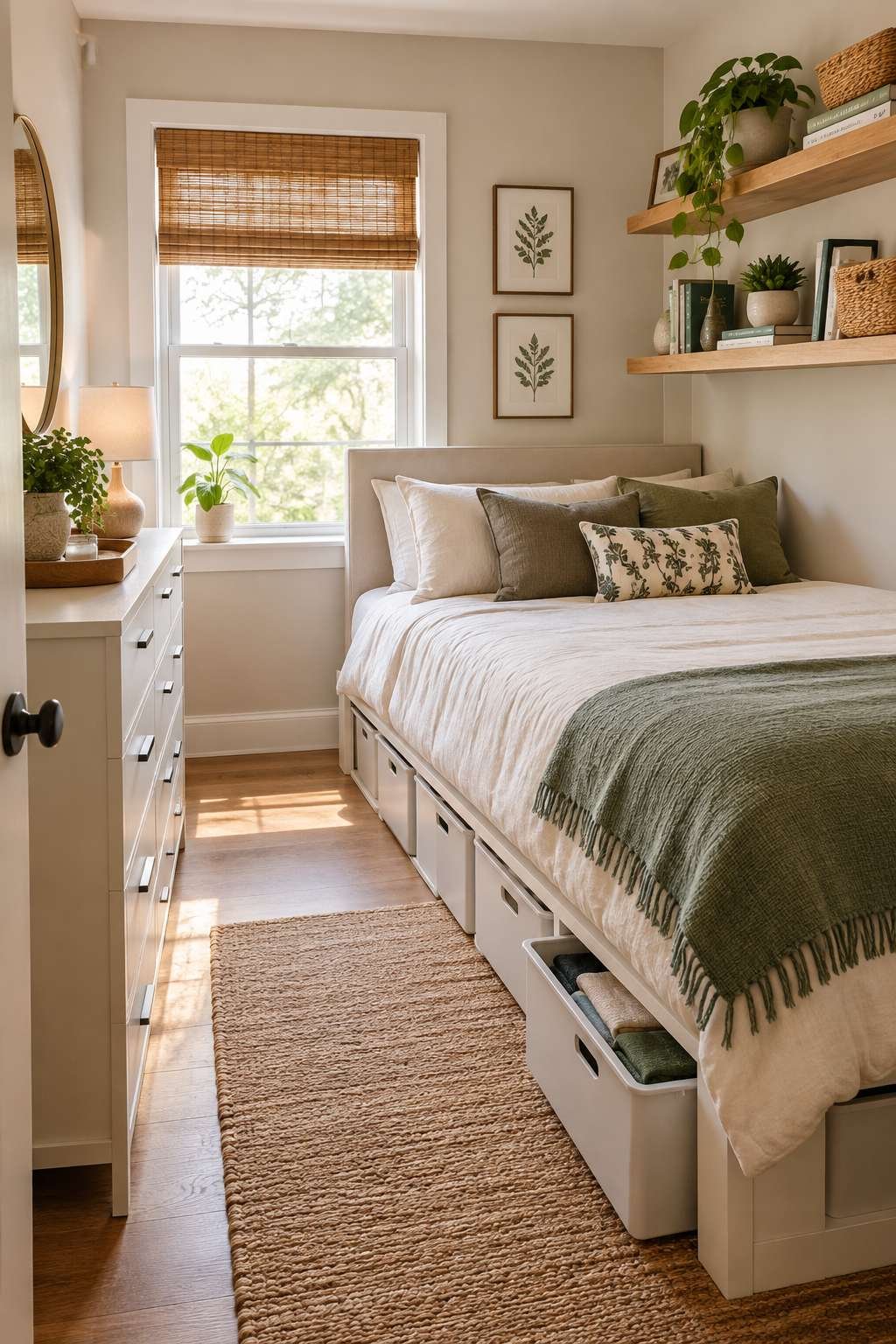
The wall space above a dresser or desk is almost always empty in a small bedroom, and a shelf adds storage without using any floor space.
A tall, narrow bookshelf uses vertical footage instead of floor footage and works for books, folded clothes, or bins.
The back of the bedroom door is unused real estate that’s perfect for shoes, accessories, or cleaning supplies.
Bags, jewelry, hats, and scarves stay visible and off the dresser top when hung on a pegboard near the closet.
A tall six-drawer dresser holds the same amount as a wide one while using a fraction of the floor space.
Corners are almost always wasted space in a small bedroom; a floating corner shelf turns dead space into storage or display.
Smart Furniture & Storage Solutions
Use it as a footrest, extra seating, and hidden storage for blankets or off-season clothing, all in one piece.
A platform bed with drawers can replace a dresser entirely in especially tight rooms.
A few extra inches under the bed frame turns unusable low clearance into room for flat storage bins.
Look for a dresser that’s narrow front-to-back with drawers stacked vertically rather than spread wide.
If the bedroom also functions as an office or guest space, a daybed frees up floor space during the day.
A desk that folds flat against the wall when it’s not in use reclaims floor space instantly.
Visible floor space beneath furniture reads as more room to the eye, even when the storage volume stays the same.
Closet Organization
Splitting one rod into two levels roughly doubles hanging capacity for shirts, folded pants, and skirts.
Dividers keep stacked sweaters and folded items from toppling into one leaning pile.
Slim hangers take up less rod space than bulky plastic ones and make a closet look tidier almost instantly.
A hanging pocket organizer keeps shoes off the closet floor, freeing that space for bins or bags.
Use the shelf above the hanging rod for labeled bins instead of a loose pile of out-of-season items.
This isn’t just visual — it makes items dramatically faster to find, which is what keeps a closet organized long-term.
Under-Bed & Hidden Storage
Low-profile bins with lids keep off-season clothing or extra linens dust-free and out of sight.
Comforters, winter coats, and extra pillows compress down to a fraction of their size for easy under-bed storage.
Drawers on casters make it easy to access under-bed storage without dragging bins out by hand.
A simple bed skirt hides bins and boxes completely, keeping the room looking finished even with storage underneath.
A flat zippered garment bag protects sheets and towels from dust better than an open bin does.
Nightstand & Surface Organization
A small floating shelf beside the bed frees up the floor space a traditional nightstand would take up.
A small tray or clip-in organizer keeps phone and lamp cords from turning into visual clutter.
Confining rings, glasses, and lip balm to one tray keeps the whole surface from creeping into clutter.
Even a single nightstand drawer benefits from small dividers so items don’t turn into one jumbled pile.
A simple cap, like a lamp, a book, and a glass of water, keeps every flat surface from becoming a catch-all.
Final Styling & Maintenance
Labels mean anyone in the household can put things back correctly, which is what actually keeps a system working.
A short weekly reset, putting stray items back in their assigned home, prevents small piles from becoming a full re-declutter.
A mirror reflects light and visually doubles the sense of space, especially when placed opposite a window.
Rotate off-season clothing between the closet and under-bed storage a couple of times a year so the closet never has to hold a full wardrobe at once.
Revisit the keep-and-donate sort every three months; a small bedroom fills back up faster than a large one.
Pro Tips
- Measure your room and every piece of furniture before you buy a single organizer — guessing is the fastest way to end up with bins that don’t fit.
- Use a one-in, one-out rule for clothing so the closet never creeps back to its original volume.
- Choose storage furniture close to your wall color so pieces visually recede instead of adding visual weight.
- Store your least-used items in the hardest-to-reach spots, highest shelves or the back of under-bed bins.
- Keep a donate box in the closet year-round so decluttering becomes an ongoing habit instead of a once-a-year event.
- Use clear bins wherever possible so you can identify contents without opening or unstacking anything.
- Hang curtains close to the ceiling rather than at the window frame to draw the eye upward and make the room feel taller.
- Stick to light, uncluttered bedding to keep the largest surface in the room feeling open rather than busy.
- Favor wall sconces over table lamps when possible; they light the room without eating into nightstand or surface space.
- Keep a clear path from the door to the bed at all times — a blocked walkway makes even a tidy room feel cramped.
- Use the inside of your closet doors before buying additional furniture; it’s free storage most people overlook.
- Digitize paperwork and documents instead of keeping physical files in a bedroom that has no room to spare.
Common Mistakes
- ×Organizing before decluttering. Buying bins for things you don’t actually need just relocates the clutter. Sort first, organize second.
- ×Buying storage before measuring. A bin that doesn’t fit under the bed or on the closet shelf is money and effort wasted. Measure first.
- ×Overloading vertical shelves. A wall of packed shelves reads as clutter too; leave breathing room so the eye has somewhere to rest.
- ×Ignoring the closet’s top shelf and ceiling space. This is usually the single most underused storage zone in a small bedroom.
- ×Choosing bulky furniture over multi-functional pieces. A single-purpose armchair uses the same floor space a storage ottoman could use twice as well.
- ×Skipping labels. An unlabeled bin system quietly falls apart within a few weeks because no one remembers what goes where.
- ×Keeping “maybe” items indefinitely. Without a firm date to revisit them, maybe boxes tend to become permanent storage for things you don’t use.
- ×Blocking natural light with tall furniture. Placing a tall dresser in front of a window makes the whole room feel smaller and darker.
- ×Letting the nightstand become a catch-all. It’s the surface closest to hand, so it’s also the first one to collect clutter if there’s no limit in place.
- ×Never revisiting the system. A setup that worked perfectly at move-in can quietly stop working after a season or two without a quick check-in.
Supplies & Tools
Get the Free Printable
Want to run through this whole process without scrolling back and forth? The free printable checklist condenses all 40 steps into a single one-page, checkbox-only version you can print and stick on the fridge or closet door while you work.
Download the Free Printable Small Bedroom ChecklistFrequently Asked Questions
How do I organize a small bedroom with no closet?
Replace the closet’s function with a freestanding wardrobe, an open clothing rack paired with matching hangers, and vertical wall storage such as floating shelves or pegboards. Keep the rack narrow and place it against the tallest available wall so it reads as furniture rather than clutter.
What’s the best storage furniture for a small bedroom?
Look for furniture that does double duty: a storage ottoman, a bed frame with built-in drawers, and a tall narrow dresser instead of a wide low one. Furniture with visible legs also helps the room feel less crowded even when it holds the same amount of stuff.
How much does it cost to organize a small bedroom?
A basic refresh using bins, dividers, and an over-door organizer typically runs $50 to $150. Adding new storage furniture, such as a storage ottoman or under-bed drawers, usually pushes the total closer to $150 to $300.
Where should I start when organizing a small bedroom?
Start by emptying every drawer, shelf, and closet section completely and sorting everything into keep, donate, trash, and relocate piles. Organizing before decluttering is the most common reason small bedroom projects stall halfway through.
How can I make a small bedroom feel bigger?
Use vertical storage instead of wide furniture, add a large mirror opposite a window, choose furniture with visible legs, and keep the floor as clear as possible. Light, uncluttered surfaces also make a noticeable visual difference.
What’s the best way to store clothes in a small bedroom?
Combine a double-hang closet rod, slim matching hangers, and under-bed bins for off-season pieces. Vacuum-sealed bags work well for bulky items like winter coats and comforters that would otherwise eat up drawer space.
Should I get rid of my dresser in a small bedroom?
Not necessarily, but swapping a wide, low dresser for a tall, narrow one usually frees up meaningful floor space while holding the same amount of clothing. If floor space is extremely limited, a bed frame with built-in drawers can replace a dresser entirely.
How often should I reorganize a small bedroom?
Plan on a quick weekly reset to put stray items back where they belong, plus a deeper seasonal swap two to four times a year to rotate clothing and check whether storage bins still make sense.
What’s the biggest mistake people make organizing a small bedroom?
Buying storage bins and furniture before decluttering or measuring the space. It’s far more effective to clear everything out, sort it, and measure exactly what’s left before purchasing a single organizer.
Can I organize a small bedroom on a budget?
Yes. Decluttering itself is free and usually has the biggest visual impact. From there, budget-friendly tools like closet dividers, stackable bins, and an over-the-door organizer cover most of the remaining gap for under $100.
Bottom line: a small bedroom doesn’t need a renovation to feel calm and functional — it needs a system that matches how you actually use the space. Work through each zone, give every item a home, and build in a five-minute weekly reset so the work you did today doesn’t unravel in a month. Small rooms respond fast to small, consistent effort.

