


Choosing between a wood deck and a composite deck comes down to one real trade-off: pay less upfront and commit to yearly upkeep, or pay more upfront and spend the next few decades barely thinking about it. Wood decking tends to suit budget-conscious homeowners and anyone who loves the natural, ages-into-character look of real lumber. Composite decking tends to suit busy households, rental properties, and anyone who wants a deck that still looks new a decade from now without a maintenance ritual. Here’s the full breakdown, real cost ranges, and our final verdict for each type of homeowner.
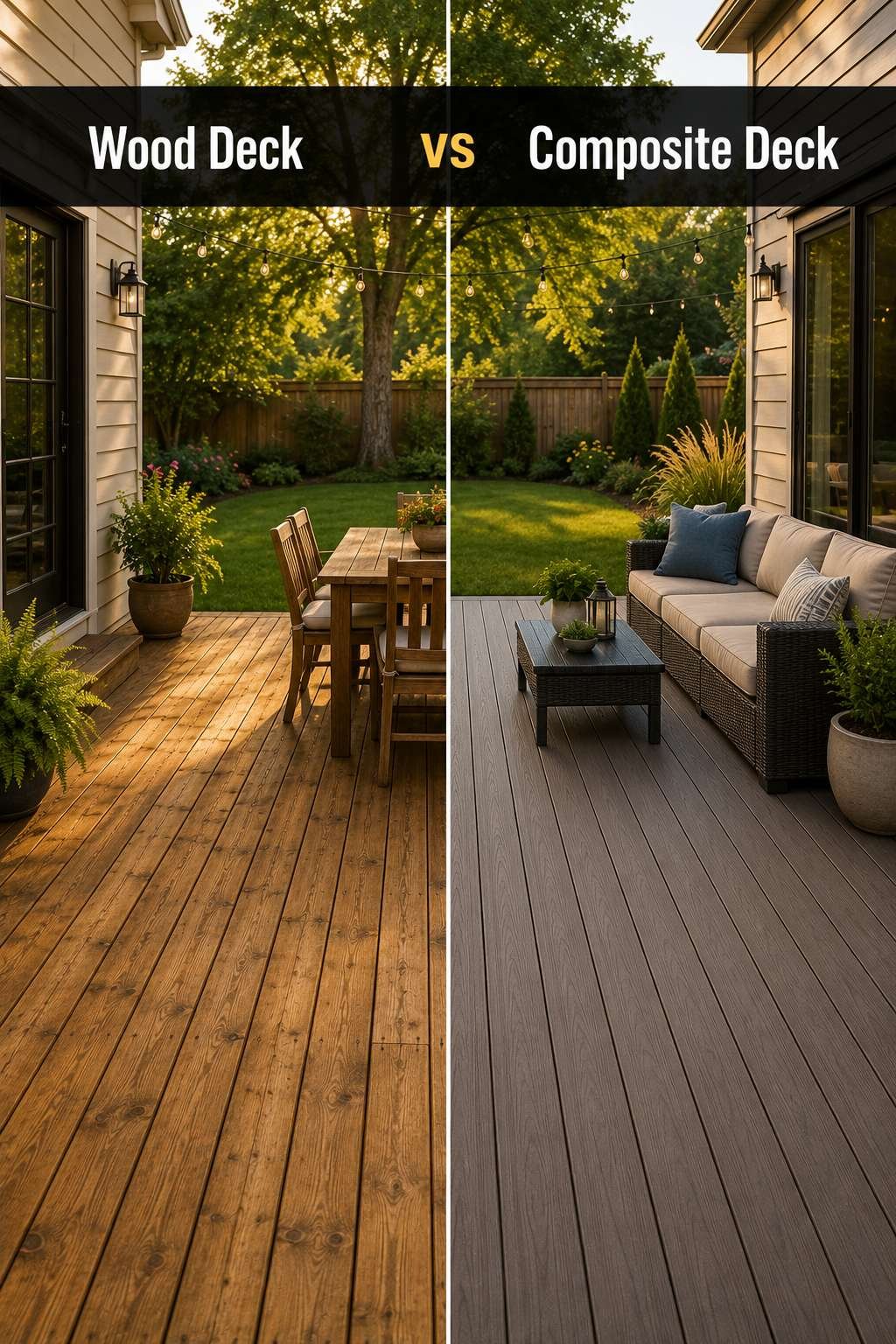
Wood Deck vs Composite Deck: Master Comparison Chart
| Criteria | Wood Deck | Composite Deck |
|---|---|---|
| Cost | $15–$35 per sq ft installed (pressure-treated); premium hardwoods run $35–$50+ | $30–$60 per sq ft installed depending on brand tier |
| Durability | Moderate — prone to rot, warping, and splintering without upkeep | High — resists rot, insects, and splintering; can fade slightly over time |
| Maintenance | High — sealing or staining every 1–2 years, regular cleaning | Low — occasional wash with soap and water, no sealing needed |
| Install difficulty | Moderate — DIY-friendly with standard tools and fasteners | Moderate to high — often uses hidden fastener systems and specific spacing |
| Lifespan | 15–20 years with regular maintenance | 25–30+ years, often backed by 25–50 year warranties |
| Aesthetic flexibility | High — can be restained or repainted in a new color anytime | Moderate — fixed color per product line, cannot be restained |
| Resale value | Good — natural material still favored by traditional buyers | Good to better — low-maintenance appeal resonates in today’s market |
What This Actually Means in a Real Backyard
The chart numbers translate to a pretty simple real-world picture. A wood deck will look genuinely beautiful the week it’s finished and for a few years after, as long as you keep up with sealing — but skip a season or two of maintenance and you’ll start seeing gray, splintering boards and the occasional soft spot near the stairs. A composite deck looks slightly more “manufactured” up close on day one, but that same deck ten years later looks almost identical to day one, because there’s no finish to wear off and no wood grain to weather. If you can picture yourself actually doing a weekend of sanding and sealing every year or two, wood earns its lower price tag. If that sounds like a chore you’ll keep putting off, composite’s higher sticker price buys you out of it entirely. If you’re also weighing deck vs patio, that’s worth deciding early too.
Quick Look: Wood Deck vs Composite Deck at a Glance
Wood Deck
Warm, natural, and budget-friendly upfront — best for homeowners willing to reseal every year or two.
View on Amazon →Composite Deck
Higher upfront cost, near-zero upkeep — best for busy households who want it to look the same in year 20.
View on Amazon →Deep Dive: Wood Deck
Wood decking is the right call for homeowners who love the authentic, natural material look, want the lowest possible upfront cost, or plan to build the deck themselves. It also suits traditional or historic-style homes where a composite deck’s uniform boards can look out of place, and it’s the easier material to repair board-by-board rather than replacing entire sections.
Pros
- Lower upfront material and installation cost
- Natural, authentic look that develops a rich patina over time
- Individual boards are easy and cheap to repair or replace
- Can be restained or repainted in a new color anytime
- Widely available materials and installers in every region
Cons
- Needs sealing or staining every one to two years
- Prone to splintering, warping, and insect damage without upkeep
- Shorter lifespan than composite without diligent maintenance
- Can rot in consistently damp or humid climates
- Ongoing maintenance costs add up significantly over 10+ years
Real cost range: $15–$35 per square foot installed for pressure-treated lumber; premium species like cedar, redwood, or ipe typically run $35–$50 or more per square foot.
Deep Dive: Composite Deck
Composite decking is the right call for busy households, rental properties, poolside builds, and anyone who wants to spend an afternoon on the deck instead of maintaining it. It’s also the stronger choice for long-term homeowners who’d rather pay more once than pay in yearly maintenance time and materials for the next two decades.
Pros
- Minimal maintenance — no sealing, staining, or sanding required
- Resists rot, insects, warping, and splintering
- Long manufacturer warranties, often 25 to 50 years
- Consistent color and plank uniformity across the whole deck
- Stronger long-term durability in wet or humid climates
Cons
- Higher upfront material and installation cost
- Cannot be restained or repainted if you want a different color
- Can retain more heat underfoot in direct summer sun
- Budget-tier boards can look less natural up close
- Repairs usually mean replacing a whole board, not sanding or patching
Real cost range: $30–$60 per square foot installed, depending on brand tier, board profile, and fastening system.
Which One Wins for Your Backyard?
Small Budget Deck
Tight renovation budget, first deck build.
Winner: Wood Deck
Poolside Deck
Constant moisture, splash zones, humidity.
Winner: Composite Deck
High-Traffic Family Yard
Daily use, kids, pets, dining and grilling.
Winner: Composite Deck
Luxury Resort-Style Build
High-end finish, premium hardwood aesthetic.
Winner: Wood Deck
Rental-Friendly Refresh
Low-commitment upkeep between tenants.
Winner: Composite Deck
Professional Tips & Common Regret Mistakes
Designer tie-breaker: if you’re leaning on resale appeal in a competitive market, composite’s “no maintenance” selling point tends to resonate more with today’s buyers than wood’s natural character.
Common regret mistake: choosing wood purely for the lower sticker price without budgeting for annual sealing — those costs can catch up to composite’s upfront premium within 5 to 7 years.
Resale reality check: appraisers rarely give a flat bonus for either material, but inspectors flag neglected wood decking (soft spots, loose boards, rot) far more often than composite issues, which can spook buyers during a sale.
Maintenance reality check: budget a real weekend for wood deck sealing every 1–2 years. Composite decking realistically needs little more than an occasional hose-down and a mild soap scrub.
Shop the Winner
If you’re leaning toward a Wood Deck, here’s what to get started with
Best Overall
A complete deck cleaner and sealant combo kit built for pressure-treated and cedar boards, with a stiff-bristle scrub brush included.
Best Budget
A basic deck wash concentrate that handles mildew and gray weathering without the added cost of a sealant bundled in.
Best Premium
A professional-grade oil-based sealant and stain system designed for multi-year UV and moisture protection on hardwood decking.
If you’re leaning toward a Composite Deck, here’s what to get started with
Best Overall
A composite-safe deck cleaner formulated to lift mold, mildew, and pollen buildup without damaging the cap layer.
Best Budget
A concentrated all-purpose outdoor cleaner diluted for composite surfaces, paired with a soft-bristle brush.
Best Premium
A dedicated composite deck restoration kit with a mold-and-mildew treatment plus a protective finish for high-traffic boards.
For the full breakdown of every option, see our full Best Deck Cleaning & Maintenance Kits guide.
See the Full Buying GuideFrequently Asked Questions
Is composite decking really maintenance-free?
Not completely maintenance-free, but close. Composite decking never needs sanding, staining, or sealing. It typically just needs an occasional wash with mild soap and water, plus periodic checks for mold or algae in humid climates.
How much does a wood deck cost per square foot installed?
Pressure-treated wood decking generally runs $15 to $35 per square foot installed. Premium species like cedar, redwood, or tropical hardwoods such as ipe can push that range to $35 to $50 or more per square foot.
How much does a composite deck cost per square foot installed?
Composite decking typically costs $30 to $60 per square foot installed, depending on the brand tier, board profile, and whether hidden fastener systems and capped boards are used.
Which lasts longer, wood or composite decking?
Composite decking generally lasts longer, averaging 25 to 30 or more years with many warranties covering 25 to 50 years. A well-maintained wood deck typically lasts 15 to 20 years, though premium hardwoods can last longer with diligent upkeep.
Can you stain composite decking?
Most composite decking cannot be effectively stained or repainted. The color is baked into the material or its cap layer, so a different color later generally means replacement rather than refinishing.
Does composite decking get hot in the sun?
Yes, composite decking tends to retain more heat than wood in direct summer sun, especially in darker colors. Lighter colors and capped products with reflective technology help reduce this.
Is wood decking cheaper than composite in the long run?
Wood costs less upfront, but ongoing sealing, staining, and periodic board replacement add up. Over 15 to 20 years, total cost of ownership for both materials often ends up closer than the initial price tags suggest.
What’s the average lifespan of a pressure-treated wood deck?
A pressure-treated wood deck typically lasts 15 to 20 years with regular sealing and maintenance. Without consistent upkeep, rot and structural issues can shorten that significantly.
Does composite decking increase home resale value?
Composite decking is increasingly appealing to buyers because of its low maintenance, which can help in listings. Neither material guarantees a flat resale bump, but a well-maintained deck of either type supports home value more than a neglected one.
Can composite decking look fake or cheap?
Lower-end composite boards can look uniform or slightly artificial up close. Higher-tier capped composite lines with deeper wood-grain embossing and color variation look significantly more natural.
How often do you need to reseal a wood deck?
Most wood decks need resealing or restaining every one to two years, depending on climate, sun exposure, and foot traffic. Decks in harsh sun or wet climates often need it closer to annually.
Is composite decking slippery when wet?
Some composite boards can be slipperier than textured wood when wet, though most modern composite products include grooved or textured surfaces specifically designed to improve wet traction.
What’s the best decking material for a pool area?
Composite decking is generally the better choice around pools because it resists moisture, mold, and warping far better than wood in a consistently wet environment.
Can you build a composite deck yourself (DIY)?
It’s possible, but composite decking often uses proprietary hidden-fastener clip systems and specific spacing requirements that make it more involved than a standard wood build, so many homeowners hire a contractor.
Does wood decking need to be replaced board by board?
Individual wood boards can typically be replaced one at a time as they warp, crack, or rot, which is one of wood’s practical advantages over composite for spot repairs.
How does composite decking hold up in extreme cold or heat?
Composite decking generally holds up well across temperature extremes, resisting cracking in cold climates better than wood, though it can expand slightly in high heat, which is why manufacturers specify gap spacing during installation.
Which decking material is more eco-friendly?
It depends on sourcing. Composite decking is often made from recycled wood fibers and plastics, diverting waste from landfills, while responsibly sourced or FSC-certified wood decking is a renewable resource. Neither is a clear universal winner on sustainability.
What’s the warranty difference between wood and composite decking?
Composite decking typically comes with much longer manufacturer warranties, often 25 to 50 years against staining, fading, and structural defects. Wood decking generally has no material warranty beyond standard lumber defect coverage.
Can termites damage a composite deck?
Composite decking is highly resistant to termites and other wood-boring insects since it contains little to no exposed organic wood fiber on the surface, unlike solid wood decking.
Which decking material is better for a rental property?
Composite decking is generally better suited to rental properties because it requires little to no ongoing maintenance from landlords or tenants and holds up well to inconsistent upkeep between tenancies.
Final Verdict: Which Deck Should You Actually Build?
If you want the lowest upfront cost, love the look of real wood, and don’t mind a seasonal maintenance ritual, a wood deck is the right call — especially for small budget builds, DIY projects, and high-end hardwood builds where authentic material matters.
If you’d rather pay more upfront and spend the next two to three decades barely thinking about your deck, a composite deck is the smarter long-term choice — especially for pools, high-traffic family yards, and rental properties where low maintenance matters more than material authenticity.

