If you’re standing in your kitchen trying to decide between open floating shelves and a full run of cabinets, you’re really weighing two different philosophies of storage: display versus concealment. Floating shelves suit homeowners who want an airy, budget-friendly look and don’t mind a little daily styling upkeep. Cabinets suit homeowners who want everything out of sight, higher resale value, and storage that can handle a busy household without a second thought. Neither one is universally “better” — the right pick depends on your room size, your budget, and how much visual clutter you can actually live with. Here’s the full breakdown, room by room, cost by cost.
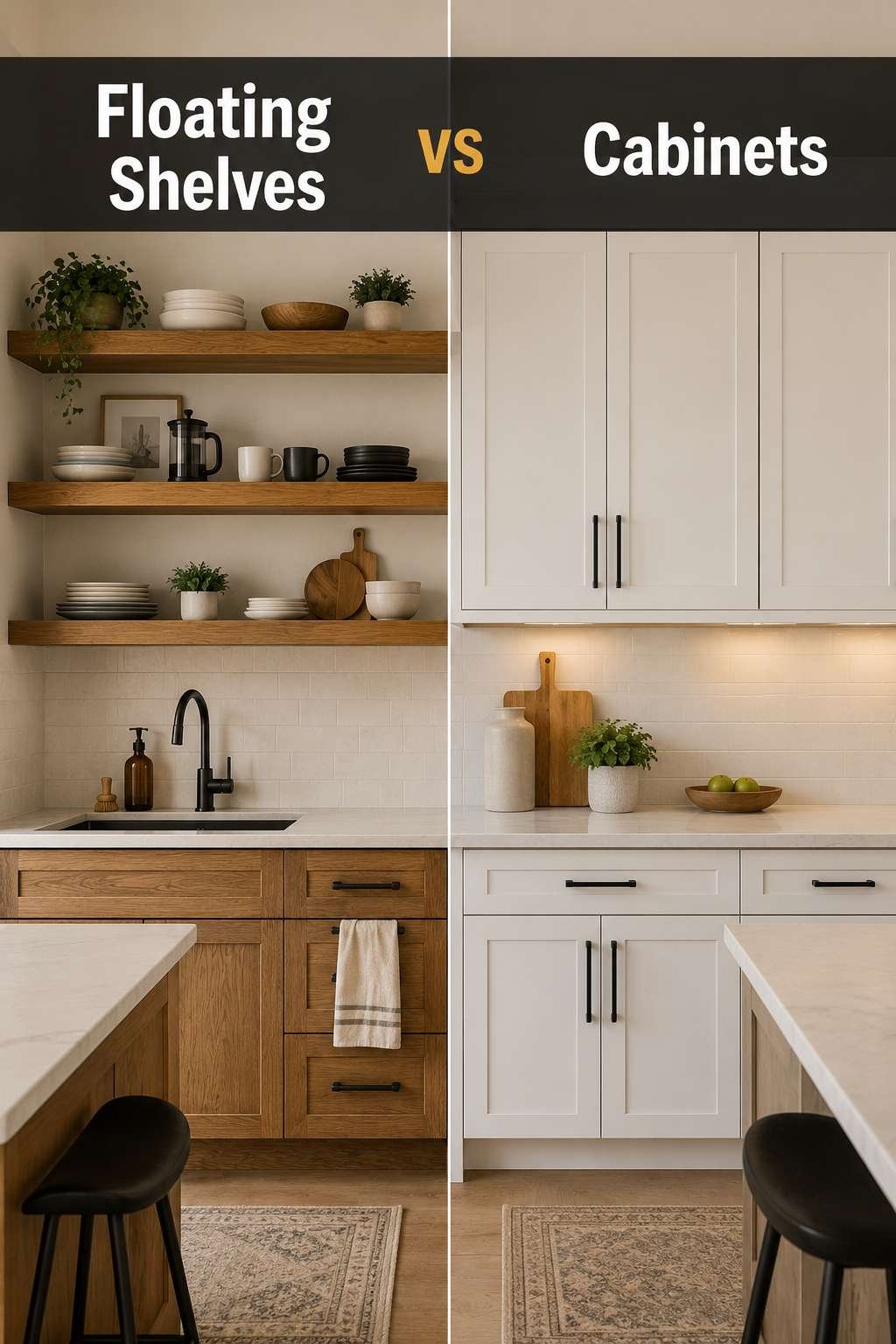
Floating Shelves vs Cabinets: The Master Comparison Chart
| Criteria | Floating Shelves | Cabinets |
|---|---|---|
| Cost | $15–$40 per linear foot installed | $150–$500 per linear foot installed (custom runs higher) |
| Storage Capacity | Open display only — items stay fully visible, no concealment | Fully enclosed storage that hides clutter behind doors |
| Install Difficulty | Low to moderate — DIY-friendly with a stud finder and level | High — usually requires a professional install and precise leveling |
| Weight Capacity | 15–50 lbs per bracket, depending on hardware and wall type | Very high — supports heavy stacked cookware and small appliances |
| Maintenance | Frequent dusting and restyling to avoid a cluttered look | Low — occasional wipe-down of doors and interior surfaces |
| Visual Openness | High — opens up small rooms and adds visual depth | Low — cabinets create a more closed, boxed-in feel |
| Lifespan | 10–15 years before hardware or finish needs updating | 20–30+ years with quality materials and proper care |
| Resale Value | Neutral to slightly negative in traditional markets | Strong positive — buyers expect concealed kitchen storage |
What This Chart Actually Means in a Real Home
The numbers above translate to a fairly simple real-world pattern: floating shelves win on cost, install ease, and visual openness, while cabinets win on capacity, durability, and resale. A “low maintenance” score for cabinets means you can toss dishes behind a door and walk away — a “frequent dusting” score for shelves means anything you put up there is collecting kitchen grease and dust within days, especially near a stove. Weight capacity matters more than people expect too: a shelf rated for 30 pounds sounds like plenty until you stack a cast iron skillet, a few mixing bowls, and a stand mixer on it. Cabinets simply don’t have that ceiling. Resale value is the quiet dealbreaker for a lot of buyers — in most markets, a kitchen with zero enclosed upper storage reads as unfinished, not stylish. Our guide on how to decorate a kitchen shelf walks through this step by step.
Quick Look: Floating Shelves vs Cabinets at a Glance
Floating Shelves
Open, budget-friendly display storage that opens up a room but needs regular styling and dusting to stay tidy.
View on Amazon →Cabinets
Fully enclosed storage that hides clutter, holds more weight, and holds up better for resale — at a higher cost.
View on Amazon →Deep Dive: Floating Shelves
Floating shelves are the right call for anyone prioritizing cost, visual openness, and flexibility over concealed storage. They shine in small kitchens, open-concept living rooms where you want a display moment, rental units where a permanent cabinet install isn’t an option, and any quick, budget-conscious refresh. They’re also a strong pick for anyone who genuinely enjoys styling their space and won’t mind a five-minute tidy-up before guests come over. Our how to decorate open kitchen shelves guide covers this in more detail.
Pros
- Significantly cheaper to install than cabinets
- Easy, DIY-friendly installation for most standard shelves
- Opens up small or narrow rooms visually
- Fast and cheap to restyle or repaint later
- No need to match existing cabinetry style or finish
Cons
- Zero concealed storage — everything stays visible
- Requires ongoing styling and dusting to avoid clutter
- Lower weight capacity than a cabinet system
- Can pose a reach or tip-over risk with young kids
- Neutral to slightly negative impact on resale value
Deep Dive: Cabinets
Cabinets are the right call for family kitchens that need to hide daily clutter, larger kitchens with more wall space to work with, and any household where resale value and long-term durability matter more than upfront cost. They’re also the safer choice if you store a lot of dishware, small appliances, or anything you’d rather not have on permanent display. Our open shelves vs closed cabinets comparison covers that decision in more depth.
Pros
- Conceals clutter completely behind closed doors
- Much higher weight capacity for heavy cookware and appliances
- Stronger positive impact on resale value
- More durable — typically lasts 20–30+ years
- Protects stored items from dust and kitchen grease
Cons
- Significantly higher upfront cost
- Usually requires professional installation
- Can make a small kitchen feel more closed-in
- Harder and more expensive to update the look later
- Custom or semi-custom orders can take weeks to arrive
Real Room Scenarios: Which One Actually Wins
Small Kitchen
Limited wall space and a need to keep the room feeling open.
Budget Renovation
Every dollar counts and cost per linear foot matters most.
Luxury Build
Custom finishes, durability, and resale value are top priority.
Rental-Friendly
No permanent changes allowed, and it needs to be removable at move-out.
High-Traffic Family Household
Kids, pets, and daily mess need to stay out of sight and out of reach.
Professional Tips
Designer Tie-Breaker Advice
- Hybrid layouts win most kitchens. Keep cabinets for the bulk of your storage and add one or two floating shelves near the stove or sink for open, easy-reach items — you get concealed capacity and a visual accent without committing fully to either extreme.
- The most common regret mistake: choosing full open shelving based on styled photos, then finding it exhausting to keep tidy day to day. If you’re not someone who enjoys arranging and dusting a display shelf weekly, lean toward cabinets even if the photos win you over.
- Resale-value note: if you’re renovating within 3–5 years of a likely sale, prioritize cabinets in the primary kitchen storage zones. Buyers consistently expect enclosed upper storage, and appraisers rarely credit open shelving the same way.
- Maintenance reality-check: anything stored on an open shelf near a stove will need wiping down far more often than you’d expect — kitchen grease settles on exposed dishware within days, not weeks.
Shop the Winner
If you’re leaning toward Floating Shelves, here’s what to get started with:
Best Overall
Heavy-duty steel hidden-bracket kit rated for stud-mounted installs and everyday dishware weight.
Best Budget
Simple L-bracket and wood shelf combo kit for a fast, low-cost DIY install.
Best Premium
Solid wood floating shelf set with a fully concealed blind-mount bracket system for a seamless look.
If you’re leaning toward Cabinets, here’s what to get started with:
Best Overall
Soft-close hinge and slide hardware kit that upgrades any stock or semi-custom cabinet box.
Best Budget
Basic cabinet pull and hinge multipack for a simple stock-cabinet refresh.
Best Premium
Brushed brass handle set paired with pull-out interior organizers for a custom-cabinetry finish.
For the full breakdown of options in each category, see our full Best Floating Shelf Hardware guide and our full Best Cabinet Hardware guide.
Shop Storage Hardware →FAQ: Floating Shelves vs Cabinets
Are floating shelves cheaper than cabinets?
Yes, in almost every case. Floating shelves typically run $15 to $40 per linear foot installed, while cabinets run $150 to $500 per linear foot depending on materials. Cabinets cost more because they involve boxes, doors, hinges, and usually professional installation.
Do floating shelves make a small kitchen look bigger?
Generally yes. Open shelving removes the visual bulk of upper cabinet boxes and lets sightlines carry further across the room, which tends to make small or narrow kitchens feel more open. The effect is strongest when shelves are styled sparingly rather than packed with items.
How much weight can a floating shelf hold?
Most floating shelves hold between 15 and 50 pounds per bracket, depending on the hardware, shelf thickness, and whether it’s anchored into wall studs. Heavy-duty steel bracket systems anchored into studs can hold significantly more than lightweight decorative brackets.
Are floating shelves hard to install?
Most floating shelves are a low to moderate difficulty DIY project. You need a stud finder, a level, and the correct anchors for your wall type. Heavier hidden-bracket systems that require precise blind-mounting are more advanced and sometimes better left to a professional.
Do floating shelves need to be anchored into wall studs?
For anything holding real weight, yes. Anchoring into studs is what gives a floating shelf its actual load capacity. Drywall anchors alone can work for very light, purely decorative shelves, but they are not reliable for dishware, books, or anything heavy.
Do open shelves collect more dust than cabinets?
Yes. Anything stored on an open shelf is exposed to airborne dust and kitchen grease, especially near a stove, and needs more frequent wiping than items sealed behind a cabinet door. This is one of the most common regrets homeowners report after switching to open shelving.
Are floating shelves a good idea in a rental?
Often yes. Lightweight floating shelves with removable bracket systems can add storage and style without the commitment or cost of built-in cabinetry, and many can be taken down and patched easily at move-out. Always check your lease before drilling into walls.
Can floating shelves replace all my upper cabinets?
They can, but it’s rarely the best move for a full kitchen. Most designers recommend keeping at least some enclosed storage for pantry items, small appliances, and anything you don’t want on permanent display, and using floating shelves as a display accent rather than the sole storage system.
Do floating shelves hurt resale value?
They can have a neutral to slightly negative effect in traditional home-buying markets, where buyers expect enclosed kitchen storage. This isn’t universal — in some trend-forward markets open shelving is seen as a stylish upgrade — but cabinets remain the safer bet for resale.
What’s the average cost to install kitchen cabinets?
Stock cabinets typically run $150 to $300 per linear foot installed, while semi-custom and custom cabinetry can run $300 to $500 or more per linear foot, depending on materials, finishes, and hardware.
How long do kitchen cabinets last?
Quality cabinets typically last 20 to 30 years or more with proper care, compared to roughly 10 to 15 years before floating shelf hardware or finishes need updating. Cabinet longevity depends heavily on material quality and how well moisture and daily wear are managed.
Are cabinets better for hiding clutter?
Yes, this is cabinets’ biggest practical advantage. Everything behind a closed cabinet door stays out of sight, which is a major benefit for households that don’t want to maintain a styled, camera-ready shelf every single day.
Do cabinets add more value to a home than open shelving?
In most markets, yes. Buyers generally expect concealed kitchen storage, and appraisers and real estate agents typically view a full cabinet system as a stronger asset than open shelving, which is often seen as a stylistic choice rather than a functional upgrade.
Can I mix floating shelves and cabinets in the same kitchen?
Absolutely, and it’s one of the most popular approaches. A common layout uses base and some upper cabinets for concealed everyday storage, with one or two floating shelves added above a sink, stove, or open wall section purely for display and easy-reach items.
Which option is better for a household with young kids?
Cabinets are generally the safer and more practical choice for households with young kids, since they conceal breakables, keep countertops clearer, and hold up better to daily bumps and mess. Open shelves at reaching height can also pose a tip-over or reach hazard with dishware.
How do I style floating shelves so they don’t look cluttered?
Leave visible negative space between groupings, vary height with a mix of stacked and standing items, and keep everyday clutter like mail or chargers off the shelf entirely. Most designers recommend styling in odd-numbered groupings of two or three items per section.
Is it cheaper to DIY floating shelves or hire a pro?
DIY floating shelves can cost well under $10 per linear foot in materials alone if you’re comfortable finding studs and mounting basic brackets. Hidden-bracket, blind-mount systems are harder to get level and flush, so many homeowners hire a pro for that specific style even on an otherwise DIY project.
Do cabinets require more maintenance than shelves?
Day-to-day, no — cabinets generally need less upkeep since contents stay protected behind closed doors. Occasional maintenance like hinge adjustments, door realignment, or refinishing over the years is typically less frequent than the ongoing dusting and restyling open shelves require.
What’s the biggest mistake people make when choosing between the two?
Choosing based on Pinterest photos alone without accounting for daily maintenance and household habits. Open shelving photographs beautifully when freshly styled, but many homeowners underestimate how often it needs to be tidied and dusted to keep that look in real life.
Which option is easier to update or change later?
Floating shelves are far easier and cheaper to update — a fresh coat of paint or swapped bracket style can change the whole look in an afternoon. Updating cabinets usually means repainting or replacing doors and hardware, which is a bigger and more expensive project.
Final Verdict
If you want the lowest upfront cost, an easy DIY project, and a room that feels bigger and lighter, floating shelves win — especially in small kitchens, rentals, and budget renovations.
If you want concealed storage, higher weight capacity, better durability, and stronger resale value, cabinets win — especially in family kitchens, luxury builds, and any home you plan to sell within a few years.
For most full kitchen renovations, the smartest move is a hybrid: cabinets as your primary storage system, with one or two floating shelves added as a display accent. If you can only pick one, let your household’s daily habits decide — not the Pinterest photo.