If you’re down to two finalists for your kitchen renovation, chances are they’re a farmhouse sink and an undermount sink. Both are the sinks designers reach for first, but they solve different problems. A farmhouse sink gives you a deep, exposed apron-front basin that becomes the visual anchor of the room, usually at the cost of a cabinet modification. An undermount sink gives you a clean, seamless line with your countertop and drops into standard cabinetry with far less disruption to your budget and timeline. Neither one is objectively better. The right call depends on your cabinets, your countertop material, your budget, and how hard your kitchen actually gets used day to day. Here’s the real breakdown, cost figures included, so you can pick with confidence instead of guessing.
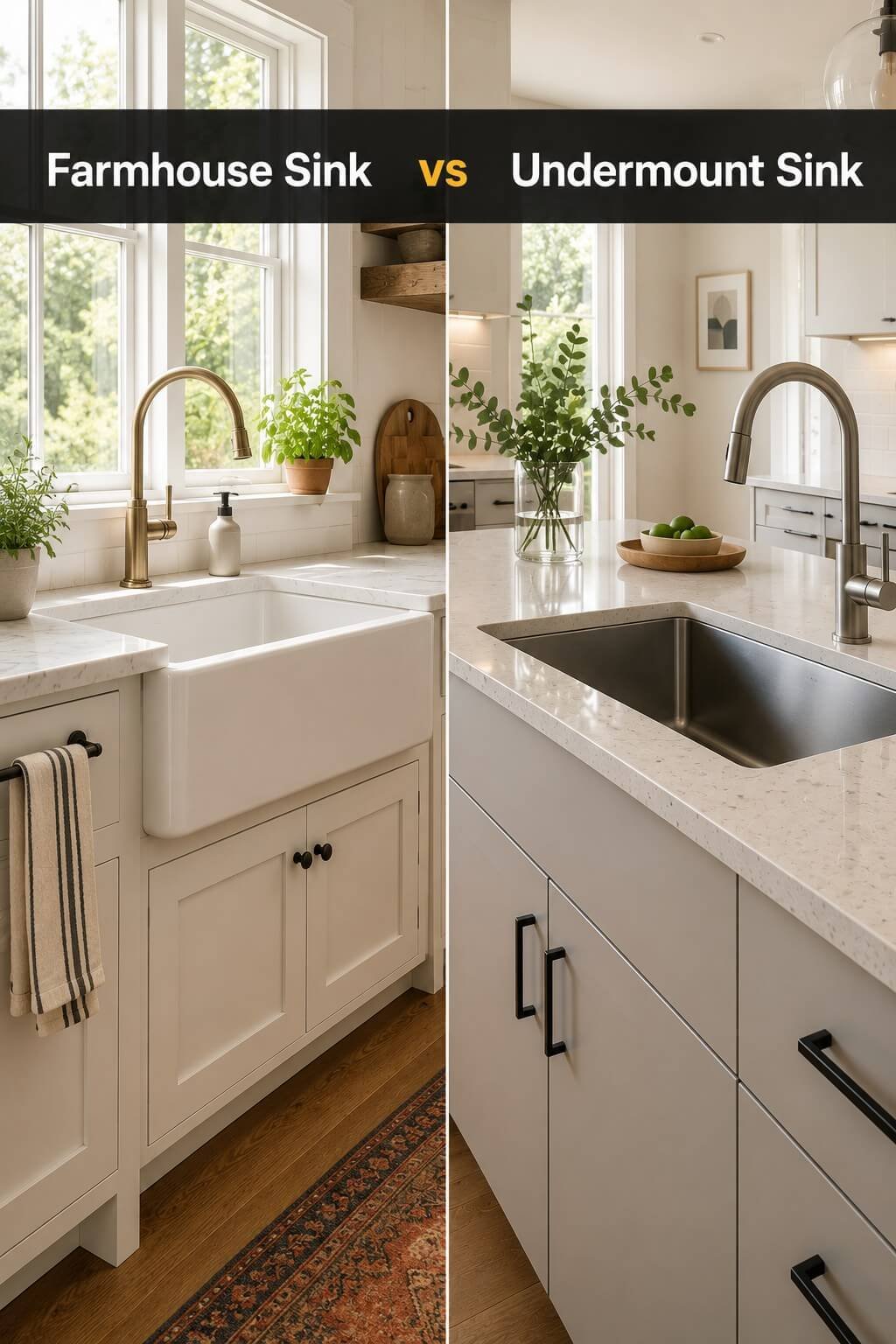
Farmhouse Sink vs Undermount Sink: The Master Comparison
| Criteria | Farmhouse Sink | Undermount Sink |
|---|---|---|
| Upfront Cost | $300–$1,200 for the sink, plus $500–$3,000+ if cabinets need custom work or modification | $150–$800 for the sink, plus roughly $150–$400 in typical install labor |
| Installation Complexity | High — often requires a custom or reinforced base cabinet to support the exposed front and weight | Moderate — fits most standard cabinetry with a more straightforward, faster install |
| Countertop Compatibility | Works with any solid-surface counter sized to the cabinet opening around the apron front | Requires a solid-surface counter such as quartz, granite, or wood — not compatible with laminate |
| Maintenance | Wipe down the exposed front regularly; care varies by material (fireclay is very low-maintenance, enamel cast iron can chip) | Check and reseal the under-counter seam every couple of years to prevent water intrusion |
| Durability / Lifespan | 30–50+ years for quality fireclay or cast iron | 15–30 years depending on material and seal upkeep |
| Style Flexibility | Strongest in farmhouse, cottage, and modern-farmhouse kitchens | Fits nearly any kitchen style, from traditional to strictly modern |
| Resale Value | Strong plus in farmhouse-style homes; can look out of place in a strictly modern build | Neutral, broadly safe choice across most buyer tastes and markets |
What These Numbers Actually Mean in Your Kitchen
The cost row is the one that surprises most homeowners. A farmhouse sink itself isn’t always dramatically more expensive than an undermount sink, material for material. What changes the total project cost is the cabinet: most kitchens aren’t built with an opening for an exposed apron front, so a farmhouse install usually means a custom cabinet, a specialty sink-base kit, or real carpentry work before the sink ever goes in. Undermount sidesteps that almost entirely as long as you already have or are installing a solid-surface countertop. On durability, both styles can last decades in the right material, but the maintenance habit is different: farmhouse asks you to keep an exposed front clean, while undermount asks you to keep an eye on the seal you can’t see.
Quick Look: Farmhouse Sink vs Undermount Sink at a Glance
Farmhouse Sink
A deep, exposed apron-front basin that becomes the focal point of the kitchen, at the cost of a cabinet retrofit.
View on Amazon →Undermount Sink
A seamless basin mounted beneath the countertop for a clean line and easy fit into standard cabinetry.
View on Amazon →Deep Dive: Farmhouse Sink
A farmhouse sink is the right call if you want the basin to double as a design feature, not just a fixture. It suits cooks who regularly wash oversized pots, sheet pans, or roasting trays, and it’s the signature look for farmhouse, cottage, and modern-farmhouse kitchens. It’s a weaker fit if your budget can’t absorb a cabinet modification, or if your kitchen’s style is strictly modern and minimalist. Our guide on how to organize your room walks through this step by step.
Pros
- Dramatic, focal-point look that anchors the whole kitchen
- Extra-deep basin handles large pots, trays, and stockpots with ease
- Exposed front is genuinely easy to reach and wipe down
- Wide single basin works well for both dishes and food prep
Cons
- Exposed front shows splashes and drips on the cabinet below
- Usually needs a custom or modified cabinet, adding real cost
- Heavier materials may need a reinforced cabinet base
- Harder and more expensive to change your mind about later
Deep Dive: Undermount Sink
An undermount sink is the right call if you want a clean, low-maintenance install that works with the cabinets you already have. It suits budget-conscious renovations, small kitchens where every inch of counter matters, and any kitchen with a modern or transitional style. It’s a weaker fit if you’re keeping a laminate countertop, since undermount installation isn’t an option there.
Pros
- Fits standard cabinetry with no retrofit required
- Seamless line maximizes usable countertop workspace
- Easy to wipe crumbs and scraps directly into the basin
- Wide material and price range, from budget to premium
Cons
- Only works with a solid-surface countertop, never laminate
- Seal can loosen over time without periodic resealing
- Front cabinet panel still takes daily wear and moisture
- Base cabinet needs to be structurally sound to bear the weight
Which One Wins in Your Kitchen?
Small Galley Kitchen
Tight counter space means every inch matters, and a seamless line keeps the room feeling open.
Winner: Undermount Sink
Budget Renovation
No cabinet modification needed means more of your budget goes toward cabinets and counters.
Winner: Undermount Sink
Luxury Custom Build
Budget for custom cabinetry is already built in, so the statement piece is worth the investment.
Winner: Farmhouse Sink
Rental-Friendly Kitchen
Standard cabinet compatibility and neutral resale appeal keep it a safe, low-risk choice.
Winner: Undermount Sink
High-Traffic Family Household
The extra-deep basin and durable materials hold up to constant dishes, big pots, and daily wear.
Winner: Farmhouse Sink
Professional Tips Before You Decide
- Confirm your cabinet situation first. Before you fall in love with a farmhouse sink online, have your installer or cabinet maker confirm what it will actually take to fit one into your existing or planned base cabinet. This single conversation prevents the most common budget surprise in this comparison.
- Match the sink to your home’s overall style, not just your kitchen. A farmhouse sink in an otherwise strictly modern home can undercut resale value instead of helping it. If your home leans modern or minimalist throughout, undermount is the safer long-term choice.
- Don’t skip the reseal check on undermount sinks. The most common regret undermount owners report isn’t the sink itself, it’s forgetting to inspect and reseal the seam every couple of years, which can lead to hidden water damage in the cabinet below.
- Weigh basin depth against your actual cooking habits. If you regularly hand-wash stockpots, sheet pans, or oversized dishes, the extra few inches of farmhouse basin depth is a real daily-use advantage, not just a style preference.
Shop the Winner
Whichever style you land on, the right accessories protect your investment and make daily cleanup easier from day one.
If you’re leaning toward the Farmhouse Sink, here’s what to get started with: a fitted bottom grid to protect the basin from scratches and dents, a large-capacity strainer sized for the deeper basin, and a set of soft-touch corner guards for the exposed front edge.
Best Overall
Stainless bottom grid + strainer combo sized for deep farmhouse and standard basins alike
Best Budget
Simple mesh strainer basket and silicone basin mat two-pack
Best Premium
Full accessory workstation kit with grid, cutting board, and colander insert
If you’re leaning toward the Undermount Sink, here’s what to get started with: mounting clips rated for your countertop thickness, a marine-grade silicone sealant for the under-counter seam, and a fitted bottom grid to protect against scratches on the exposed basin floor.
See our full Best Kitchen Sink Accessory Kits guide for the complete lineup and buying advice.
See the Full Buying GuideFrequently Asked Questions
Is a farmhouse sink more expensive than an undermount sink?
Yes, in most cases. A farmhouse sink typically costs $300 to $1,200 for the sink itself, plus $500 to $3,000 or more if your cabinets need to be custom-built or modified to fit the apron front. An undermount sink usually runs $150 to $800 for the sink plus $150 to $400 in labor, with no cabinet changes needed in most kitchens.
Do farmhouse sinks require special cabinets?
Often, yes. Standard base cabinets are built for a sink that sits on top of the counter, not one with an exposed front. Many farmhouse installs need a custom cabinet, a modified opening, or a sink base kit designed specifically for apron-front sinks.
Can I put an undermount sink under a laminate countertop?
No. Undermount sinks need a solid-surface countertop such as quartz, granite, solid wood, or concrete so the sink edge can be securely bonded and sealed underneath. Laminate countertops can’t support an undermount seal long-term and will allow water intrusion at the edge. Our how to style orange wood floors guide covers this in more detail.
Which sink is easier to install, farmhouse or undermount?
Undermount is generally easier and faster to install, especially in a kitchen with standard cabinetry already in place. Farmhouse installation is more involved because the cabinet base often needs to be built or reinforced to support the sink’s front and weight.
Do farmhouse sinks chip or crack easily?
It depends on the material. Fireclay is fired at extremely high heat and resists chipping and scratching very well. Cast iron with an enamel coating can chip if a heavy pot is dropped directly on an edge, though the chip is usually cosmetic rather than structural.
How long do undermount sink seals last before resealing?
Most undermount seals hold up for several years, but it’s worth inspecting the seam under the counter edge every year or two and resealing with silicone caulk at the first sign of separation, discoloration, or a soft spot, before water damage reaches the cabinet below.
Which sink style is better for a small kitchen?
Undermount is usually the better fit for a small or galley kitchen. It preserves more usable counter space on either side and doesn’t add the visual bulk of an exposed apron front, which can make a narrow kitchen feel more cramped.
Do farmhouse sinks add resale value to a home?
In farmhouse, cottage, or modern-farmhouse style homes, a farmhouse sink is a strong, expected feature that buyers respond well to. In a strictly modern or minimalist home, it can look out of place, so its resale impact depends heavily on matching the home’s overall style.
Can I replace an undermount sink with a farmhouse sink later?
It’s possible, but it’s a real renovation project, not a simple swap. You’ll likely need to modify or rebuild the base cabinet and countertop opening, so it’s worth deciding on your sink style before your cabinets and countertop are finalized rather than after.
What countertop materials work with an undermount sink?
Quartz, granite, marble, solid-surface acrylic, concrete, and solid wood butcher block all work well with undermount sinks. The key requirement is a solid, non-laminate material that can be cut cleanly and sealed to the sink’s rim.
Are farmhouse sinks harder to clean than undermount sinks?
The basin itself isn’t harder to clean, and the exposed front is actually easy to wipe down since there’s no counter overhang in the way. The tradeoff is that the exposed front collects more visible splashes and drips than an undermount sink hidden beneath the counter edge.
Which sink is more durable long term?
Both can last decades with the right material. Fireclay and cast iron farmhouse sinks are known for exceptional long-term durability, often 30 to 50 or more years. High-quality stainless or granite composite undermount sinks typically last 15 to 30 years depending on gauge and care.
Do undermount sinks look cheap compared to farmhouse sinks?
Not at all. A well-chosen undermount sink in a quality material like granite composite or a heavier-gauge stainless steel reads as clean and high-end, especially paired with a nice stone countertop. It simply has a different, more understated visual language than an apron-front sink.
How deep is a typical farmhouse sink basin?
Most farmhouse sinks have a basin depth of 8 to 10 inches, deeper than the typical 7 to 8 inch depth of a standard undermount sink. That extra depth is one of the main practical reasons people choose farmhouse for large pots, sheet pans, and stockpots.
What is the average cost to install a farmhouse sink including cabinet changes?
Including the sink itself and typical cabinet modification or a custom sink base, most homeowners can expect a total of roughly $1,000 to $4,000, depending on sink material and how much cabinetry work is required. A simple drop-in replacement into an already-farmhouse-ready cabinet costs far less.
Can renters install an undermount sink?
Generally this is a landlord or property-owner decision rather than a renter project, since it involves permanently altering the countertop and cabinet. Renters wanting a similar clean look without permanent changes are usually better served by a quality drop-in sink instead.
Do farmhouse sinks work with quartz countertops?
Yes. Quartz is one of the most common and best-performing countertop choices for a farmhouse sink installation, since it’s a solid, non-porous surface that can be fabricated precisely around the sink’s front opening.
What causes an undermount sink to detach from the countertop?
The most common cause is the silicone seal or epoxy bond breaking down over time, often from age, heavy daily use, or repeated temperature changes from hot water, which lets water seep in and weakens the mounting clips or adhesive holding the sink in place.
Which sink style fits a modern kitchen better?
Undermount generally fits a strictly modern or minimalist kitchen better, thanks to its clean, seamless line with the countertop. Farmhouse can still work in a modern kitchen if it’s a simpler, unfluted style paired with streamlined cabinetry rather than traditional shaker fronts.
Is fireclay or cast iron better for a farmhouse sink?
Fireclay is generally more scratch and stain resistant and keeps its glossy finish longer, while cast iron is often slightly more affordable and comes in a wider range of enamel colors. Fireclay is the better pick for heavy daily use; cast iron is a solid choice if color options matter more.
Final Verdict
Choose the farmhouse sink if you’re doing a full renovation with room in the budget for cabinet work, you cook in serious volume, and your kitchen’s style is farmhouse, cottage, or modern-farmhouse. It’s the sink that becomes a feature, not just a fixture, and it earns that role in the right kitchen.
Choose the undermount sink if you’re working with a fixed budget, standard cabinetry, a small kitchen, or a modern or transitional style. It’s the lower-risk, easier-to-install choice that fits nearly any kitchen without asking you to rebuild anything around it.
If you’re still torn, default to undermount. It’s the safer resale choice across more home styles, and it doesn’t lock you into a bigger cabinet budget than the rest of your renovation calls for.