Standing in the mattress aisle trying to decide between a platform bed and a box spring usually comes down to one nagging question: which one will actually hold up, and which one is quietly wrong for the mattress you already bought? A platform bed gives you a frame and a foundation in one low-profile piece, while a box spring is the traditional coil-filled box that lifts a mattress higher on top of a separate frame. If you’re furnishing a first apartment, replacing a saggy old foundation, or just tired of your bed creaking at 2 a.m., here’s the direct answer: for most modern mattresses, a platform bed is the better long-term buy, and a box spring only earns its keep if you have a traditional innerspring mattress and already own a frame built for one.
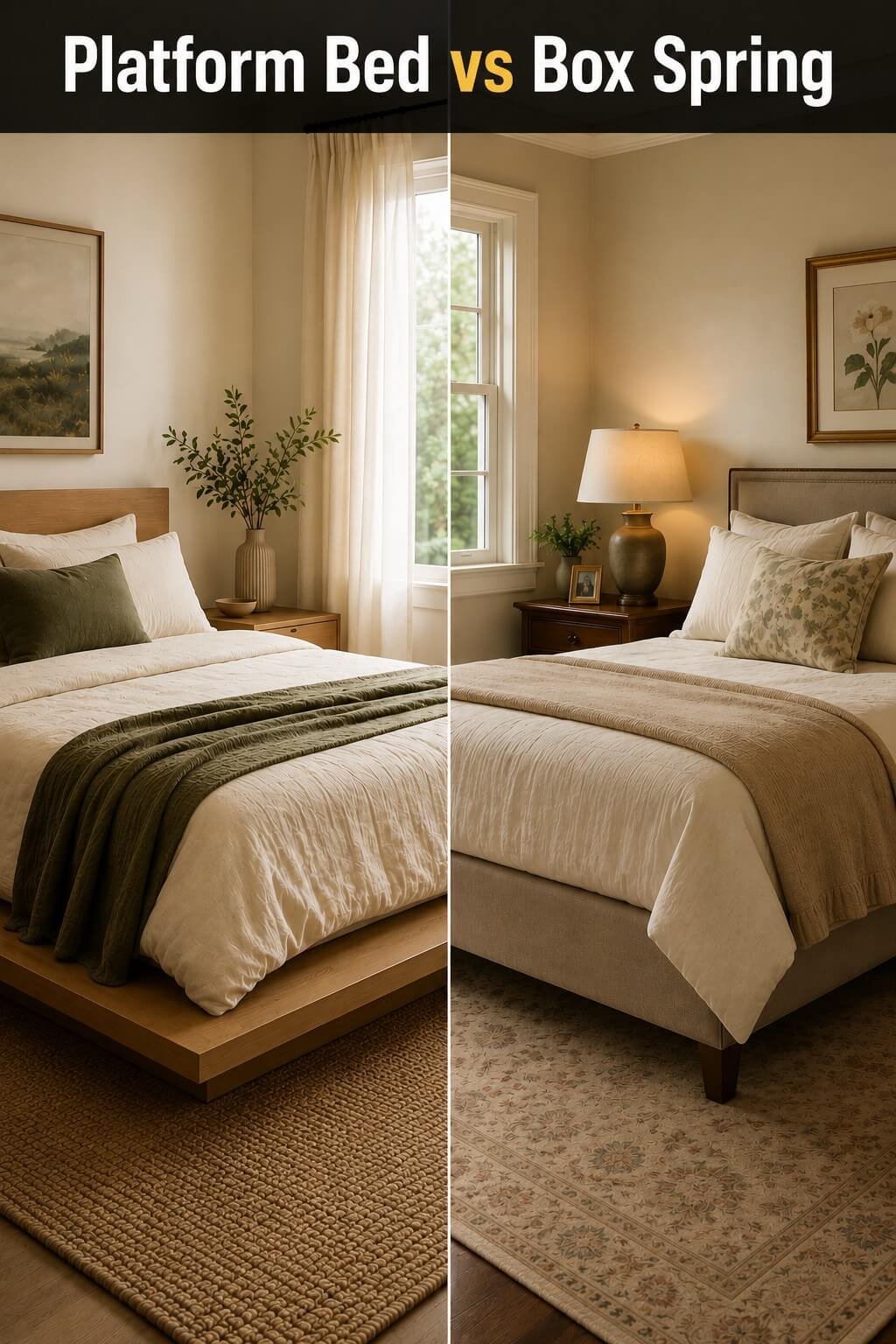
Platform Bed vs. Box Spring: The Master Comparison
| Criteria | Platform Bed | Box Spring |
|---|---|---|
| Cost | $100–$2,000, all-in-one frame and foundation | $100–$500, plus a separate bed frame |
| Lifespan | 10–15+ years | 8–10 years |
| Mattress compatibility | Memory foam, latex, hybrid, and innerspring | Best for traditional innerspring only |
| Assembly | Moderate | Easy |
| Storage | Often includes under-bed drawers or clearance | Little to no usable storage |
| Aesthetic | Low-profile, modern | Taller, traditional |
| Rental-friendliness | Easy to assemble/disassemble, no extra frame needed | Requires a matching frame, bulkier to move |
The numbers tell a pretty clear story: a box spring is cheaper to buy today, but it’s also the piece you’ll be replacing again in under a decade, and it locks you into a mattress type. A platform bed costs more up front in some cases, but it’s doing double duty as frame and foundation, which is why the total cost of ownership usually favors it once you look past the sticker price. The compatibility row matters more than people expect too — if you’ve already got a memory foam or hybrid mattress, a box spring isn’t just unnecessary, it can actively shorten that mattress’s life. Check our bed size chart if you want exact numbers before you shop.
Quick Look: Platform Bed vs. Box Spring at a Glance
Platform Bed
A low, slatted or solid frame that supports most mattress types on its own — no box spring required.
View on Amazon →Box Spring
A coil-filled foundation that lifts a mattress higher and adds bounce, best suited to traditional innerspring mattresses.
View on Amazon →Deep Dive: Platform Bed
Best for: memory foam, latex, and hybrid mattress owners; small apartments and rentals; anyone who wants a modern, low-profile look or a bit of built-in storage. Real cost range: roughly $100 for a basic metal frame up to $2,000+ for a solid wood or upholstered design with storage drawers. Our 29 clever bedroom storage ideas has more inspiration along these same lines.
Pros
- Doubles as frame and foundation, so there’s nothing extra to buy or replace
- Works with nearly every mattress type, including memory foam and hybrid
- Sturdy slats resist sagging and typically outlast a box spring by several years
- Many models include built-in storage drawers, ideal for small bedrooms Our small walk in closet ideas has more inspiration along these same lines.
- Low profile gives rooms a cleaner, more modern feel
Cons
- Cheaper models can have widely-spaced slats that shorten mattress life if not properly supported
- Some sleepers find the lower height less convenient to get in and out of
- Solid wood or upholstered versions can cost significantly more than a basic box spring setup
- Heavier designs are harder to move than a simple box spring and frame
Deep Dive: Box Spring
Best for: traditional innerspring mattress owners; households that already have a compatible bed frame; anyone prioritizing the lowest possible upfront cost. Real cost range: roughly $100 to $500 depending on size and quality, not including the separate bed frame most box springs require.
Pros
- Lower upfront cost than most platform beds
- Adds height, which some sleepers prefer for getting in and out of bed
- Provides some shock absorption and bounce for traditional innerspring mattresses
- Widely available and easy to find replacement sizes
Cons
- Not a safe long-term match for memory foam or hybrid mattresses
- Typically needs replacing every 8 to 10 years as coils or wood weaken
- Requires a separate bed frame, adding to the real total cost
- Offers no under-bed storage and takes up more visual bulk in the room
Which One Wins in Your Room?
Studio Apartment
Every square foot counts and storage is scarce.
Winner: Platform Bed
Guest Room
Used occasionally; taller, traditional look is welcome.
Winner: Box Spring
Kid’s Bedroom
Needs to survive jumping, climbing, and daily wear.
Winner: Platform Bed
Memory Foam Owner’s Bedroom
Needs a solid, flat surface to prevent sagging.
Winner: Platform Bed
Rental-Friendly Bedroom
Needs to assemble, disassemble, and move easily.
Winner: Platform Bed
Professional Tips Before You Buy
- Check your mattress warranty first. Many memory foam and hybrid mattresses explicitly require a solid or slatted foundation — using a box spring instead can void the warranty even if the bed feels fine at first.
- Don’t ignore slat spacing. On a platform bed, slats spaced more than about 3 inches apart can let a mattress sag prematurely; tighter spacing or a solid base is safer for foam mattresses.
- Think about resale and moving. Platform beds tend to disassemble and transport more easily than a bulky box spring and matching frame, which matters if you rent or move often.
- A bunkie board can split the difference. If you like your current frame’s height but don’t want a full box spring, a thin bunkie board adds firm support without the coils.
- Budget for total cost, not just today’s price. A box spring’s lower sticker price gets erased once you factor in a matching frame now and a replacement foundation in 8 to 10 years.
Shop the Winner
If You’re Leaning Toward a Platform Bed, Here’s What to Get Started With
Once you’ve decided a platform bed is the right foundation for your mattress and your room, the next step is picking the right frame for your budget and style. Here’s how to shop the category:
Best Overall
A mid-height solid wood frame with closely-spaced slats and a reinforced center beam — built to support foam, hybrid, and innerspring mattresses alike.
Best Budget
A simple metal platform frame that skips the box spring entirely, ideal for a first apartment or guest room on a tight budget.
Best Premium
An upholstered platform frame with built-in storage drawers, designed to anchor a small bedroom without sacrificing floor space.
For a full rundown of specific models, sizes, and prices, see our full Best Platform Bed Frames guide.
See the Full Platform Bed Frames GuideFrequently Asked Questions
Do I need a box spring with a platform bed?
No. A platform bed’s slatted or solid base is designed to support the mattress directly, so a box spring isn’t needed and can actually reduce airflow and comfort.
Can I put a box spring on a platform bed?
You can, but it’s rarely necessary and mainly adds height rather than support. Most platform beds are engineered to hold the mattress on their own.
Is a platform bed bad for your back?
No, a quality platform bed with proper slat spacing offers firm, even support, which is often better for back comfort than a sagging box spring.
How long do box springs last?
Most box springs last around 8 to 10 years before the coils or wood frame start to sag or weaken, which can shorten your mattress’s lifespan too.
How long do platform beds last?
A well-built platform bed frame can last well over a decade, since there are no coils to lose tension and solid wood slats resist sagging.
Can memory foam mattresses go on a box spring?
Generally no. Memory foam needs a solid, flat, or closely-spaced slatted surface; a traditional box spring’s give can cause the foam to sag and may void the mattress warranty.
What’s the difference between a box spring and a foundation?
A box spring contains actual metal coils for bounce and shock absorption, while a foundation is typically just a solid or slatted wooden box with no springs, mainly used to add height.
Are platform beds cheaper than box springs?
Upfront costs are similar at the entry level, but platform beds are usually cheaper over time since they don’t need a separate box spring or frame replaced every decade.
Do platform beds sag over time?
Quality platform beds with sturdy slats rarely sag; issues usually only appear with cheap, thin slats spaced too far apart or overloaded weight limits.
What mattress type works best with a platform bed?
Memory foam, latex, and hybrid mattresses all work well on a platform bed, since the flat or closely-slatted surface gives them the solid support they need.
Why do box springs make noise?
Noise usually comes from aging metal coils rubbing or loosening inside the box spring, or from a worn wooden frame flexing under movement.
Is a bunkie board the same as a box spring?
No. A bunkie board is a thin, solid, low-profile panel with no springs, mainly used to add firm support and a bit of height without the bulk of a box spring.
Can I use a platform bed without a headboard?
Yes, platform beds function fully on their own, and a headboard is purely optional and mostly a style choice.
Do platform beds need special sheets?
Not usually, though a lower bed height may mean you don’t need deep-pocket sheets, since the mattress sits closer to the frame.
Are box springs still necessary in 2026?
They’re mainly relevant now for traditional innerspring mattresses on older bed frames; most modern mattress types are designed to skip the box spring entirely.
What height should a platform bed be?
Most platform beds range from about 5 to 12 inches at the frame, with total sleeping height (frame plus mattress) typically landing between 18 and 24 inches.
Can a box spring void my mattress warranty?
Yes, pairing certain memory foam or hybrid mattresses with an unsupported or incompatible box spring can void the manufacturer’s warranty, so it’s worth checking the mattress care guide first.
Is it cheaper to buy a platform bed or a bed frame plus box spring?
A platform bed is usually cheaper overall, since it replaces both the frame and the foundation in one purchase instead of buying and later replacing two separate pieces.
Do platform beds work for heavy sleepers or larger mattresses?
Yes, most platform beds are built to support heavier mattresses and sleepers well, especially models with reinforced center support beams and closely-spaced slats.
How do I know if my current bed frame needs a box spring?
Check the frame: if it has only a few widely-spaced slats or side rails with no solid support surface, it likely needs a box spring, foundation, or bunkie board to properly hold the mattress.
The Verdict
If you own a memory foam, latex, or hybrid mattress, or you’re furnishing a small apartment, rental, or kid’s room, a platform bed is the smarter buy — it costs less over its lifespan, supports more mattress types, and often throws in storage you’d otherwise pay extra for. A box spring still makes sense if you have a traditional innerspring mattress and a bed frame already built to hold one, and you’re not planning to upgrade your mattress anytime soon. For nearly everyone else, skip the box spring and put that money toward a solid platform frame instead.