Choosing between a memory foam and a hybrid mattress usually comes down to one trade-off: how closely you want the mattress to hug your body versus how much structural support and airflow you need underneath you. Memory foam contours deeply, isolates motion, and costs less to start with. Hybrid mattresses swap some of that contouring for pocketed coil support, stronger edges, and noticeably better cooling. If you sleep hot, sleep heavy, or move around a lot at night, lean hybrid. If you sleep cool, sleep light, or share a bed with someone whose tossing and turning wakes you up, lean memory foam. The rest of this guide breaks down exactly why.
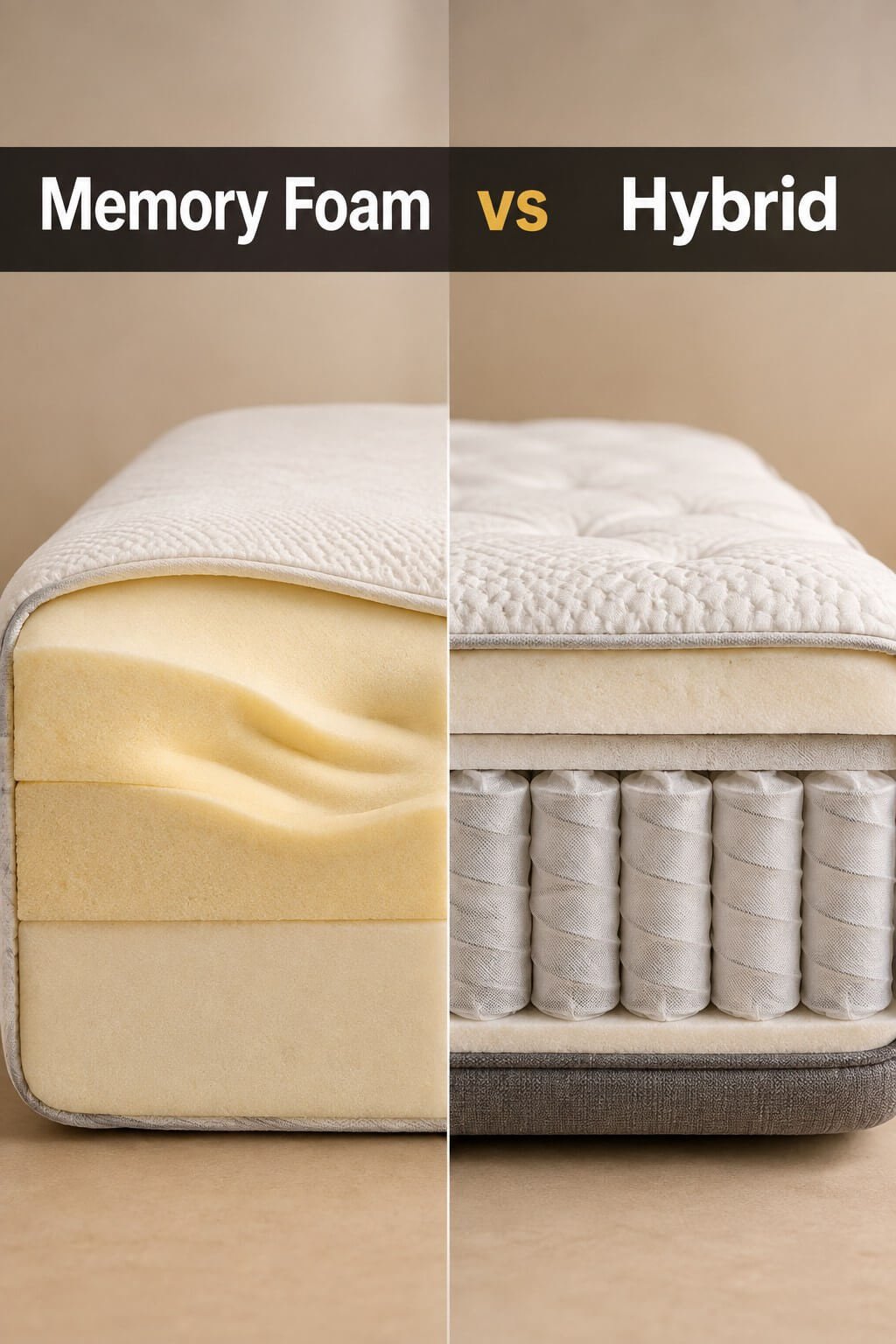
Memory Foam vs Hybrid Mattress: Full Comparison
| Criteria | Memory Foam | Hybrid Mattress |
|---|---|---|
| Cost (Queen) | $600–$2,500 | $900–$3,200 |
| Cooling | Fair to poor — retains body heat | Good — coil layer allows airflow |
| Motion Isolation | Excellent | Good to moderate |
| Edge Support | Weak to fair | Strong |
| Durability / Lifespan | 6–8 years | 7–10 years |
| Firmness Range | Soft to medium-firm | Medium-soft to firm |
| Best For | Side sleepers, light sleepers, couples, budget buyers | Hot sleepers, heavier bodies, combo sleepers |
Those ratings translate into real, everyday differences. “Excellent motion isolation” on memory foam means you can drop a bowling ball on one side of the bed and barely feel a ripple on the other — genuinely useful if your partner gets up at 5 a.m. “Good airflow” on a hybrid means the surface actually feels cooler to the touch within the first few nights, not just on a spec sheet. And “weak to fair edge support” on memory foam is the reason people describe rolling off the edge when they sit down to put on socks. None of these differences are marketing spin — they come directly from how each mattress is built. Check our bed size chart if you want exact numbers before you shop.
Quick Look: Memory Foam vs Hybrid at a Glance
Memory Foam
Dense, contouring foam layers that hug the body, isolate motion, and stay quiet — best for pressure relief and light or budget-conscious sleepers.
View on Amazon →Hybrid Mattress
Pocketed coils topped with a foam comfort layer, built for airflow, edge support, and more responsive feel — best for hot, heavier, or combo sleepers.
View on Amazon →Deep Dive: Memory Foam
Memory foam is the right call when pressure relief and quiet are non-negotiable. It’s the go-to for side sleepers dealing with hip or shoulder pain, for light sleepers who wake up at the slightest movement, and for anyone furnishing a bedroom on a tighter budget. The trade-off is heat retention and softer edges — real drawbacks, not deal-breakers, but ones you should walk in expecting. Our small walk in closet ideas has more inspiration along these same lines.
Pros
- Exceptional pressure relief for shoulders and hips
- Outstanding motion isolation — partner movement barely felt
- Quieter than coil-based mattresses, no spring noise Our mattress size chart breaks down the exact measurements to plan around.
- Lower typical entry price
- Contours closely to the body, ideal for side sleepers
Cons
- Retains body heat, sleeps warmer for many people
- Softer edges make it easy to roll off when sitting or standing
- Slower response can feel like being “stuck” for combo sleepers
- Heavier sleepers may sink past the comfort layer sooner
- Longer off-gassing smell when new
Real cost range: $600–$2,500 for a queen, with most solid mid-range options landing between $900 and $1,400.
Deep Dive: Hybrid Mattress
A hybrid earns its higher price when cooling, support, and durability matter more than deep contouring. It’s the stronger pick for hot sleepers, heavier body types, and anyone who moves through several sleep positions in a night and needs the mattress to keep up. The trade-offs are cost, weight, and slightly more motion transfer than full foam.
Pros
- Better airflow keeps the surface noticeably cooler
- Stronger, more supportive edges
- More responsive bounce, easier to reposition on
- Handles a wider range of body weights well
- Combines contouring comfort with real structural support
Cons
- Higher typical price point
- Coils transmit more motion than all-foam construction
- Heavier overall, harder to move or rotate solo
- Some coil designs can develop noise after years of use
- Less deep contouring for pinpoint pressure relief
Real cost range: $900–$3,200 for a queen, with most solid mid-range options landing between $1,300 and $1,900.
Which One Wins for Your Bedroom?
Hot Sleepers
Coils let air circulate underneath, so a hybrid sleeps noticeably cooler than solid memory foam.
Winner: HybridRestless Partner
Foam absorbs movement at the source — coils simply can’t match its motion isolation.
Winner: Memory FoamSide Sleepers with Hip/Shoulder Pain
Deep, even contouring cushions pressure points better than a coil-based surface.
Winner: Memory FoamBudget Bedroom or Guest Room
Lower entry pricing makes memory foam the practical pick when budget decides.
Winner: Memory FoamHeavier Bodies & Combo Sleepers
Coil support resists sinking and holds up better under weight and frequent repositioning.
Winner: HybridProfessional Tips
Designer & Sleep-Expert Notes
- Don’t buy on the firmness label alone — “medium” varies wildly between brands. Always confirm the sleep trial’s actual return window before you commit.
- If your weight is on the higher end, size up. A queen or king spreads body weight more evenly and reduces the chance of feeling undersupported.
- Mattresses have essentially no resale value — think in cost-per-year of use, not resale, when weighing a budget tier against a premium one.
- Use a mattress protector from day one. It’s the simplest way to protect either construction type and keep the warranty valid.
- Rotate the mattress head-to-foot every 3–6 months on modern one-sided constructions — don’t try to flip it.
- The most common regret we hear is choosing on price alone and skipping the in-home trial. Always sleep on it for the full trial period before deciding.
Shop the Winner
If you’re leaning toward memory foam, here’s what to get started with:
Best Overall
A balanced medium-firm memory foam mattress built for all-around pressure relief and everyday comfort.
Best Budget
An entry-tier all-foam mattress that covers the essentials for a guest room or first apartment.
Best Premium
A multi-layer foam mattress with cooling gel infusion and reinforced edges for a higher-end feel.
If hybrid support and cooling matter more to you, start here:
Best Overall
A medium-firm hybrid with individually pocketed coils and a breathable foam comfort layer.
Best Budget
An affordable coil-and-foam hybrid that still delivers real edge support and airflow.
Best Premium
A zoned-support hybrid with reinforced coils, built for heavier sleepers and adjustable bases.
Frequently Asked Questions
Is a hybrid mattress worth the extra cost over memory foam?
For most hot sleepers, heavier body types, or anyone who wants stronger edge support, yes — the extra cost tends to pay off in comfort and longevity. If pressure relief and quiet sleep matter more than cooling, memory foam is often the better value.
Do hybrid mattresses sleep cooler than memory foam?
Generally yes. The coil layer allows air to circulate through the mattress, while solid memory foam traps body heat close to the skin.
Which is better for back pain, memory foam or hybrid?
It depends on the type of pain: memory foam typically wins for pressure-point pain in the hips and shoulders, while a medium-firm hybrid often wins for lower-back support because it keeps the spine more level.
How long does a memory foam mattress last vs a hybrid?
Memory foam mattresses typically last 6–8 years, while hybrids often last 7–10 years thanks to the more durable coil support core.
Do memory foam mattresses sag faster than hybrids?
Yes, on average. All-foam mattresses tend to develop body impressions sooner than coil-supported hybrids, especially under heavier or concentrated weight.
Which mattress type is better for side sleepers?
Memory foam is usually the better fit, since its deep contouring cushions the hips and shoulders that bear the most pressure in a side-sleeping position.
Which mattress type is better for stomach sleepers?
A firmer hybrid tends to work better, since stomach sleepers need more even support to avoid the hips sinking out of spinal alignment.
Do hybrids have better edge support than memory foam?
Yes. The perimeter coil construction in most hybrids provides a firmer, more stable edge than all-foam mattresses, which tend to compress near the border.
Is memory foam or hybrid better for couples?
If motion transfer is the main concern, memory foam wins. If temperature and different firmness needs matter more, a hybrid — especially a zoned or split option — is usually the better pick.
Which off-gasses more, memory foam or hybrid?
Memory foam mattresses typically have a stronger, longer-lasting new-mattress smell because they contain more foam by volume. Hybrids off-gas too, but usually less noticeably.
Do hybrid mattresses need a specific foundation or base?
Most hybrids work on a standard slatted foundation, platform bed, or adjustable base — check the manufacturer’s slat spacing requirement, since gaps that are too wide can void the warranty.
Which is heavier to move, memory foam or hybrid?
Hybrid mattresses are noticeably heavier due to the steel coil layer, which makes rotating or moving them a two-person job more often than with memory foam.
Is memory foam or hybrid better for heavier body types?
Hybrid is generally the better fit, since the coil core resists sinking and provides more consistent support under higher body weight.
Which mattress type has a longer break-in period?
Memory foam typically has a longer break-in period, often several weeks, as the foam softens and fully expands into its final feel.
Do memory foam mattresses trap more heat than hybrids?
Yes — this is one of the most consistent differences between the two types, driven by airflow, or the lack of it, through the mattress core.
Which is more budget-friendly to start, memory foam or hybrid?
Memory foam generally has a lower entry price, making it the more budget-friendly starting point for a first mattress or guest room.
Can you flip a memory foam or hybrid mattress?
Most modern memory foam and hybrid mattresses are one-sided and not designed to be flipped — rotating head-to-foot is the correct maintenance instead.
Which is quieter, memory foam or hybrid?
Memory foam is quieter, since it has no moving coil parts. Some hybrids can develop faint spring noise over years of heavy use.
Do hybrids work well on adjustable bases?
Yes, most hybrids are compatible with adjustable bases, though very thick or heavy hybrids may flex less smoothly at sharp incline angles than an all-foam mattress.
Which mattress type is better for a guest room on a budget?
Memory foam is usually the more practical choice for a guest room, since it costs less upfront and doesn’t need to perform for one specific sleeper’s nightly needs.
Final Verdict
Choose hybrid if: you sleep hot, you’re on the heavier side, you sleep in multiple positions through the night, or you sit on the edge of the bed often and need it to hold up.
Choose memory foam if: you’re a side sleeper dealing with hip or shoulder pain, you share a bed with a restless partner, or you’re working with a tighter budget and want the most comfort per dollar.
Neither type is objectively “better” — they’re built to solve different problems. Match the mattress to how you actually sleep, not to whichever one is trending, and you’ll avoid the single biggest regret buyers report: picking based on price or hype instead of fit.