Standing in a mattress showroom trying to decide between a king and a queen bed usually comes down to one honest question: will this fit my room, and will it fit my life? A king gives you and a partner more personal space than almost anything else you can do for your sleep quality, but it demands a bigger room and a bigger budget at every turn — mattress, frame, sheets, all of it. A queen is the size most Americans actually sleep on, and for good reason: it works in almost any bedroom, costs meaningfully less to furnish, and still comfortably fits two adults. If you’re renovating a primary bedroom, furnishing a first apartment, or replacing an old mattress, here’s the real, room-by-room breakdown — not just a size chart.
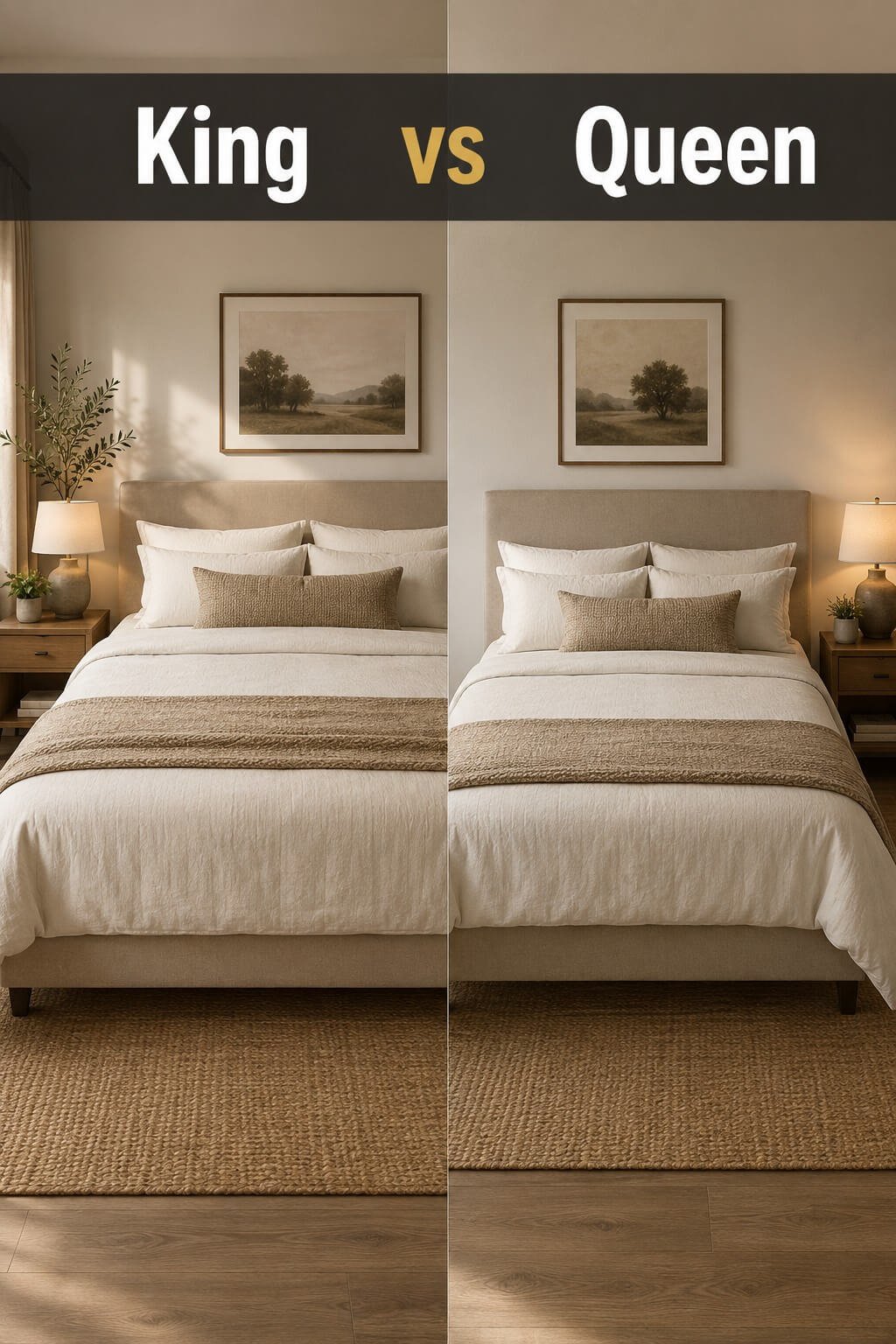
King vs Queen Bed: The Full Comparison
| Feature | King | Queen |
|---|---|---|
| Dimensions | 76″ x 80″ | 60″ x 80″ |
| Min. Room Size | 12′ x 12′ (144 sq ft) | 10′ x 10′ (100 sq ft) |
| Mattress Cost | $700–$2,500+ | $500–$1,800+ |
| Bedding Cost | $70–$160/set | $50–$120/set |
| Best For | Couples needing personal space, restless sleepers, occasional co-sleeping, sleepers over 6 ft | Solo sleepers, average-space couples, guest rooms, first apartments |
| Moving/Delivery | Moderate to difficult through narrow stairwells or hallways | Easier through standard stairwells and hallways |
| Resale & Flexibility | Narrower buyer pool in smaller homes; best in larger primary suites | Broadest buyer and renter appeal; fits nearly any bedroom |
The numbers only tell half the story. That extra 16 inches of width on a king is almost exactly the width of a twin bed — meaning two people on a king each get roughly the personal space of sleeping alone. On a queen, each person gets about 30 inches, which is comfortable for most couples but starts to feel tight for restless sleepers, larger-bodied sleepers, or anyone regularly sharing the bed with a kid or a large dog. The trade-off is floor space: that same 16 inches has to come from somewhere in your room, which is why the “12×12 minimum” rule for a king isn’t arbitrary — go smaller and you’ll likely lose a nightstand, a dresser, or walking room around the bed. Our small walk in closet ideas has more inspiration along these same lines.
Quick Look: King vs Queen Bed at a Glance
King Bed
Maximum sleeping space for couples who want room to spread out, at the cost of needing a larger bedroom and budget.
View on Amazon →Queen Bed
The most space-efficient, budget-friendly size that still comfortably fits two adults in almost any bedroom.
View on Amazon →Deep Dive: King Bed
A king bed is the right call when personal space during sleep matters more than square footage in the room. It shines for couples with mismatched schedules, restless sleepers, households where a child or pet regularly climbs into bed, and anyone tall enough that a little extra width (even without extra length) makes a real difference. Real cost range: expect $700 to $2,500+ for the mattress alone, plus $150 to $500+ for a frame and $70 to $160 per sheet set. Check our bed size chart if you want exact numbers before you shop.
Pros
- Roughly twin-bed width of personal space per sleeper
- Comfortably handles occasional co-sleeping with a child or pet
- Feels proportionate and upscale in a larger primary suite
- Reduces disturbance from a restless or early-rising partner
- Extra width benefits taller or larger-bodied sleepers
Cons
- Needs a room at least 12′ x 12′ to avoid feeling cramped
- Mattress, frame, and bedding all cost more at every tier Our mattress size chart breaks down the exact measurements to plan around.
- Harder to move through narrow stairwells and hallways
- Narrower resale/rental buyer pool in smaller homes
Deep Dive: Queen Bed
A queen bed is the default recommendation for most bedrooms, and for good reason — it fits comfortably in rooms as small as 10′ x 10′, costs meaningfully less across every category, and still sleeps two adults without feeling like a compromise for the average couple. It’s also the safest choice for guest rooms and first apartments, where flexibility and budget matter more than maximizing personal sleeping space. Real cost range: expect $500 to $1,800+ for the mattress alone, plus $120 to $400 for a frame and $50 to $120 per sheet set.
Pros
- Fits comfortably in rooms as small as 10′ x 10′
- Meaningfully lower cost across mattress, frame, and bedding
- Easier to move through standard stairwells and doorways
- Broadest resale and rental appeal of any bed size
- Leaves more floor space for other bedroom furniture
Cons
- Can feel tight for two larger-bodied or restless sleepers
- Less comfortable for regular co-sleeping with kids or pets
- Taller primary suites can feel underfurnished with only a queen
Which Size Wins for Your Room?
Small Primary Bedroom
Under 10′ x 12′ with a dresser and walking room to preserve.
Queen wins
Guest Room
Used occasionally, needs to fit a couple without a large footprint.
Queen wins
First Apartment
Tight stairwells, elevators, and a budget-conscious move-in.
Queen wins
Growing Family / Co-Sleeping
Occasional co-sleeping with a child or pet needs the extra width.
King wins
Luxury Primary Suite
13′ x 13’+ with room to spare for a sitting area or bench.
King wins
Professional Tips
- Run the nightstand test before buying. Measure your room, subtract the bed’s footprint, and check whether at least 24 inches remains on each side for nightstands and walking room — not just whether the bed technically fits.
- Check your tightest turn before ordering a king. Measure the narrowest stairwell landing or hallway corner between the door and the bedroom; king mattresses that ship compressed in a box sidestep this problem entirely.
- Budget for the mattress protector. It’s the most commonly forgotten cost on both sizes, and king protectors run noticeably more than queen — factor it in alongside the mattress and sheets, not as an afterthought.
- Think about resale before committing a small home to a king. A king-only primary bedroom in a starter home can quietly narrow your buyer pool later; a room that comfortably fits either size keeps more options open.
Shop the Winner: Mattresses
If you’re leaning toward a queen for space and budget, or a king for maximum sleeping room, here’s what to get started with once you’ve settled on a size.
Best Overall
A balanced medium-firm hybrid mattress that performs well for couples and solo sleepers in both king and queen sizes.
Best Budget
An affordable all-foam mattress that keeps total cost down, especially useful when upgrading to a king for the first time.
Best Premium
A plush hybrid or latex mattress with reinforced edge support, worth the upgrade cost on a king shared by two people.
Frequently Asked Questions
What is the exact size difference between a king and queen bed?
A standard king bed measures 76 inches wide by 80 inches long, while a queen bed measures 60 inches wide by 80 inches long. That’s a 16-inch difference in width, with the same length, giving each sleeper on a king roughly 8 more inches of personal space per side.
How much bigger is a king bed than a queen bed in square footage?
A king bed covers about 42.2 square feet of floor space versus about 33.3 square feet for a queen, a difference of roughly 9 square feet, which is why king beds need a noticeably larger room to feel comfortable rather than cramped.
Is a king bed too big for a small bedroom?
In a bedroom smaller than about 12 feet by 12 feet, a king bed usually leaves little room for nightstands, a dresser, or walking space. In rooms under that size, a queen bed almost always feels more balanced.
What size room do I need for a king bed?
Aim for at least 12 feet by 12 feet (144 square feet) so you can fit nightstands on both sides and still walk comfortably around the bed. Larger primary suites of 13 feet by 13 feet or more give a king room to breathe.
What size room do I need for a queen bed?
A queen bed works comfortably in a room as small as 10 feet by 10 feet (100 square feet), which is why it’s the standard choice for guest rooms, first apartments, and mid-sized primary bedrooms.
Which bed size is best for couples?
Couples who are restless sleepers, have different schedules, or share the bed with kids or pets tend to sleep better in a king. Couples who don’t mind close quarters and want to save on cost and room size are usually happy with a queen.
Is a queen bed big enough for two adults?
Yes — a queen gives each person about 30 inches of width, similar to a twin bed, which is enough space for most couples. It only starts to feel tight for larger-bodied sleepers, restless sleepers, or couples who regularly share the bed with a child or large pet.
How much does a king mattress cost compared to a queen?
A king mattress typically runs $700 to $2,500 or more depending on material and brand, while a comparable queen mattress runs $500 to $1,800 or more. Expect to pay roughly 20 to 30 percent more for a king at any given quality tier.
Do king sheets cost a lot more than queen sheets?
Yes, and it adds up over time. King sheet sets typically run $70 to $160 versus $50 to $120 for queen, and that difference repeats every time you replace bedding, a mattress protector, or a comforter.
Which bed size is better for a small bedroom?
A queen bed is the better fit for a small bedroom. It leaves enough floor space for a dresser, nightstands, and walking room, while a king in the same space often blocks furniture placement entirely.
Which bed size is best for a guest room?
Queen is the standard choice for guest rooms. It comfortably sleeps a couple or two adults, fits in most standard-sized spare rooms, and keeps bedding costs manageable for a room that isn’t used every day.
Can two adults and a child comfortably co-sleep on a king bed?
A king bed handles occasional co-sleeping with one child or a pet much better than a queen, since there’s enough width for three bodies without anyone being pushed to the edge. It’s still tight for nightly co-sleeping with more than one child.
Is a king bed better for tall people?
Standard king and queen beds are both 80 inches long, so a king doesn’t add legroom over a queen. Tall sleepers who need extra length should look at a California king (72 by 84 inches) rather than a standard king.
Does bed size affect resale value of a home?
Bed size itself isn’t a resale line item, but primary bedrooms sized to comfortably fit a king tend to be seen as a stronger selling point in larger homes, while smaller starter homes with rooms sized for a queen are more broadly appealing to first-time buyers.
How hard is it to move a king mattress?
King mattresses are noticeably harder to maneuver through narrow stairwells, tight hallway turns, and standard doorways than queen mattresses. Measure your tightest turn before buying, and consider a mattress that ships compressed in a box if clearance is limited.
What’s the difference between a king and a California king?
A standard king is 76 by 80 inches, while a California king is 72 by 84 inches — narrower but 4 inches longer. California king suits taller sleepers, while a standard king suits sleepers who want maximum width.
Should I get a king or queen bed for a first apartment?
Queen is the more practical choice for a first apartment. It’s easier to move through apartment stairwells and elevators, costs less to furnish, and fits typical apartment bedroom dimensions without overwhelming the room.
Do king beds need special bedding or sheets?
King beds need their own dedicated king-size sheets, mattress protector, and comforter — queen bedding will not fit. This is a recurring cost to factor in beyond the mattress and frame price.
Is a queen bed better for a single sleeper?
For most solo sleepers, a queen bed is more than enough space and is more cost-effective to furnish and maintain. A king only makes sense for a solo sleeper who wants extra sprawl room or shares the bed with pets.
Which bed size is more popular, king or queen?
Queen is the best-selling bed size in the United States, largely because it balances comfortable sleeping space with affordability and fits the widest range of bedroom sizes.
Final Verdict
Choose a queen bed if you’re furnishing a bedroom under 12′ x 12′, a first apartment, or a guest room — it’s the more practical, budget-friendly choice for the vast majority of bedrooms and sleepers.
Choose a king bed if your primary bedroom is 12′ x 12′ or larger and you’re a couple who wants real personal space, deals with restless sleep, or regularly shares the bed with a kid or pet. The extra cost buys sleep quality, not just square footage.
If you’re stuck between the two and your room is right on the edge, size down to queen — a room that feels spacious will always outlast a bed that felt like an upgrade on paper.