If you’re standing in your backyard trying to decide between a poured concrete patio and an interlocking paver patio, the honest answer is that neither one is universally “better” — but one is almost certainly better for your yard. Concrete tends to suit tight budgets, straightforward rectangular spaces, and anyone who wants the lowest-hassle install. Pavers tend to suit homeowners who want long-term repairability, a more custom look, and better resale perception, especially in climates with real winters or heavy pool use. Below, we break down the real costs, the durability trade-offs nobody mentions upfront, and which option wins for five common backyard scenarios.
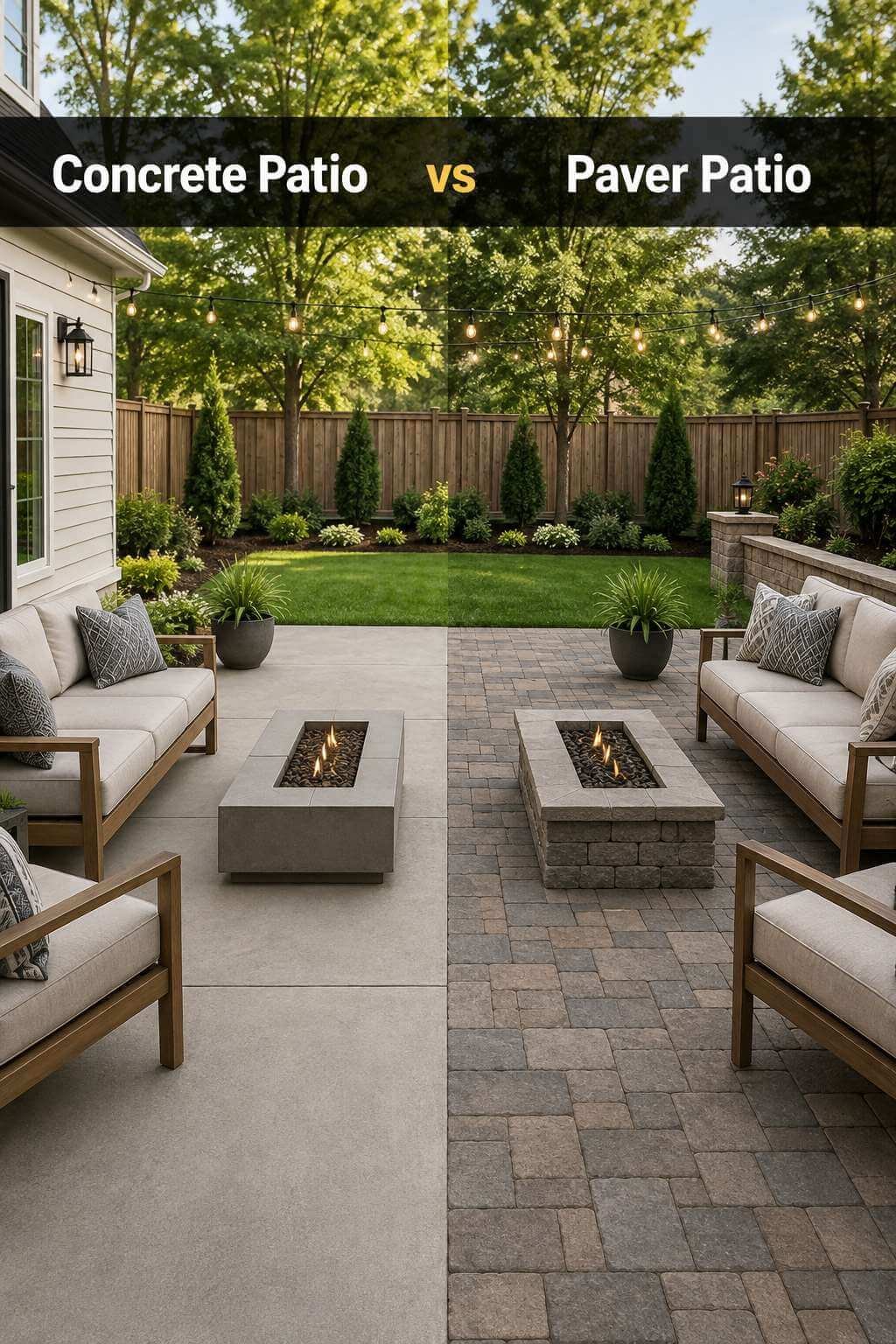
Concrete Patio vs Paver Patio: The Master Comparison
| Criteria | Concrete Patio | Paver Patio |
|---|---|---|
| Cost per Sq Ft | $6–$10 installed for a basic slab; $10–$18 for stamped or colored finishes | $10–$17 installed for standard pavers; $17–$30+ for natural stone-look options |
| Durability | Prone to cracking from ground movement, tree roots, or freeze-thaw cycles, and cracks are hard to hide once they appear | Individual units flex with minor ground shifting and rarely crack; a damaged paver can be swapped without touching the rest |
| Maintenance | Needs resealing roughly every 2–3 years to prevent staining and moisture damage; pressure washing handles most surface grime | Needs joint sand topped off occasionally and is more prone to weed growth between joints, but spot repairs are simple |
| Install Difficulty | Usually requires a concrete contractor and specialized equipment; not realistic as a full DIY project for most homeowners | A realistic weekend DIY project with proper base prep, though professional installation is still common for larger patios |
| Lifespan | 25–30 years with proper sealing and a well-prepared base | 25–50 years, since individual pavers can be reset or replaced instead of the whole surface failing at once |
| Aesthetic Flexibility | Can be stamped, stained, or scored into patterns, but the finished look is essentially one continuous surface | Available in dozens of shapes, colors, and laying patterns for a more custom, dimensional look |
| Resale Value | Seen by buyers as a solid, low-maintenance standard feature | Often perceived as a higher-end upgrade, especially in warmer climates where patios see heavy use |
What those ratings mean in practice: concrete’s lower up-front cost is real, but it’s a bet that your soil won’t shift and your climate won’t put it through harsh freeze-thaw cycles — because once a slab cracks, you’re looking at a patch job that’s rarely invisible. Pavers cost more to install but spread that cost differently: instead of one catastrophic failure, you get small, cheap, individual repairs over decades. If you’ve ever seen a 15-year-old concrete patio with a spiderweb crack across it next to a 20-year-old paver patio that still looks even, that’s the trade-off in a single image. Our small patio ideas has more inspiration along these same lines.
Quick Look: Concrete Patio vs Paver Patio at a Glance
Concrete Patio
The lower-cost, lowest-hassle option to install, best for tight budgets and simple, rectangular spaces.
View on Amazon →Paver Patio
The more repairable, more customizable option, best for durability, resale value, and long-term flexibility.
View on Amazon →Deep Dive: Concrete Patio
Best-fit scenarios: Concrete makes the most sense for homeowners on a tight renovation budget, simple rectangular or square backyard shapes, and anyone who wants the fastest path from bare dirt to a usable patio without managing a multi-day DIY project. It’s also a solid choice for landlords or property owners who want a low-maintenance surface they won’t need to think about often.
Pros
- Lowest up-front installed cost of the two options
- Fastest overall install timeline once poured
- One continuous surface with no joints for weeds or ants
- Can be stamped or colored to mimic stone at a lower price
Cons
- Cracks from ground movement, roots, or freeze-thaw are hard to hide
- Needs resealing every 2–3 years to resist staining and moisture
- Not a realistic full DIY project for most homeowners
- Repairing a damaged section rarely blends in seamlessly
Real cost range: Expect roughly $6–$10 per square foot installed for a basic broom-finished slab, and $10–$18 per square foot for stamped, stained, or decoratively scored concrete, depending on region and contractor demand.
Deep Dive: Paver Patio
Best-fit scenarios: Pavers are the stronger pick for irregularly shaped or small backyards where units can be cut to fit tight corners, high-traffic family spaces that need spot repairs over time, poolside decks that benefit from better grip and heat resistance, and any homeowner who wants a more custom look with mixed colors or patterns. It’s a similar trade-off to deciding on deck vs patio elsewhere in the space.
Pros
- Individual units can be lifted and replaced instead of the whole surface
- Handles freeze-thaw and minor ground shifting better than a rigid slab
- Far more pattern, shape, and color flexibility
- Realistic as a DIY project for a motivated homeowner
Cons
- Higher up-front installed cost than basic concrete
- Joint sand and occasional weed growth require periodic upkeep
- Base preparation is labor-intensive and easy to get wrong
- Individual pavers can shift slightly without proper edge restraints
Real cost range: Expect roughly $10–$17 per square foot installed for standard concrete pavers, and $17–$30 or more per square foot for natural stone-look or premium paver products, depending on pattern complexity and region.
Which One Wins for Your Backyard?
Small Urban Backyard Patio
Paver Patio wins — individual units cut and fit around tight corners and irregular lot lines far more easily than a single poured slab.
Budget Renovation Patio
Concrete Patio wins — the lowest per-square-foot cost gets you the most usable outdoor space for a limited renovation budget.
Luxury Poolside Patio
Paver Patio wins — better slip resistance, cooler surface temperature underfoot, and a more upscale, dimensional look next to water.
Rental-Friendly Patio Upgrade
Concrete Patio wins — the simplest, lowest-maintenance surface for owners who want a durable upgrade they won’t need to manage between tenants.
High-Traffic Family Backyard
Paver Patio wins — daily wear, dropped toys, and dragged furniture are far easier to spot-repair one paver at a time than to patch a cracked slab.
Professional Tips Before You Decide
- The most common regret: choosing based on install cost alone and skipping proper base compaction — a rushed base is the number one reason either material fails early, and it’s far more expensive to fix after the fact than to do right the first time.
- Designer tie-breaker: if you’re genuinely torn, let your climate decide — pavers are the safer bet anywhere with real freeze-thaw winters, while concrete is perfectly fine in milder, drier climates.
- Resale-value note: in competitive housing markets, a paver patio photographs better for listings and tends to read as a more intentional upgrade than a plain concrete slab, even when the cost difference was modest.
- Maintenance reality-check: neither surface is maintenance-free — budget for resealing concrete every 2–3 years or topping off paver joint sand every few years, whichever you choose.
Shop the Winner
Whichever material you land on, sealing it properly is what actually determines whether it looks good in year one or year ten.
If you’re leaning toward Concrete Patio, here’s what to get started with:
Best Overall
A penetrating concrete sealer that soaks into the surface to block moisture and salt damage without leaving a glossy film, ideal for driveways-adjacent patios in freeze-thaw climates.
Best Budget
A basic acrylic concrete sealer that adds a light protective sheen and is straightforward to apply with a roller for a first-time DIY resealing job.
Best Premium
A UV-resistant concrete and paver sealer that resists yellowing over time and holds up well on stamped or colored concrete exposed to full sun.
If you’re leaning toward Paver Patio, here’s what to get started with:
Best Overall
A paver joint and surface sealer that locks polymeric sand in place while reducing weed growth and efflorescence on the paver faces.
Best Budget
A basic acrylic paver sealer that adds a light wet-look finish and modest weed resistance for a first pass at protecting a new install.
Best Premium
A polymeric sand and sealer combo kit designed to be applied together for maximum joint stability and long-term color retention.
Frequently Asked Questions
Is a paver patio more expensive than a concrete patio?
Yes, in most cases. A basic poured concrete patio typically runs $6 to $10 per square foot installed, while a standard paver patio runs $10 to $17 per square foot, with premium natural stone-look pavers going higher. The gap narrows once you add stamping, staining, or decorative finishes to concrete.
Which lasts longer, concrete or pavers?
Pavers generally last longer in practice, often 25 to 50 years, because individual units can be lifted and replaced instead of the whole surface failing at once. A well-installed concrete patio typically lasts 25 to 30 years before major cracking or resurfacing is needed.
Can I install a paver patio myself?
Yes, a paver patio is a realistic weekend-to-multi-weekend DIY project for a motivated homeowner, as long as the base is properly excavated, compacted, and leveled. Skipping proper base prep is the most common DIY mistake and leads to uneven settling later.
Do concrete patios crack easily?
Concrete is prone to cracking from ground movement, tree root growth, and freeze-thaw cycles, especially without proper reinforcement and control joints. Once a crack forms, it’s difficult to fully hide, even after patching.
How often do you need to reseal a concrete patio?
Most concrete patios should be resealed roughly every 2 to 3 years to protect against staining, moisture penetration, and freeze-thaw damage. High-traffic or high-sun areas may need it slightly more often.
Do pavers need sealing too?
Sealing pavers is optional but recommended. It locks polymeric sand in place, reduces weed growth between joints, and keeps colors from fading, typically needing reapplication every 3 to 5 years depending on sun and foot traffic.
Which patio material handles freezing winters better?
Pavers generally handle freeze-thaw cycles better because individual units can shift slightly without cracking. A poured concrete slab is more rigid, so repeated freezing and thawing is a leading cause of cracking in colder climates.
Do weeds grow between pavers?
Weeds can grow in paver joints if sand washes out or gaps open over time, but polymeric sand and periodic sealing significantly reduce this. It’s a real maintenance trade-off compared to a single continuous concrete surface.
Can you repair a cracked concrete patio?
Small cracks can be patched, but the repair is rarely invisible and the patio typically needs to be resurfaced or replaced once cracking becomes widespread. This is one of concrete’s biggest long-term drawbacks compared to pavers.
Is a paver patio worth more when selling a house?
Many buyers and appraisers perceive pavers as a higher-end upgrade compared to plain poured concrete, particularly in warmer climates where outdoor living space gets heavy use. Concrete is still seen as a solid, standard feature, just less of a differentiator.
Which is better for a pool deck, concrete or pavers?
Pavers are usually the better choice around a pool because they stay cooler underfoot, offer better slip resistance with a textured surface, and individual units can be replaced if stained by pool chemicals.
How long does it take to install a concrete patio vs a paver patio?
A poured concrete patio typically takes a few days for the pour and curing before it’s usable. A paver patio can take longer for base preparation but is often ready to walk on almost immediately after the final pavers and joint sand are placed.
Can pavers be installed over an old concrete patio?
In some cases pavers can be installed directly over an existing concrete slab if it’s structurally sound and properly sloped for drainage, which can reduce demolition costs. A contractor should confirm the existing slab is a suitable base first.
Which patio material is more slip-resistant?
Textured pavers generally offer better slip resistance than smooth or heavily sealed concrete, especially when wet. Stamped or broom-finished concrete can close some of this gap, but a glossy sealed finish reduces traction.
Do concrete patios stain easily?
Unsealed or poorly sealed concrete can stain from grease, leaves, and rust fairly easily. Regular resealing significantly reduces staining risk, but concrete is generally more stain-prone than sealed pavers.
What’s the average lifespan of a paver patio?
A well-installed paver patio typically lasts 25 to 50 years, since individual pavers can be reset or swapped out over time instead of the entire surface needing replacement.
Is stamped concrete cheaper than pavers?
Stamped or decorative concrete usually costs somewhere between basic poured concrete and standard pavers, often landing close to mid-range paver pricing once coloring and stamping labor are included.
Can I DIY a concrete patio?
A full concrete pour is not a realistic DIY project for most homeowners because it requires specialized forms, reinforcement, and finishing equipment, and mistakes are difficult to fix once the concrete sets. Most homeowners hire a contractor for this step.
Which patio option is better for a small backyard?
Pavers are often better suited to small or irregularly shaped backyards because individual units can be cut and fitted around tight corners, utility access points, or existing landscaping more easily than a single poured slab.
What’s the biggest mistake homeowners make when choosing between concrete and pavers?
Choosing based on upfront cost alone, without factoring in resealing, repair costs, and how the material will hold up to the specific climate and traffic level of the yard. The cheaper option today isn’t always the cheaper option over 10 to 15 years.
Final Verdict
If you’re renovating on a tight budget, want the fastest install, or you’re a landlord who just wants a durable surface you won’t think about again, go with a concrete patio — it’s the lower-cost, lower-maintenance-decision choice.
If you’re building for the long haul, dealing with a small or irregular yard, living somewhere with real winters, or you want a space that photographs well and holds resale value, go with a paver patio — the higher install cost pays for itself in repairability and flexibility over the next 20-plus years.
For most homeowners planning a standard backyard renovation who aren’t purely budget-constrained, pavers are the safer long-term bet — but concrete remains the smart, defensible choice when the budget is the deciding factor.