The kitchen is the heart of every home, but during the Christmas season, it transforms into something truly extraordinary — a warm, fragrant, and visually enchanting space where memories are baked, mulled wine simmers on the stove, and the spirit of the holidays lingers in every corner. Unlike the living room, which tends to steal the spotlight with its towering Christmas tree and fireplace, the kitchen offers a uniquely intimate canvas for holiday decorating. It’s a room where function and festivity must coexist, where garlands share shelf space with spice jars, and where a single wreath hung in the right place can shift the entire atmosphere of the room. Thoughtful Christmas kitchen decor isn’t just about aesthetics — it’s about creating a sensory experience that makes everyone who walks in feel the magic of the season.
What makes Christmas kitchen decorating so exciting is how deeply personal it can be. Whether your kitchen is a sleek modern space with dark cabinetry and marble countertops, a cozy farmhouse room with shiplap walls and open wooden shelving, or a compact apartment kitchen where every inch counts, there is a holiday decorating approach that will feel completely at home in your space. The 23 ideas explored in this article span a remarkable range of styles, aesthetics, and budgets — from the grand and luxurious to the quietly minimal, from the playfully colorful to the sophisticatedly restrained. Each one demonstrates that Christmas decor in the kitchen doesn’t have to be overwhelming or disconnected from your existing design; instead, the most beautiful results happen when seasonal touches feel like a natural extension of the space itself.

Throughout this article, you’ll find detailed explorations of different Christmas kitchen decorating concepts, each grounded in a specific design philosophy and brought to life with carefully chosen materials, color palettes, and lighting approaches. Whether you’re looking for inspiration to redecorate your entire kitchen for the holidays or simply searching for one perfect vignette to bring a touch of Christmas warmth to your cooking space, these ideas will give you the creative foundation you need. The goal is always the same: to make your kitchen feel like the most welcoming, joyful room in the house during the most wonderful time of the year.
1. The Farmhouse Christmas Kitchen With Garland-Draped Shelving
There is something deeply nostalgic and instantly comforting about a farmhouse-style kitchen dressed for Christmas, and when the decorating centers around open wooden shelving draped in fresh garland, the result is nothing short of breathtaking. In this design concept, generous lengths of rich green pine garland cascade along the edges of rustic wooden shelves, accented with natural pinecones, clusters of deep red berries, and the gentle gleam of small brass bells that catch the light with every movement. The combination of organic materials and traditional holiday colors creates a layered, textural display that feels handcrafted and genuinely warm rather than mass-produced or overly curated.
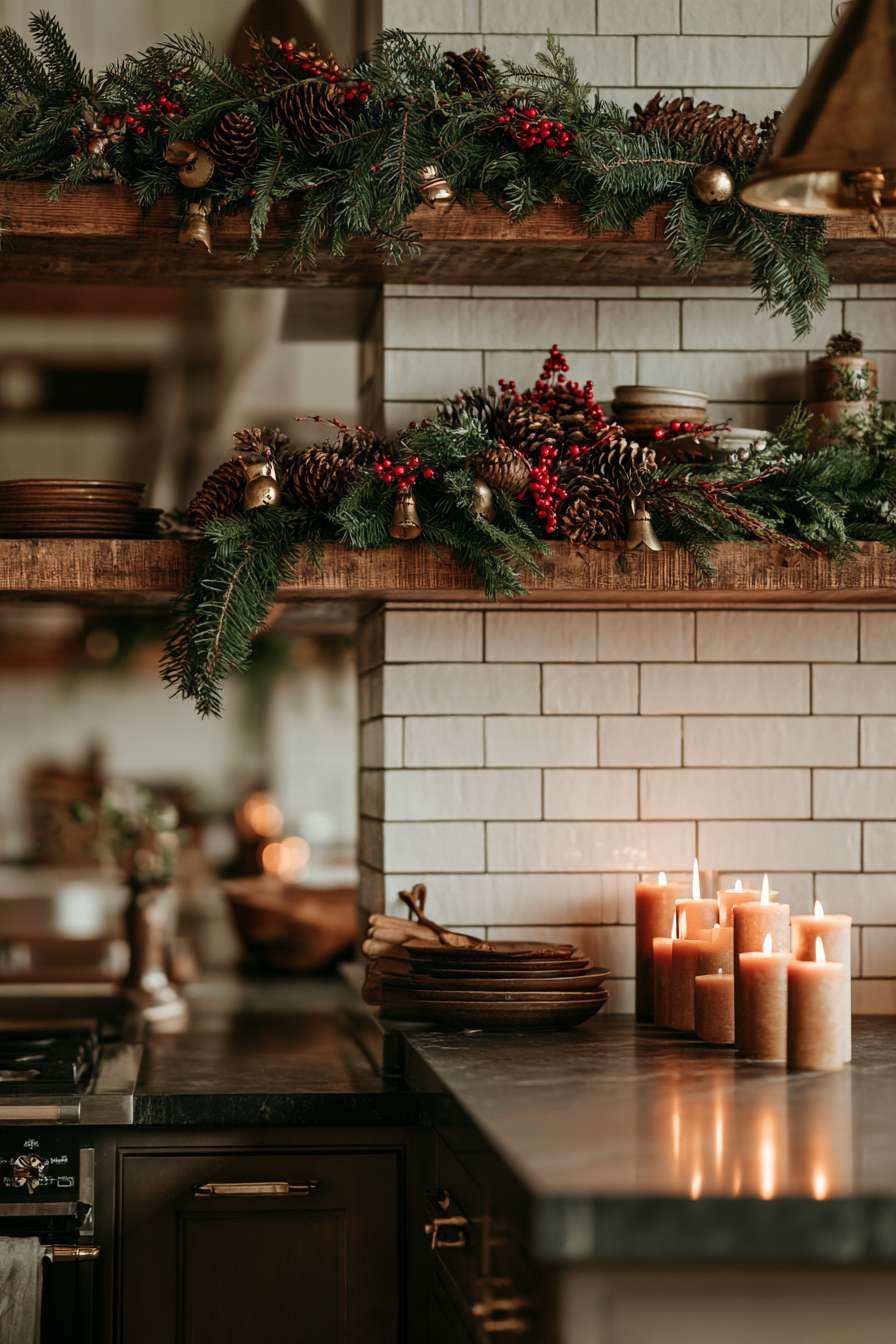
The white subway tile backsplash serves as a perfect foil to the deep, lush greenery, its clean grid pattern providing visual structure that prevents the natural materials from feeling chaotic. Against this crisp backdrop, the garland reads almost like a painting — vivid, dimensional, and alive. A row of pillar candles arranged along the countertop casts the kind of soft, dancing candlelight that no electric fixture can replicate, warming every surface with golden undertones and making the brass bells and pinecones glow with a quiet radiance. The natural textures of wood, stone, and dried botanicals are elevated by this light source, each material revealing its unique grain and surface detail.
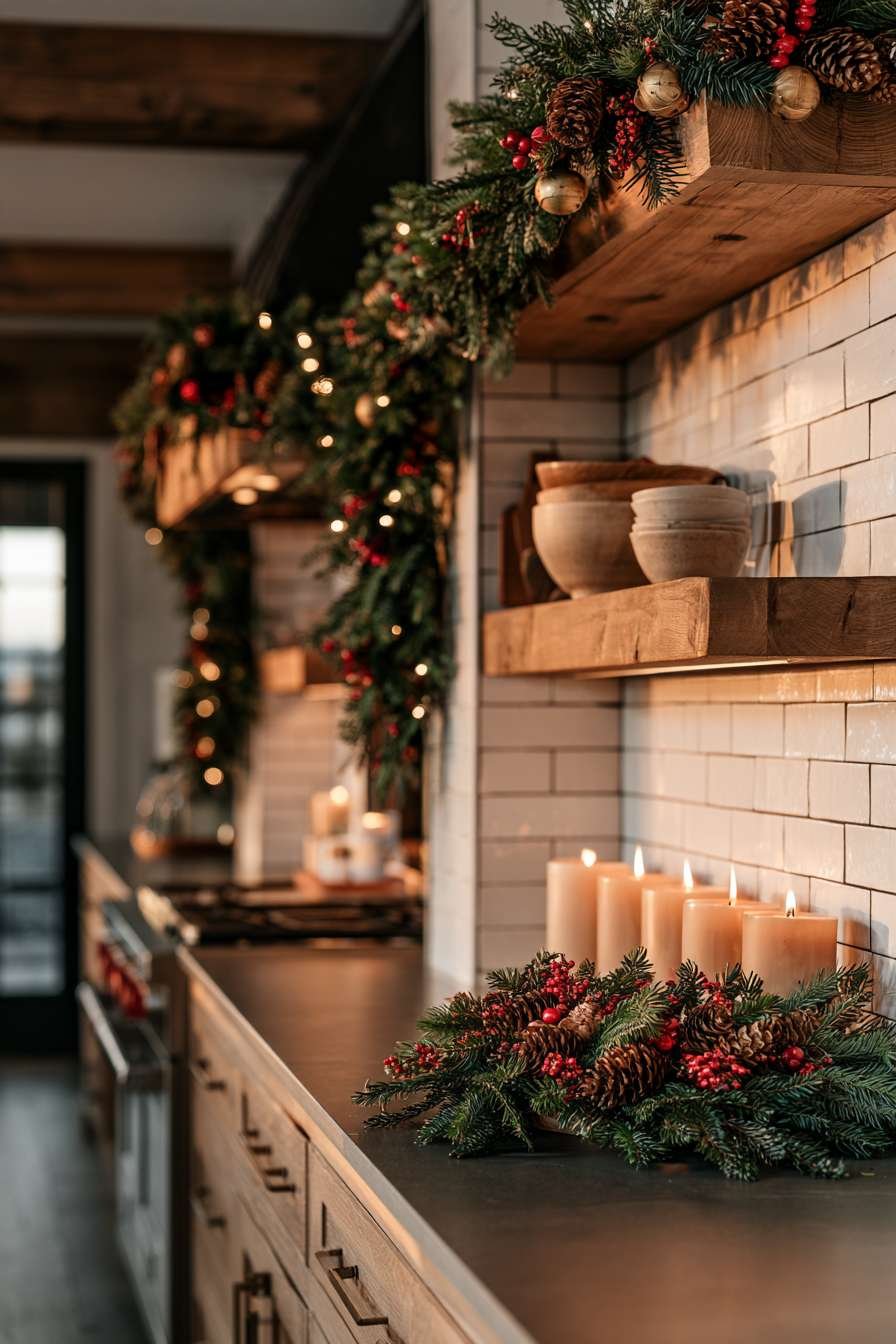
The overall mood of this kitchen design is one of unhurried abundance — a space that suggests someone has been cooking, gathering, and celebrating for days. The garland doesn’t look installed so much as it looks grown into place, as though the kitchen has always been this green and fragrant. This is the aesthetic power of using genuine natural materials rather than artificial substitutes: fresh pine garland carries a scent that is itself a form of decor, filling the kitchen with the unmistakable fragrance of a winter forest. Paired with the warm spice notes that inevitably arise from holiday baking, this sensory combination creates a deeply immersive Christmas atmosphere.
Key Design Tips:
- Use fresh pine or fir garland rather than artificial for authentic fragrance and texture, and mist it lightly with water every few days to extend its life throughout the season.
- Mix garland materials — combining pine with eucalyptus, cedar, or holly — for a richer, more layered look that photographs beautifully.
- Anchor brass or gold accents like bells, clips, and ribbon to tie the garland into the kitchen’s existing hardware finishes.
- Use LED pillar candles in a warm amber tone to achieve the candlelight look safely near garland and open shelving.
- Vary the density of the garland — fuller sections at shelf corners and lighter draping in between creates a naturally flowing, organic installation.
2. The Modern Minimalist Christmas Kitchen With Eucalyptus Garland
Not every Christmas kitchen needs to be dense with ornaments and bursting with color. In this modern white kitchen, the holiday season is celebrated with extraordinary restraint — and the result is arguably more elegant for it. A single eucalyptus and cedar garland runs the length of the kitchen island bar, its silvery-green leaves and feathery cedar fronds tied at intervals with natural linen ribbon that echoes the kitchen’s commitment to organic, undyed materials. The garland is intentionally slim and unstructured, more of a botanical gesture than a statement piece, and this deliberate understatement is precisely what makes it so effective in a contemporary space.
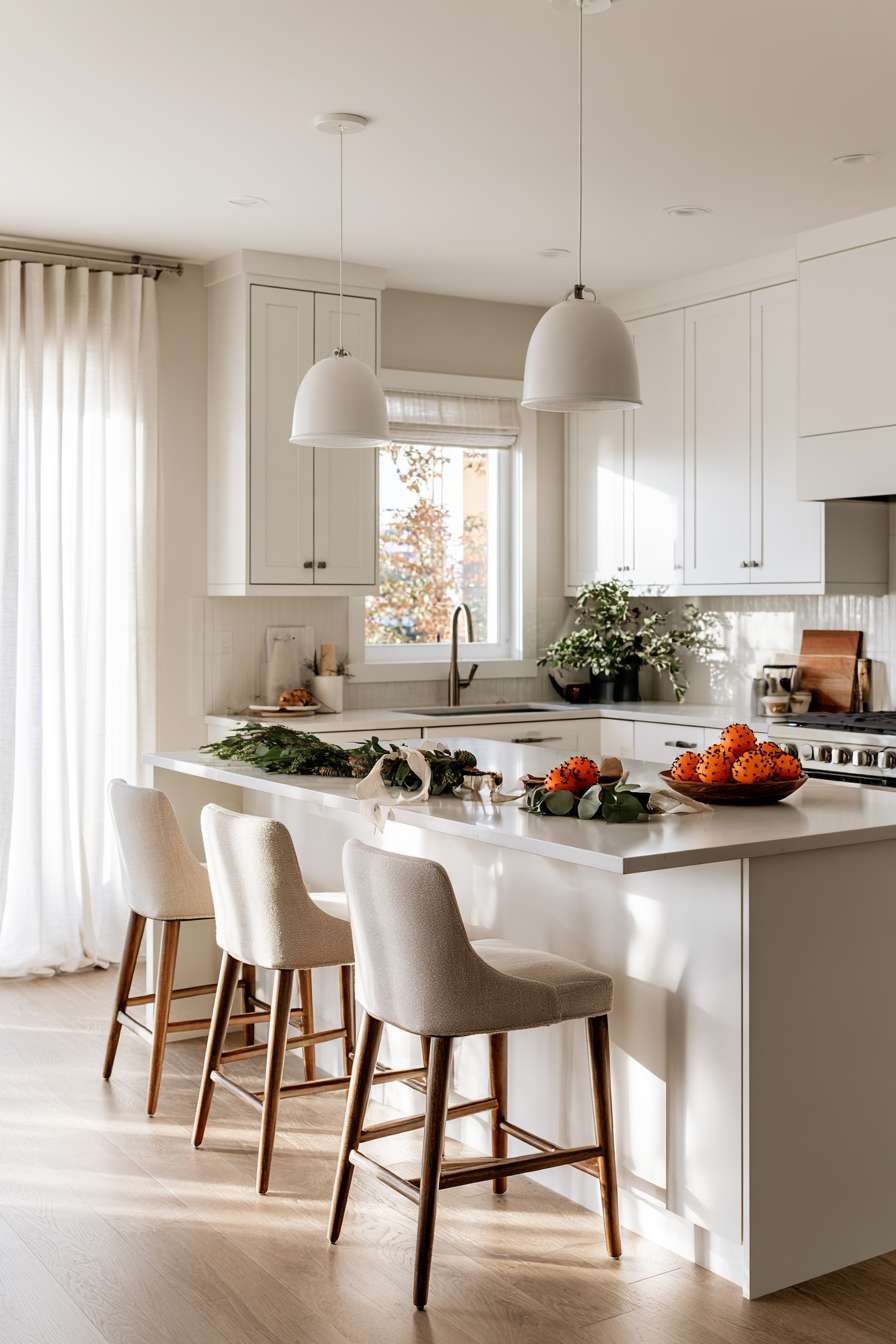
On the countertop nearby, a ceramic bowl of oranges studded with cloves introduces the olfactory dimension of holiday decorating in the most sophisticated possible way. The studded oranges — a centuries-old tradition known as pomander balls — are simultaneously decorative objects and natural air fresheners, their combination of citrus brightness and warm spice creating a scent profile that is complex, festive, and completely free of synthetic fragrance. Beside this sits a wooden cutting board, its natural grain and warm honey tones grounding the otherwise crisp white and green palette with an essential note of organic warmth.

Soft natural daylight streaming through sheer curtains is the defining lighting condition of this kitchen, and it transforms the space beautifully. Where a farmhouse Christmas kitchen glows with candlelight, this modern interpretation is flooded with the clear, even light of a winter morning — a light that makes white surfaces luminous, brings out the subtle grey-green tones of eucalyptus, and gives the citrus oranges a jewel-like quality. The clean lines of the cabinetry and the uncluttered countertops ensure that each carefully chosen decorative element reads with maximum clarity, nothing competing for attention, everything working in harmony.
Key Design Tips:
- In modern kitchens, choose one hero garland element rather than decorating multiple surfaces — visual restraint amplifies impact.
- Eucalyptus is an excellent choice for minimalist holiday decor because its natural silver-green tones complement grey, white, and black color schemes without introducing traditional Christmas red or green.
- Make pomander balls a decorative project — they take minimal time, cost almost nothing, and function as both centerpiece and natural fragrance diffuser for weeks.
- Use linen, jute, or undyed cotton ribbon rather than synthetic satin to maintain the organic, modern aesthetic.
- Let natural daylight do the heavy lifting; avoid adding string lights or warm-bulb fixtures in a contemporary kitchen where cool, clean light is part of the design language.
3. The Traditional Cozy Christmas Kitchen With Vintage Touches
There is a particular kind of Christmas kitchen decor that feels like stepping into a cherished memory — one associated with grandmothers’ kitchens, holiday baking traditions, and the specific warmth of a home where generations have gathered. This traditional cozy Christmas kitchen achieves exactly that feeling through a careful selection of vintage-inspired elements that feel genuinely lived-in rather than artificially aged. The red and white gingham table runner on the butcher block island is the first signal — that classic pattern, associated for decades with country kitchens and summer picnics, takes on an entirely new character in a Christmas context, becoming immediately festive without a single ornament in sight.
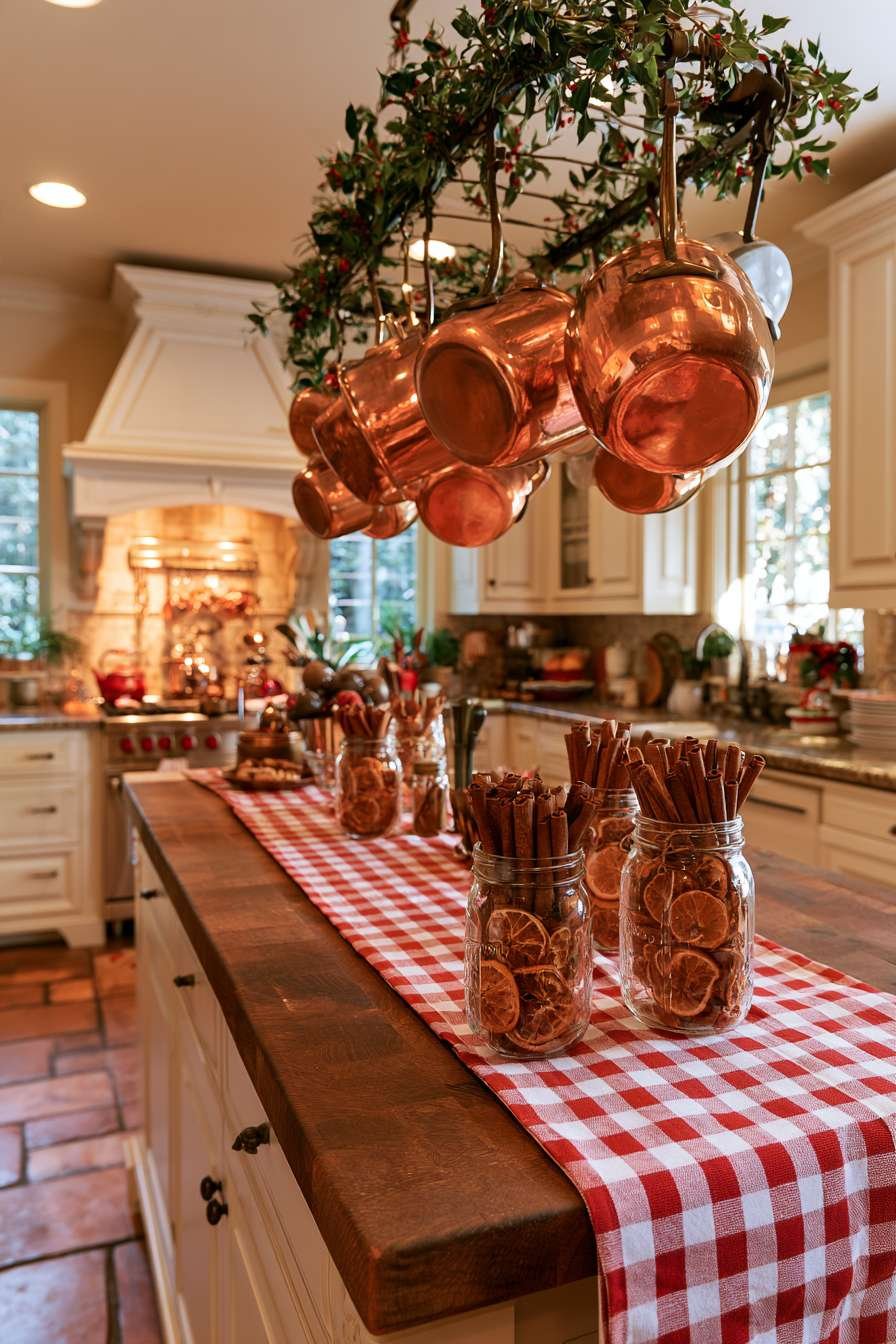
Mason jars filled with cinnamon sticks and dried orange slices line the countertop in varying heights, functioning simultaneously as decorative vignettes and aromatic installations. The rough-hewn glass of the jars, the warm amber of the dried citrus, and the warm brown of the cinnamon create a still-life composition of remarkable beauty — one that costs almost nothing to assemble but reads as thoughtfully curated. Above, copper pots hanging from an overhead rack become part of the Christmas decor simply by virtue of their material: the warm, rosy metallic tones of copper are inherently festive, and when sprigs of holly are tucked between pot handles and the rack’s crossbars, the functional kitchen storage becomes a decorative installation.
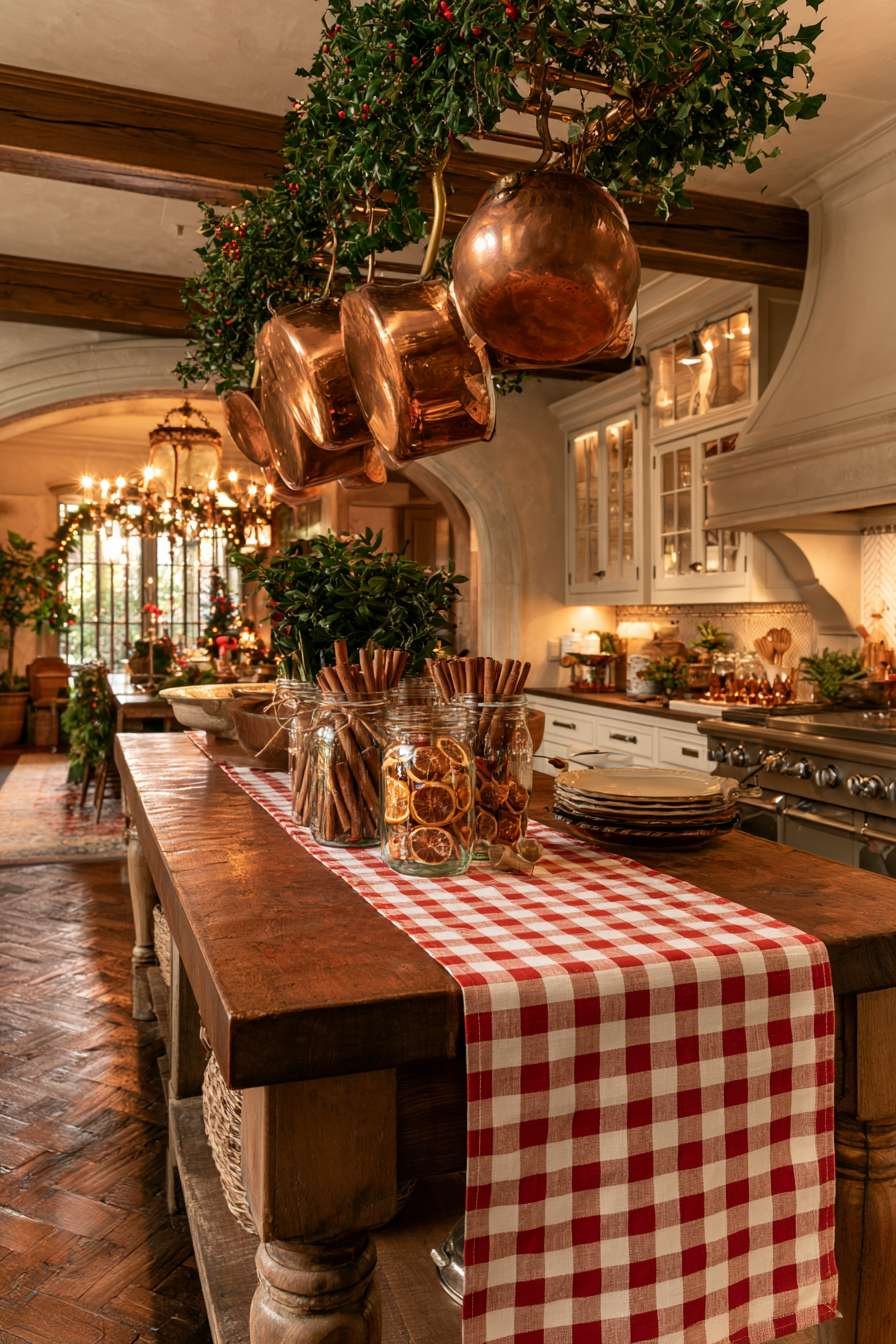
Warm incandescent lighting is essential to this aesthetic, because it transforms every surface it touches — making the copper pots gleam like something precious, giving the gingham runner a soft rosy glow, and casting the mason jar arrangements in the kind of golden light that makes them look like holiday lanterns. The overall palette of this kitchen is one of deep reds, warm coppers, natural wood tones, and cream whites — a classic Christmas color story told through materials and textures rather than synthetic ornaments, which is what elevates it from simply decorated to genuinely designed.
Key Design Tips:
- Use functional objects as decor — copper cookware, wooden rolling pins, cast iron pans, and vintage kitchen tools have an inherent beauty that becomes festive when arranged thoughtfully.
- Fill mason jars with single materials (all cinnamon sticks, all star anise, all dried oranges) rather than mixing for a cleaner, more intentional visual result.
- Layer textiles in the kitchen — gingham runner, plaid dish towels, linen napkins — mixing patterns at different scales for a rich, collected look.
- Replace standard overhead lighting with warm incandescent or Edison bulb fixtures during the holiday season to achieve the golden, nostalgic ambiance that defines traditional Christmas kitchen decor.
- Incorporate holly, ivy, or other traditional Christmas foliage as simple accents tucked into existing kitchen elements rather than as separate decorative installations.
4. The Scandinavian-Inspired Minimalist Christmas Kitchen
Nordic holiday design has a particular genius: it finds the intersection between the functional and the beautiful, the simple and the deeply meaningful, and produces decor that feels both ancient and startlingly modern. In this Scandinavian-inspired kitchen, the white cabinetry and natural birch wood accents create a backdrop of pure Nordic simplicity — a canvas that requires very little to feel festive, because its inherent beauty and restraint already carry the spirit of a quiet, candlelit winter celebration. The holiday additions are carefully chosen to feel indigenous to this aesthetic: small woven straw star ornaments hanging from cabinet pulls reference centuries of Nordic Christmas craft tradition, their geometric forms catching light in a way that is at once ancient and architecturally interesting.

A ceramic bowl of red apples on the counter introduces the only saturated color in the space — and that single red note, against all the white and birch and pale grey, becomes electrifying in its simplicity. This is a masterclass in the Scandinavian design principle of lagom — just enough, and not a single element more. On the windowsill, a slim potted Christmas tree stands in quiet dignity, its perfect conical form silhouetted against the pale winter light outside, small and unpretentious and somehow more moving than any large tree decorated with hundreds of ornaments. Diffused natural daylight is the defining light quality of this kitchen, soft and even, without dramatic shadows or highlights, allowing every material to be seen in its truest form.
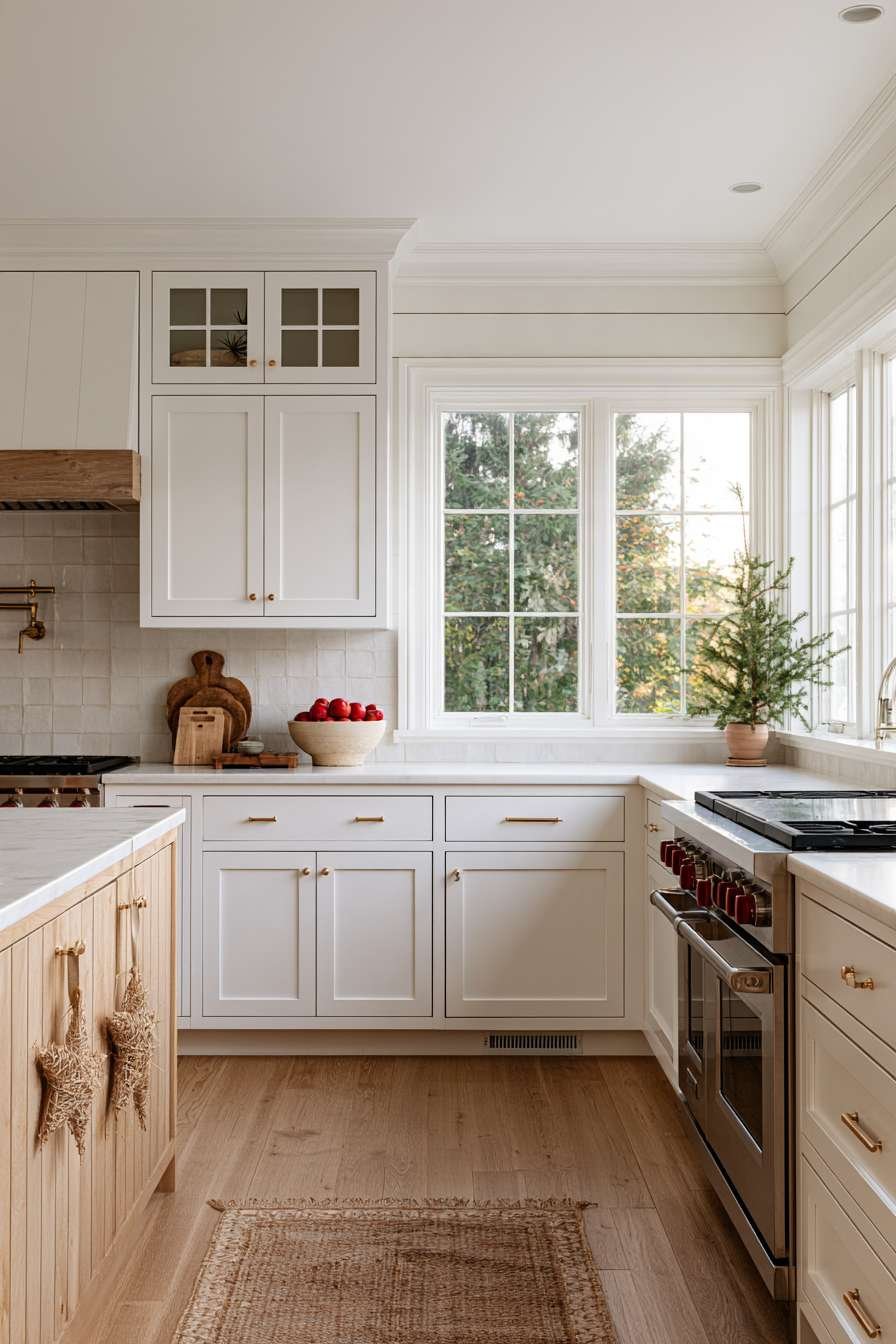
The material palette of birch, white ceramic, natural straw, and red apple skin is not accidental — each element has been chosen because it occurs naturally in the Nordic winter landscape, making the decor feel like a celebration of the season itself rather than an overlay of manufactured festivity. The minimal color palette — predominantly white, cream, and natural wood, punctuated by a single red — is disciplined in a way that requires genuine design confidence, and the result is a kitchen that feels profoundly calm and deeply beautiful rather than busy and overwhelming.
Key Design Tips:
- Invest in hand-crafted Nordic ornaments — woven straw stars, wooden Dala horses, carved wooden hearts — that carry authentic cultural and aesthetic meaning rather than mass-produced alternatives.
- Use a single accent color (red, deep blue, or forest green) and apply it sparingly for maximum visual impact in a neutral Nordic kitchen.
- A small potted living Christmas tree on a windowsill is more meaningful and space-efficient than a large cut tree, and its compact form suits a kitchen beautifully.
- Prioritize natural daylight by keeping window treatments minimal — sheer linen panels at most — to maintain the luminous, airy quality that defines Scandinavian interior spaces.
- Embrace empty space as a design element; resist the urge to fill every surface, because in Scandinavian design, negative space is as intentional and beautiful as the objects themselves.
5. The Rustic Country Cottage Christmas Kitchen
Step into this rustic country cottage kitchen and the sensation is immediate and overwhelming: you are somewhere deeply, authentically Christmas. Exposed wooden ceiling beams wrapped in fresh pine garland and fairy lights create a canopy of green and gold that makes the entire kitchen feel like the interior of a decorated forest. The beams themselves — rough-hewn, darkened with age, and carrying the marks of a building with genuine history — provide a structural drama that no amount of decoration could manufacture. When garland and fairy lights are added, they become a ceiling installation of genuine architectural impact.
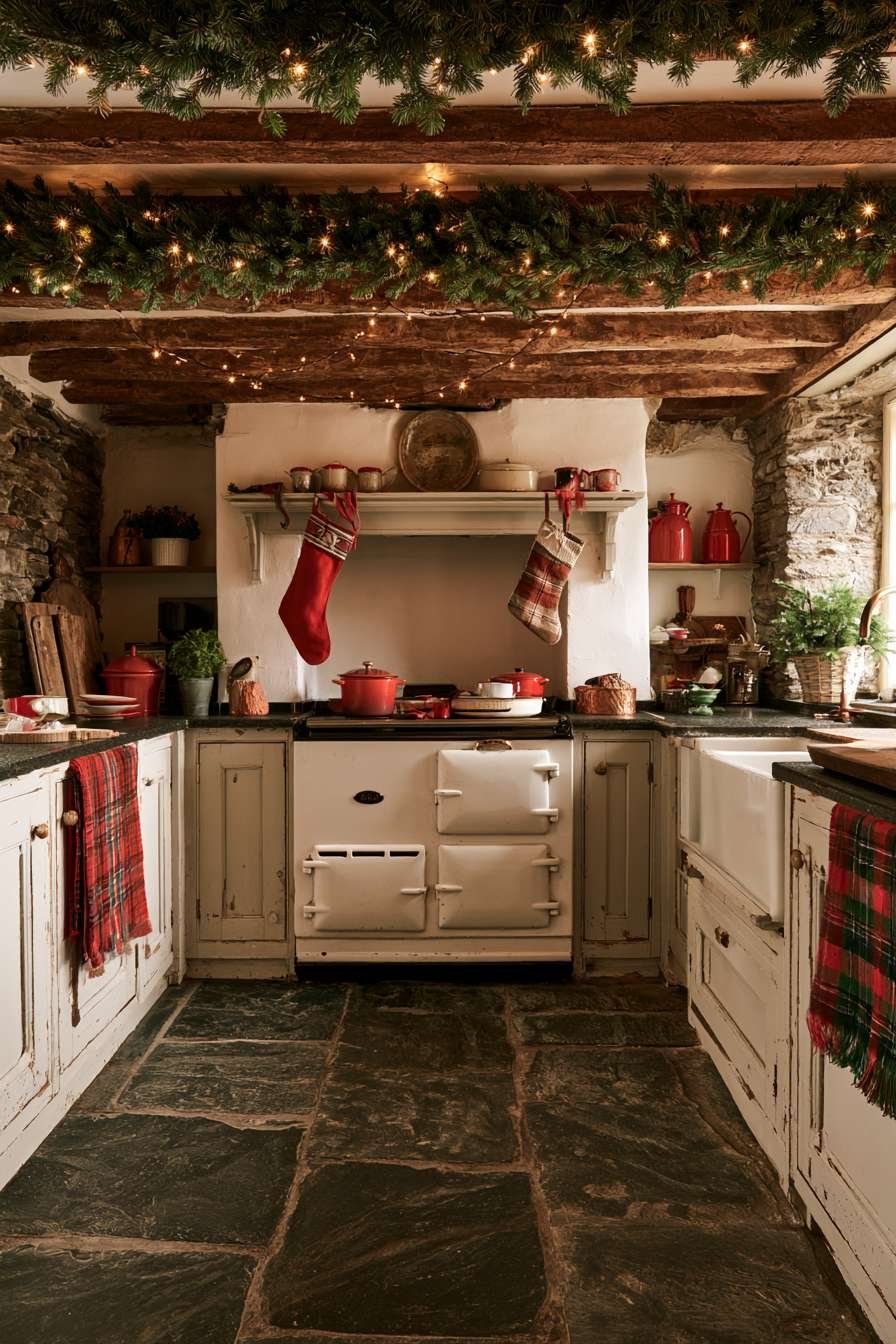
A vintage enamel stove occupies its rightful place as the kitchen’s focal point, flanked by stockings hung from a small mantel shelf in a charming transposition of the living room tradition into the kitchen. This unexpected gesture — stockings in the kitchen — is both playful and deeply homey, suggesting a household where Christmas isn’t confined to one room but suffuses every space with its warmth. The stone tile floor and distressed white cabinets anchor the space in its country heritage, their imperfections and material honesty creating the kind of authenticity that cannot be designed from scratch but only accumulated over time. Plaid dish towels in red and green drape casually from oven handles, the most low-effort decorative touch imaginable, yet perfectly in keeping with the room’s unpretentious character.
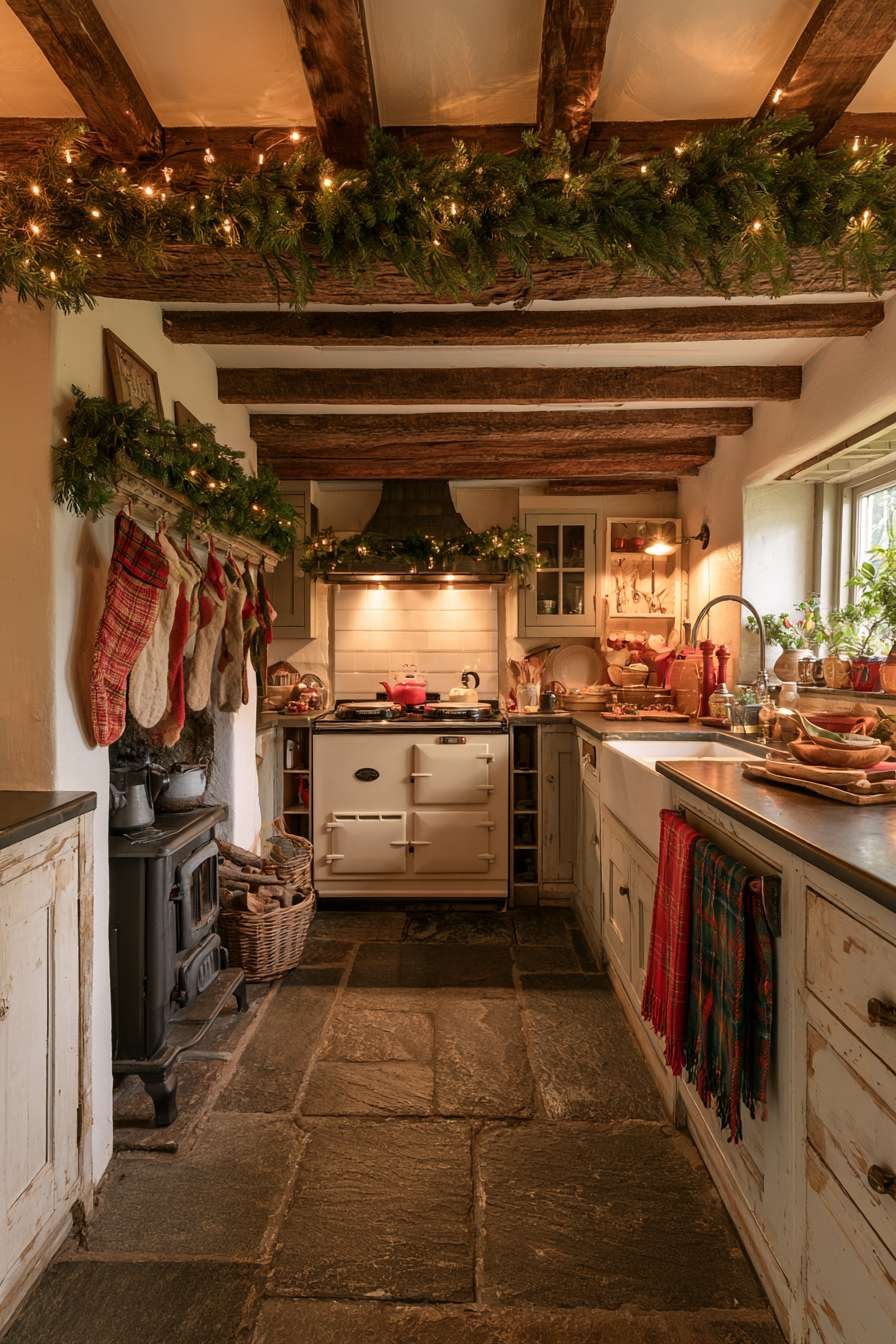
Warm, soft lighting is absolutely essential to this design — harsh or cool overhead lighting would destroy the magic instantly, stripping the rough textures of their warmth and making the garland look flat and lifeless. Instead, the fairy lights woven through the ceiling garland provide the primary ambient illumination, supplemented by pendant lights with warm Edison bulbs and perhaps a few pillar candles on the countertop. The result is a kitchen that glows rather than illuminates — a distinction that makes all the difference between a room that feels designed for Christmas and one that simply has Christmas decorations in it.
Key Design Tips:
- Wrap ceiling beams in garland from the center outward, securing at intervals with clear fishing line or green florist wire that disappears visually into the greenery.
- Hang stockings in the kitchen — on a mantel shelf above the stove, on a decorative hook rack, or from open shelving — for a charming and unexpected holiday touch.
- Combine fairy lights with garland on beams or shelving rather than using them separately; the integration creates a more cohesive, designed look.
- Use plaid textiles — dish towels, seat cushions, oven mitts — as one of the simplest and most effective ways to introduce Christmas color into a kitchen without permanent installation.
- In a rustic kitchen, embrace imperfection: rough knots in garland, asymmetric candle arrangements, and casually draped textiles feel more authentic than rigidly perfect styling.
6. The Organized Baker’s Display Christmas Kitchen
In a kitchen where functional beauty and festive display converge, this design concept celebrates the baker’s art while simultaneously solving the eternal challenge of Christmas kitchen decor: how to make the space feel festive without sacrificing the counter space needed for actual holiday cooking. The solution is inspired: glass canisters filled with layered holiday baking ingredients — red and white striped candy canes, rich cocoa powder, sparkling granulated sugar — are displayed on open shelving as decorative objects that happen also to be perfectly organized pantry storage. Each canister becomes a self-contained still life, its layered contents creating a color composition of cream, brown, red, and white that is inherently Christmas.
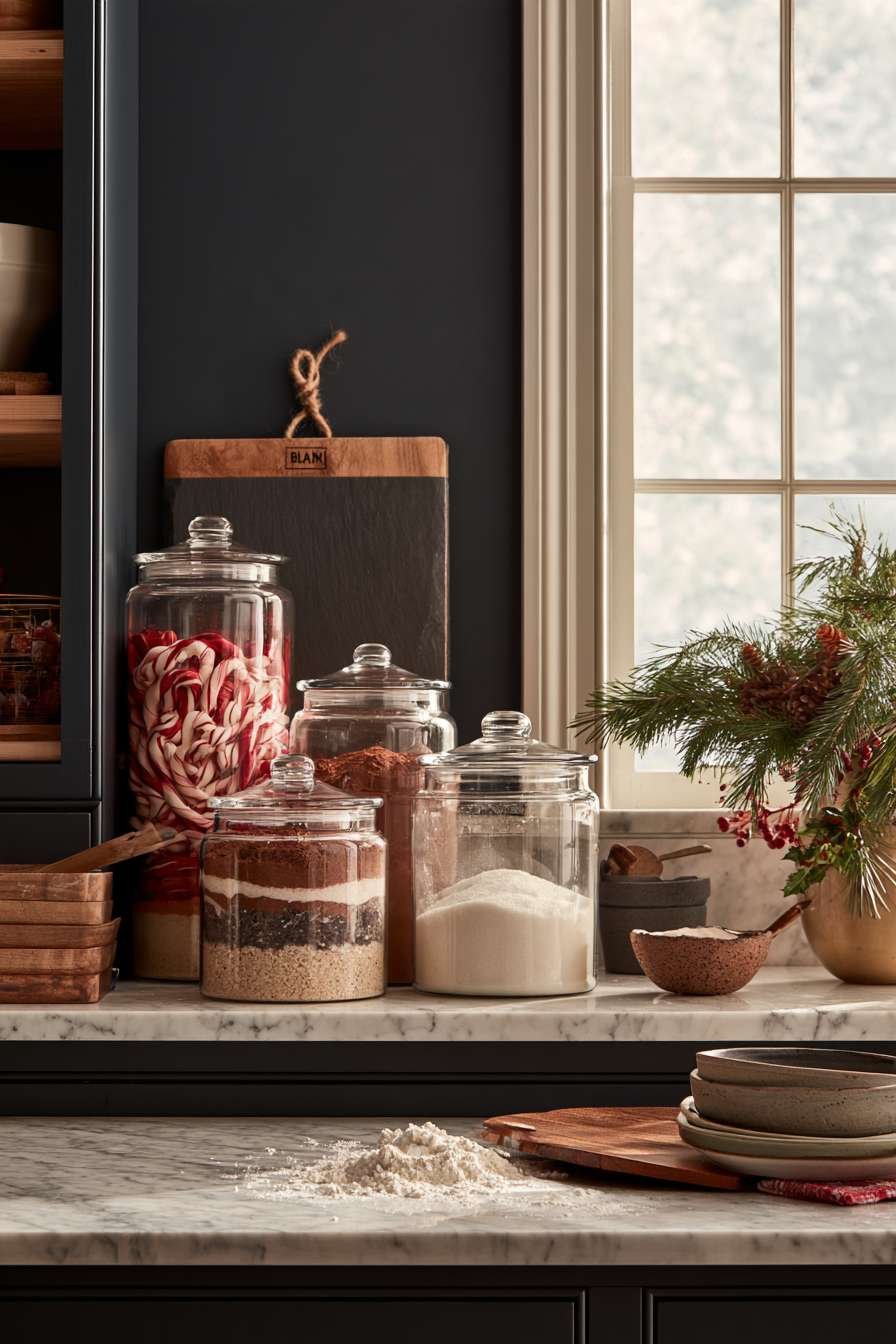
Above the marble countertop, a chalkboard menu sign bearing handwritten seasonal recipes introduces a personal, artisanal quality that no manufactured sign could replicate. Chalkboard surfaces have a particular magic in kitchens: they are simultaneously casual and considered, suggesting a household where the kitchen is a place of creative activity rather than mere utility. The marble countertop itself — with its cool grey veining and smooth, luminous surface — is dusted with flour in this concept, an honest acknowledgment that the most beautiful kitchen at Christmas is one that is actually being used for its intended purpose.
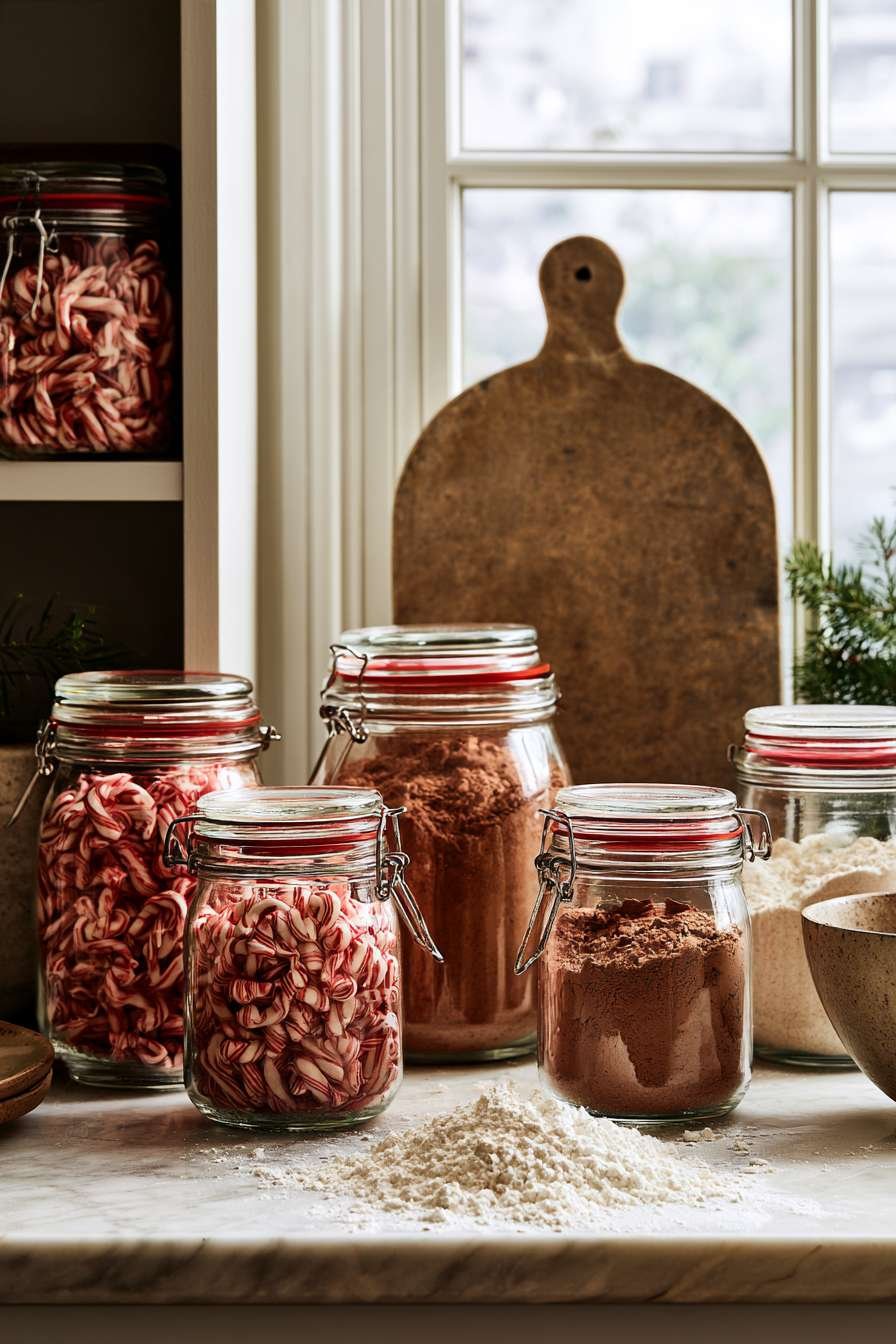
Professional natural window light illuminates this kitchen with the clear, unflattering honesty that only daylight can provide, and it works here because there is nothing to hide: every element in this space is genuinely beautiful, from the filled canisters to the handwritten sign to the inevitable scatter of flour on the marble. This is a kitchen designed for people who love to cook as much as they love to decorate, and the design philosophy reflects that — every decorative choice serves a function, every functional element has been chosen for its beauty, and the distinction between the two has been thoughtfully erased.
Key Design Tips:
- Use wide-mouth glass canisters with tight-fitting lids to store and display baking ingredients simultaneously — they look beautiful, stay organized, and eliminate the need for separate holiday decor on shelving.
- Layer ingredients by color and texture when filling display canisters — visual contrast between dark cocoa, white sugar, and colorful candy creates natural decoration.
- Install or hang a chalkboard panel in the kitchen for seasonal menus, recipe notes, and holiday messages that change throughout December.
- Choose marble or light-colored stone for countertops in a baker’s kitchen — they photograph beautifully and the inevitable flour dusting actually adds to their festive, active appearance.
- Invest in matching storage containers across all open shelving; visual consistency transforms practical storage into sophisticated display.
7. The Bold Jewel-Toned Christmas Kitchen
This design concept is for the decorator who refuses to play it safe, and it is magnificent. A dark navy blue kitchen is an unexpected canvas for Christmas decor, but it turns out to be perhaps the most dramatic and sophisticated one available. Against those deep navy cabinet fronts with their brass hardware, holiday decor in jewel tones — burgundy velvet ribbon, deep red pomegranates, gold star garland — doesn’t compete with the background so much as it collaborates with it, creating a layered color composition of extraordinary richness. The navy and burgundy relationship is particularly successful, the two deep tones creating a color harmony more complex and grown-up than any traditional red-and-green combination.

Burgundy velvet ribbon tied in careful bows around cabinet handles is one of the most elegant and least expensive holiday decorating gestures possible — a single roll of quality ribbon can transform an entire run of cabinetry, adding both color and texture without a single nail or adhesive required. The clusters of deep red pomegranate on the island serve as a centerpiece of genuine drama: pomegranates are among the most beautiful fruits in existence, their burgundy-crimson skin, star-shaped crown, and jewel-like interior making them natural ornaments. Arranged in a dark ceramic or wooden bowl, they create a centerpiece of museum-quality beauty.
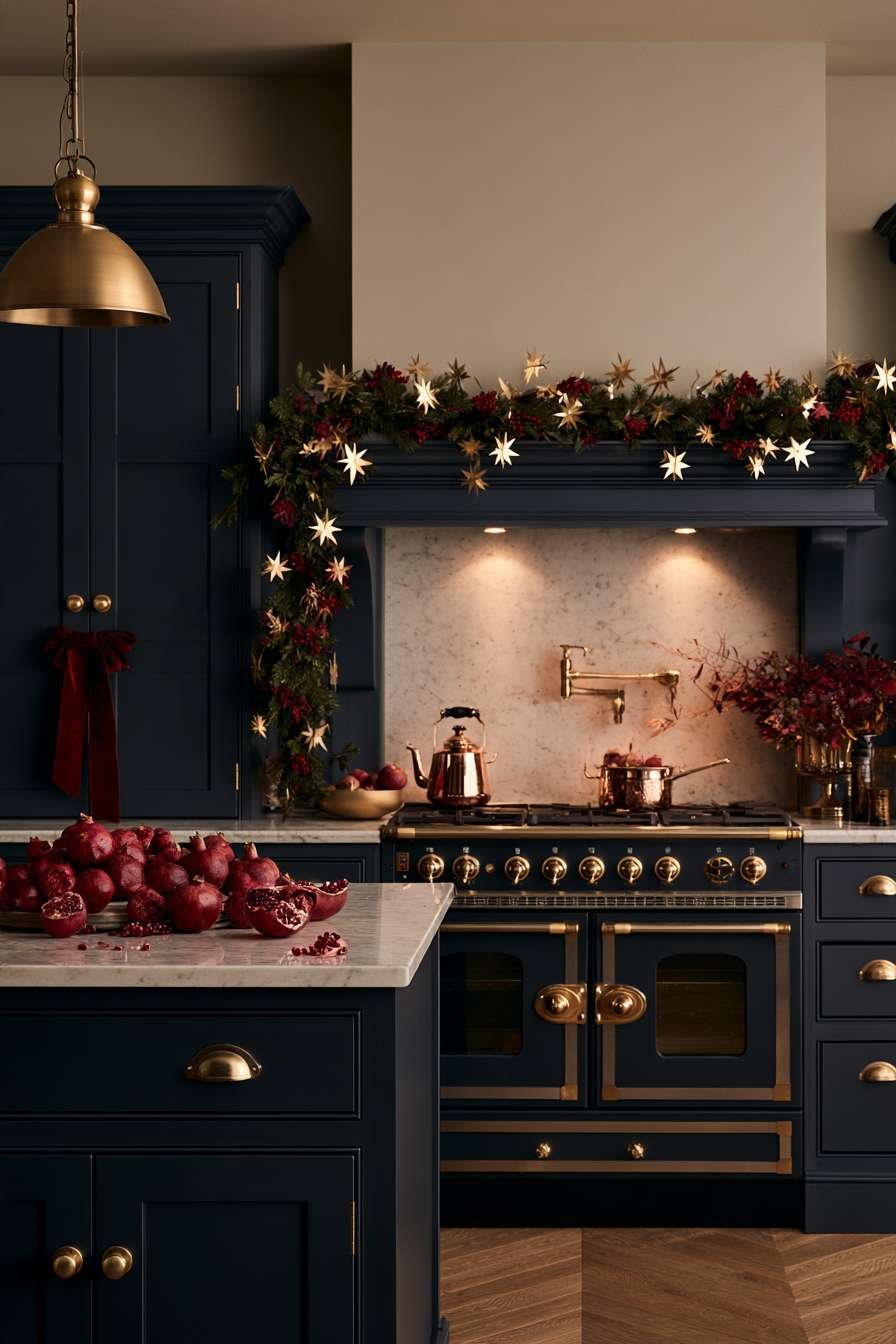
Gold star garland along the range hood catches the dramatic downlighting of the pendant fixtures, creating points of bright reflection against the deep tones of the surrounding kitchen. Dramatic moody lighting is not accidental here — it has been carefully orchestrated to create the kind of atmosphere more associated with a fine restaurant or an elegant cocktail party than a domestic kitchen, and this elevated ambiance is entirely appropriate for a space that has been decorated with such intentionality. The marble countertops and brass fixtures complete the luxurious material palette, every surface contributing to an experience of extraordinary visual richness.
Key Design Tips:
- Dark kitchen cabinetry (navy, forest green, charcoal, deep burgundy) provides an exceptional backdrop for jewel-toned Christmas decor that reads as sophisticated rather than playful.
- Use velvet ribbon rather than satin for a more luxurious, matte finish that suits deep color palettes and moody lighting conditions.
- Pomegranates, quinces, blood oranges, and other dark-toned fruits make exceptional and entirely edible Christmas decorations that are more interesting than conventional ornaments.
- Invest in dramatic pendant lighting with dimmer switches so that ambient brightness can be reduced to create the moody, intimate atmosphere that dark-cabinet kitchens do best.
- Limit your holiday color palette to two or three deep tones — the beauty of jewel-toned Christmas decor lies in its sophistication and restraint, not its abundance.
8. The Small Apartment Christmas Kitchen
Limited space has never been a limitation for genuine creativity, and this small apartment kitchen demonstrates that with joyful confidence. The principle governing this design is maximum festive impact from minimum footprint, and every decorating decision reflects that constraint. A tabletop mini Christmas tree on the counter — compact, perfectly shaped, simply dressed — delivers the full emotional impact of a Christmas tree in approximately one-tenth the space. Beside it, a stack of holiday mugs in classic Christmas patterns introduces color and seasonal character through objects that are already part of the kitchen’s daily function, requiring no additional storage space or installation effort.
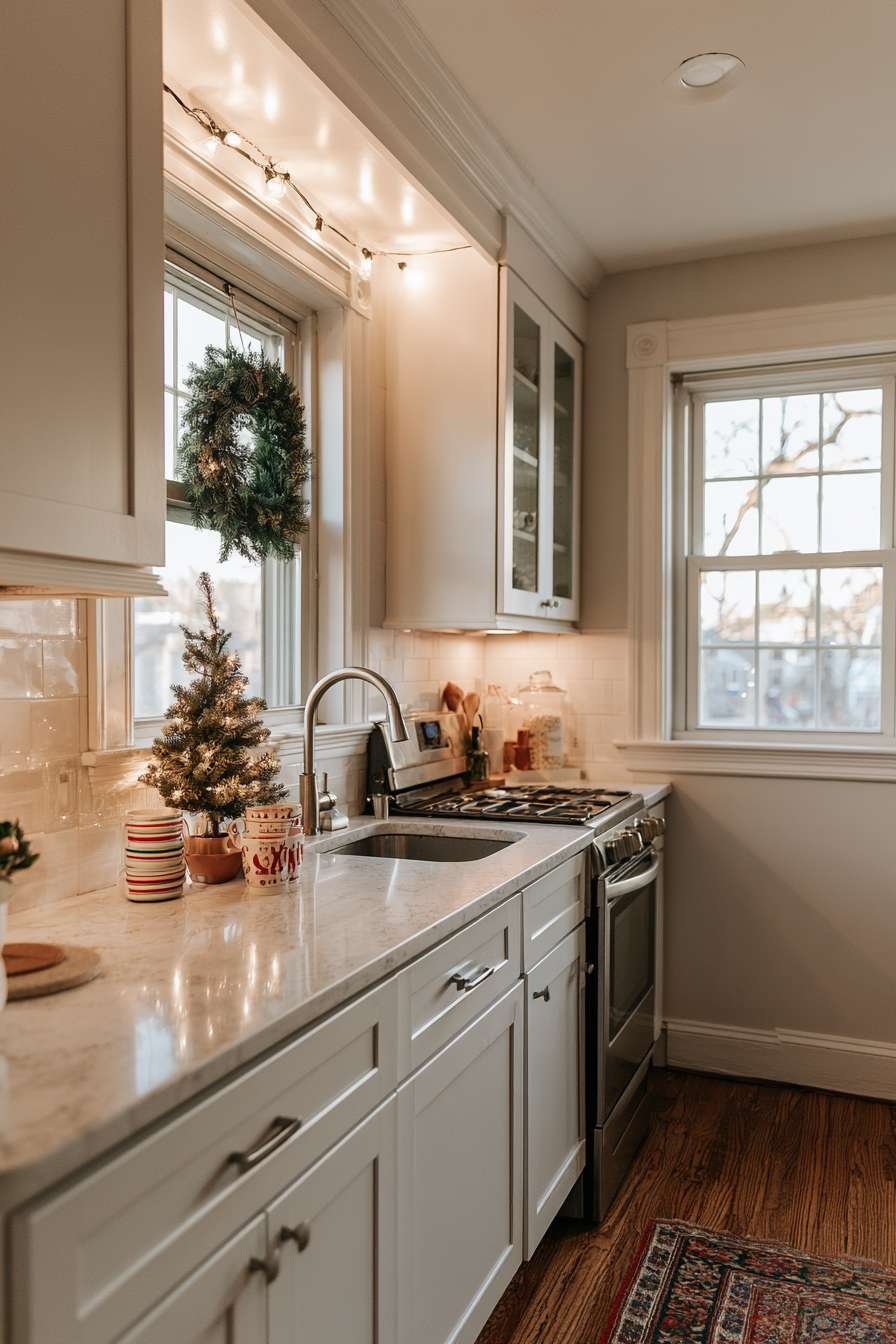
A wreath hung inside a glass cabinet door is perhaps the cleverest idea in this entire article: a small wreath, visible through glass-front cabinet doors, transforms the cabinet into a shadowbox display, adding a festive element without using any counter or wall space whatsoever. This kind of thinking — working with existing architectural features rather than imposing decoration onto them — is the hallmark of skilled small-space design. A single string of warm white lights along the upper cabinet edge provides ambient festive illumination without the need for additional light fixtures, its simple linear installation taking up no space and costing almost nothing to achieve.
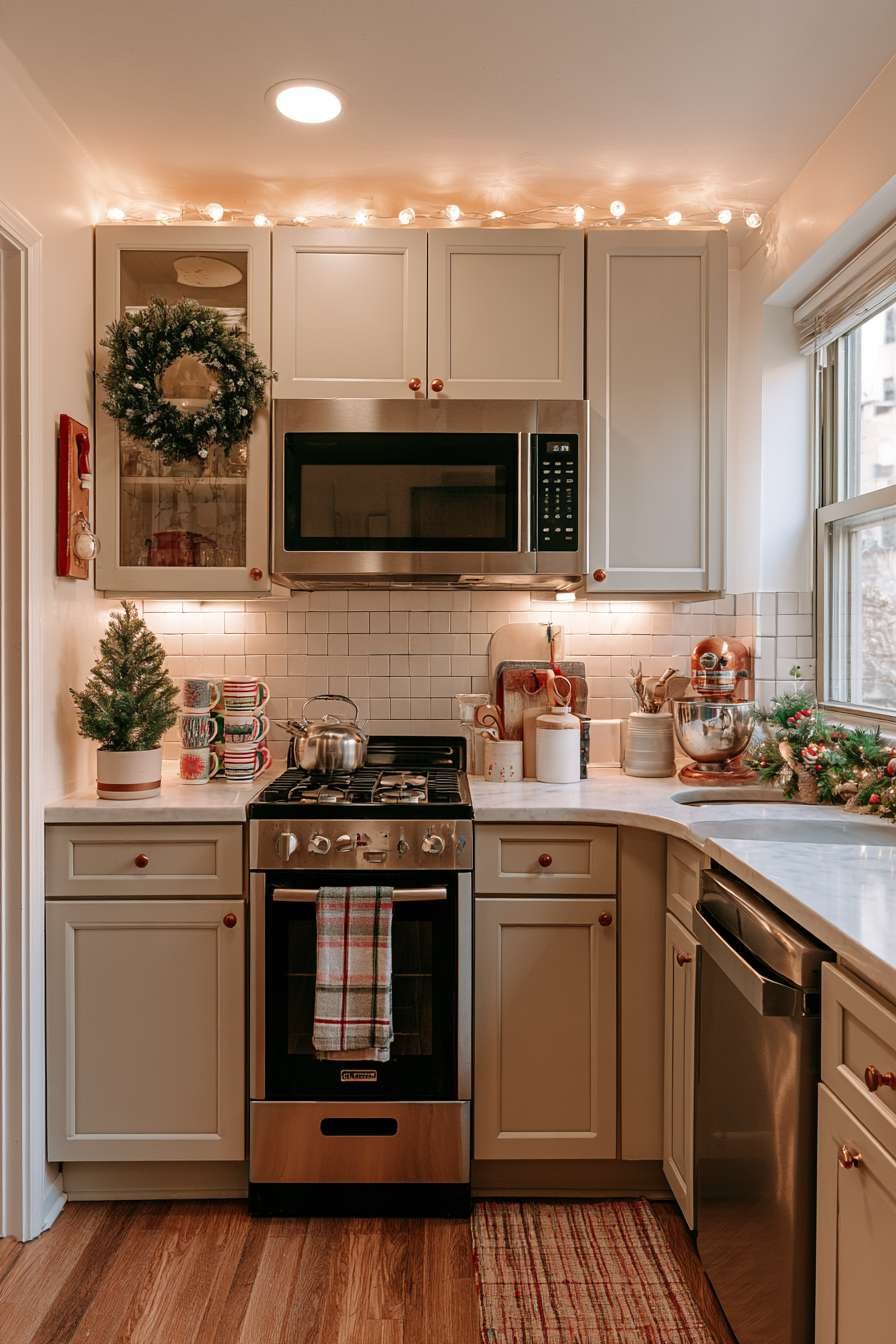
Wide-angle interior photography captures this kitchen in a way that reveals its thoughtful spatial planning: every decorative element has been placed to create the impression of a fully decorated holiday kitchen, yet the workspace remains entirely functional, the countertops clear enough for actual cooking. This is the ultimate test of small-space Christmas decorating — when the decor enhances rather than impedes the room’s primary function, the design has truly succeeded.
Key Design Tips:
- Think vertically in small kitchens — string lights along upper cabinet edges, small wreaths inside glass cabinet doors, and mini trees on countertop corners all add festive character without consuming floor or counter space.
- Choose a tabletop tree as the hero decorative element in an apartment kitchen; look for pre-lit options in 18–24 inches height for maximum impact in minimal footprint.
- Stack holiday mugs and serving pieces you already own rather than purchasing additional decor; functional objects with seasonal patterns do double duty beautifully.
- Use a single string of warm white LED lights rather than colored or flashing lights in a small space — the warm tone creates coziness without visual busyness.
- Edit ruthlessly: in a small kitchen, one perfect decorative moment is more powerful than several competing ones; choose your single best idea and execute it with intention.
9. The Elegant All-White Christmas Kitchen
There is a particular kind of restraint that communicates luxury more effectively than any amount of richness or abundance, and this bright, airy Christmas kitchen in all-white with gold and cream holiday accents achieves it with effortless grace. The kitchen itself — white cabinetry, quartz countertops, open shelving in painted white — provides a canvas of almost architectural purity, and the holiday decor that occupies it has been chosen to honor rather than interrupt that purity. Gold wire star sculptures on open shelves introduce geometry and metallic gleam without color, their warm gold tones sitting comfortably within the white and cream palette while adding the festive sparkle the season requires.
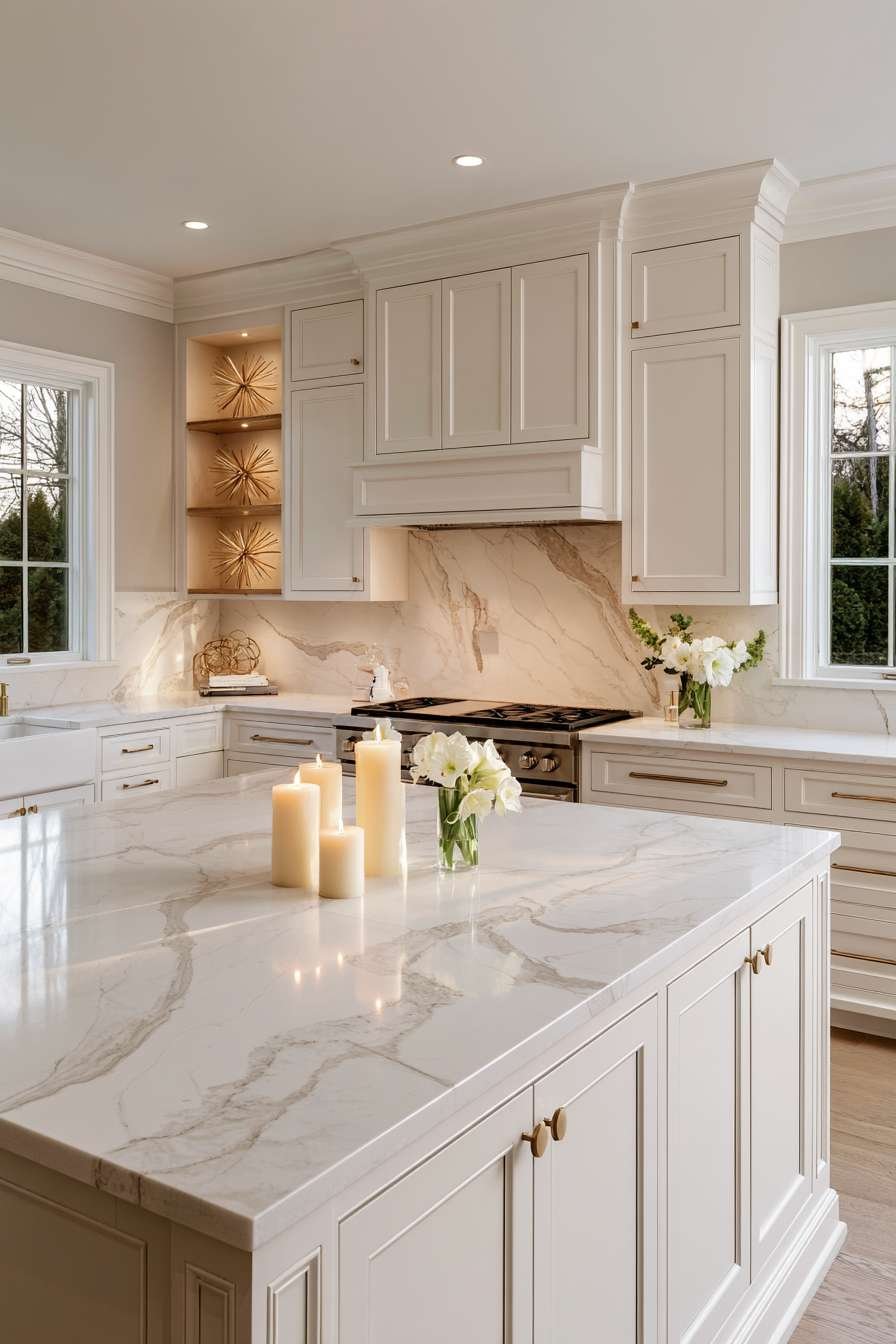
Cream pillar candles of varying heights on the island create a centerpiece of quiet drama — the variation in height introducing a sense of composition and rhythm, the cream tones keeping the palette pure, and the candlelight (even in LED form) providing the warmth that any all-white space requires to feel welcoming rather than clinical. A small vase of white amaryllis — one of the most magnificent flowering plants of the winter season — adds organic beauty and vertical height, its trumpet blooms of pure white achieving a sculptural quality that no ornament could rival.
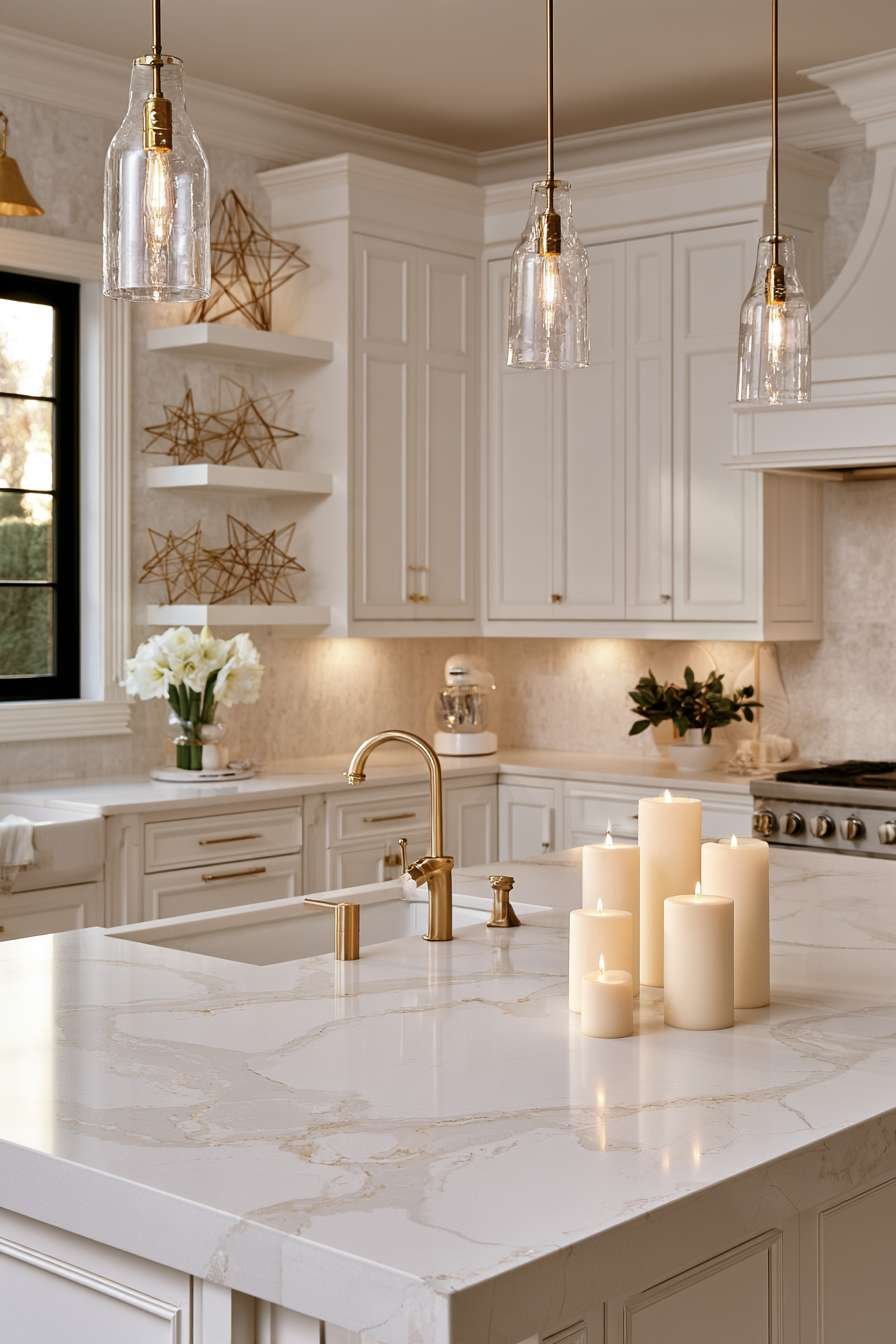
Morning natural light is the defining condition of this kitchen, flooding the space with the particular clarity of winter sunlight filtered through cool air, creating soft shadows and subtle variations across every white surface that reveal the difference between matte and gloss, flat paint and glazed tile, polished quartz and brushed ceramic. This is a kitchen that asks visitors to look closely, to appreciate the nuance of tone and texture within a seemingly monochromatic palette, and to understand that white is not one color but hundreds — each surface revealing a different aspect of that infinite spectrum.
Key Design Tips:
- In an all-white kitchen, choose holiday accents in warm metallics (gold, brass, copper) rather than cool metallics (silver, chrome) to prevent the space from feeling cold.
- Amaryllis is the finest Christmas flower for interior design purposes — its dramatic scale, pure colors, and long vase life make it worth every penny over traditional poinsettias.
- Vary candle heights significantly when grouping — the difference between the tallest and shortest candle should be dramatic enough to create genuine compositional rhythm.
- Gold wire sculptural objects (stars, geometric forms, birds) are exceptional choices for white kitchens because they add presence and light-catching sparkle without introducing color.
- Keep the countertops absolutely clear of everything except the three or four decorative elements you’ve chosen — in an all-white kitchen, clutter destroys the effect instantly.
10. The Festive Window Treatment Christmas Kitchen
A kitchen window is often the most overlooked decorating opportunity in the entire room, yet it offers unique potential: it frames a view, admits light, and occupies a visual position that is naturally prominent from both inside and outside the home. This design concept makes the window its hero, dressing it in a swag of fresh pine, cedar, and dried citrus slices tied with a wide plaid ribbon that frames the view of a snowy backyard in the most cinematically beautiful way imaginable. The combination of textures — the feathery softness of cedar, the structural strength of pine, the papery delicacy of dried citrus — creates a garland of remarkable dimensional interest.
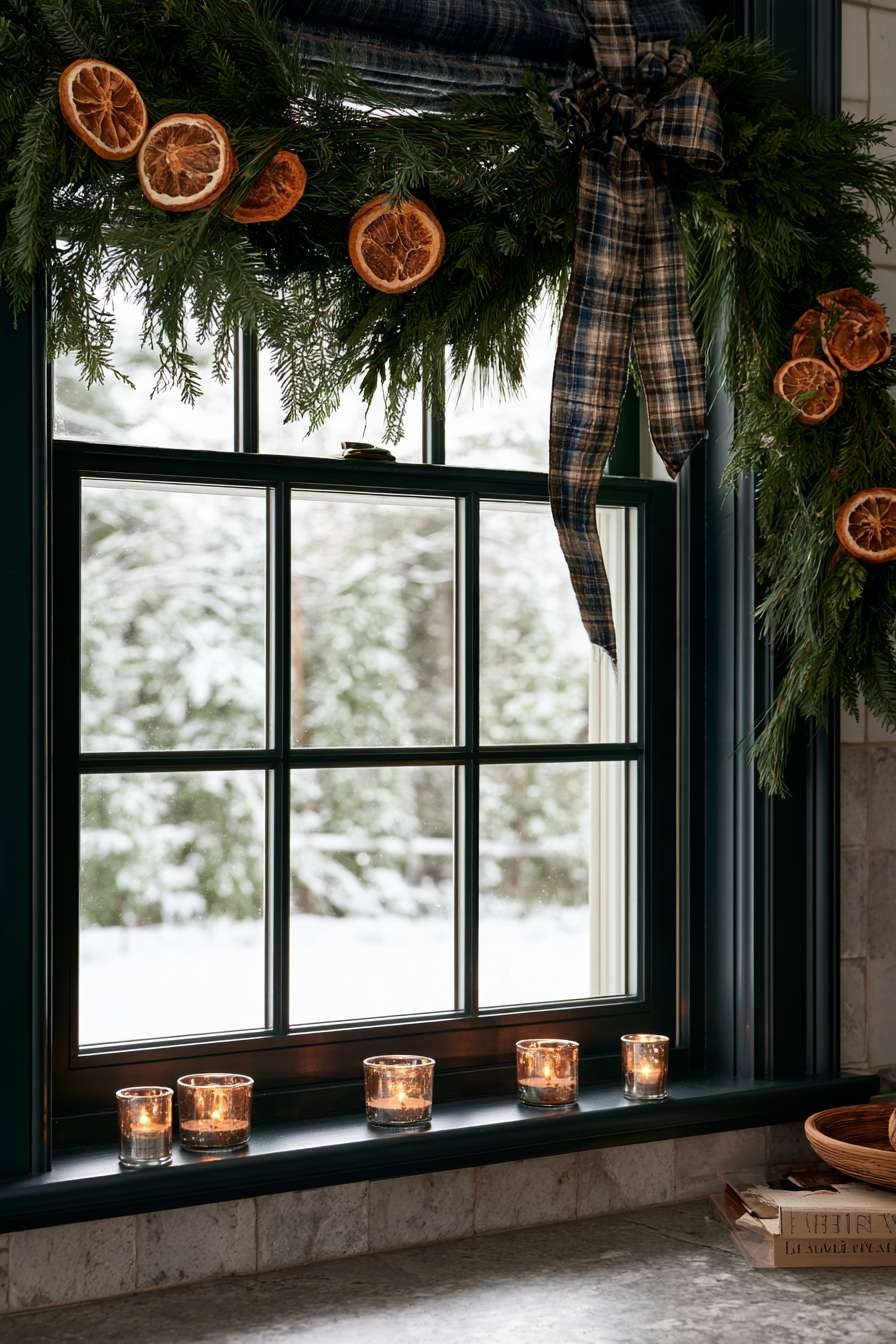
Mercury glass votives on the windowsill glow with candlelight in a way that interacts beautifully with the daylight streaming through the glass above — the mercury glass finish reflecting both natural and candlelight simultaneously, creating points of warm luminosity that draw the eye to the sill even in a brightly lit room. The layered natural materials of this window treatment — fresh evergreen, dried fruit, plaid ribbon — represent a commitment to organic, seasonally appropriate decoration that connects the interior of the kitchen to the winter landscape visible through the window, creating a sense of continuity between inside and outside.
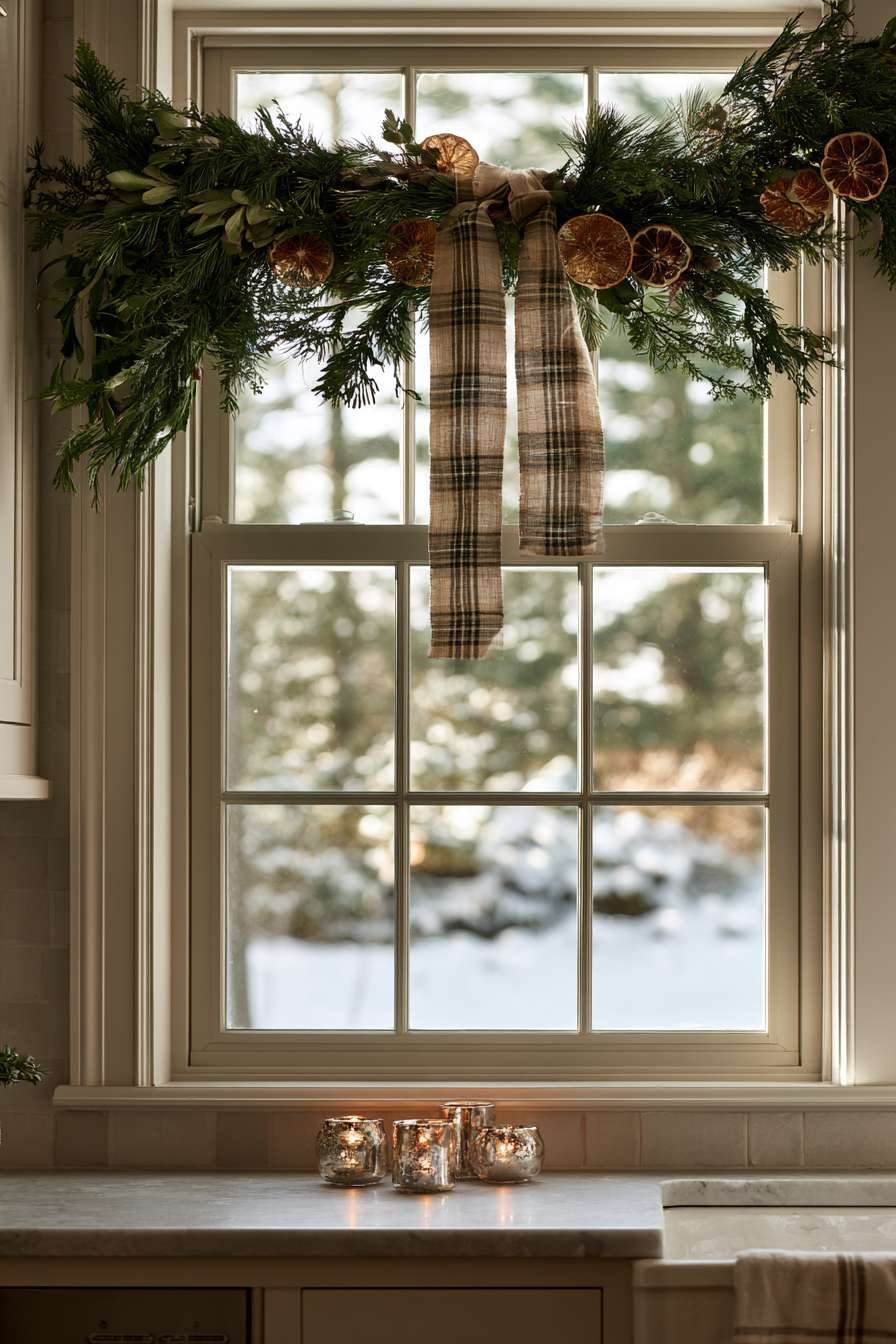
Soft diffused daylight is the primary light source for this concept, and it works in favor of the window treatment by backlighting the garland slightly, making the pine needles and citrus slices translucent and luminous. From outside the house, the decorated window glows with warmth and life, the silhouette of the garland visible against the interior light — a gift to anyone walking past who happens to look up at a lit kitchen window on a December evening and see something beautiful within.
Key Design Tips:
- A window swag is more architectural than a flat garland — it gathers at the center of the window top and cascades down the sides, creating a formal framing effect that suits traditional and transitional kitchens beautifully.
- Dry citrus slices yourself by slicing thin rounds of orange, lemon, or grapefruit and baking at 200°F for 3–4 hours; the result is a beautiful, inexpensive, and fragrant garland addition.
- Mercury glass votives are among the most versatile and cost-effective decorating tools available — their reflective surface amplifies whatever light source is nearest, making two or three votives look like twice as many candles.
- Use ribbon that is twice the width you think you need — wider ribbon reads better from a distance and ties into a more dramatic bow.
- Change window garlands mid-season if the fresh elements begin to dry out; a dried citrus and pinecone swag is actually more beautiful than a fresh one for the final two weeks of the holiday season.
11. The Mid-Century Modern Christmas Kitchen
The aesthetic language of mid-century modern design — its clean geometric lines, teak wood cabinetry, retro appliances in cream, and commitment to functional beauty — might seem at first glance like an unlikely partner for Christmas decoration. Yet this design concept proves that these two aesthetics have more in common than their surface differences suggest: both are invested in quality materials, honest construction, and objects that are beautiful precisely because they serve their purpose well. The starburst wreath on the refrigerator is a masterstroke — the starburst form, so iconic of mid-century design, transformed by the addition of natural materials into a Christmas wreath that belongs completely to both its era and its season.
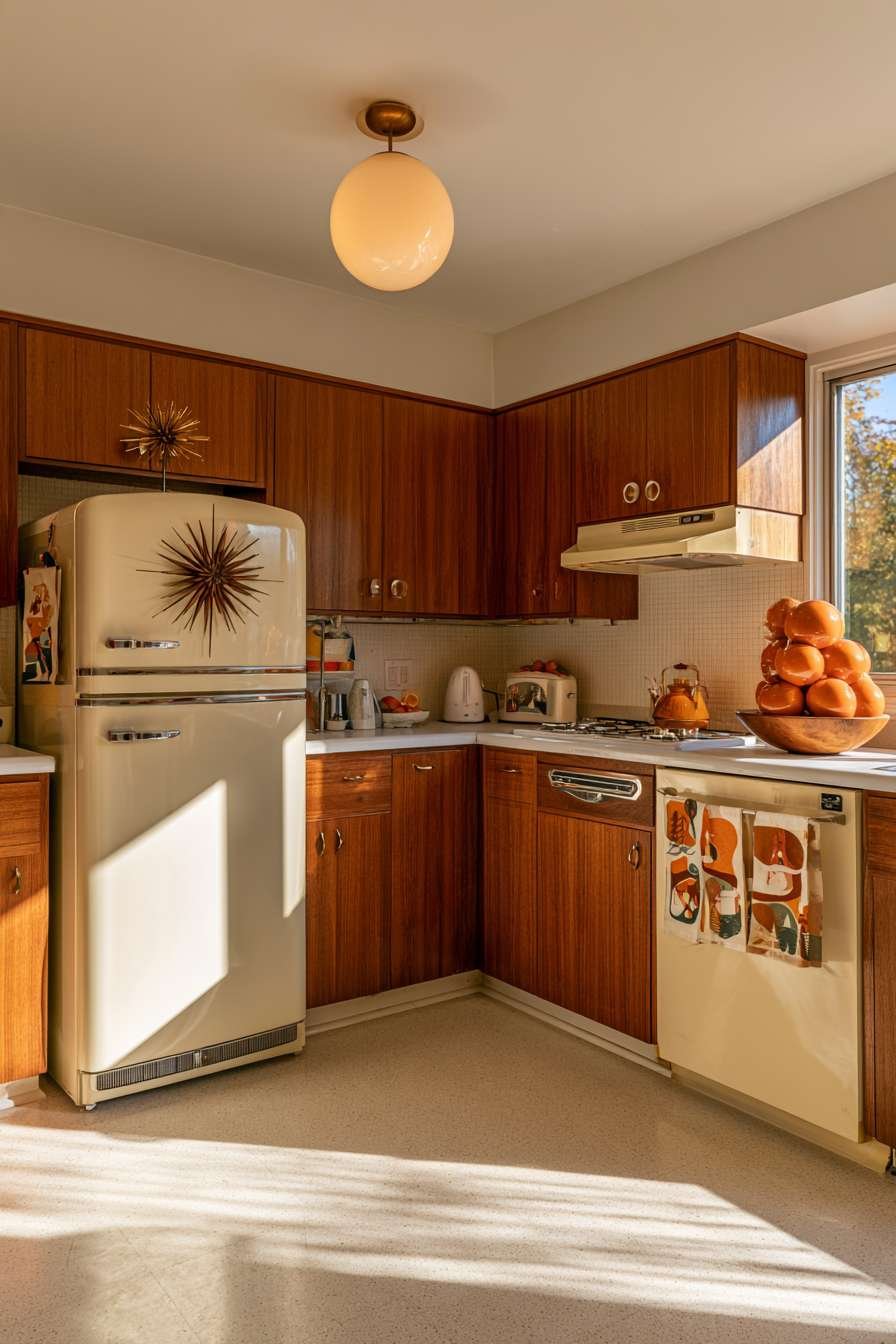
Abstract Christmas-themed tea towels and a cluster of orange globe ornaments in a wooden bowl continue the design conversation, each element chosen because it speaks the language of the mid-century aesthetic while simultaneously communicating Christmas. The globe ornaments in warm orange — a color that reads as both retro and harvest-seasonal — fill a wooden bowl that could be a piece by a craft furniture maker of the 1950s, creating a centerpiece of surprising originality. Warm afternoon sunlight creates the long, dramatic shadows that mid-century photography made iconic, raking across smooth teak surfaces and cream appliances in a way that emphasizes their sculptural quality and reveals every material in its most beautiful light.
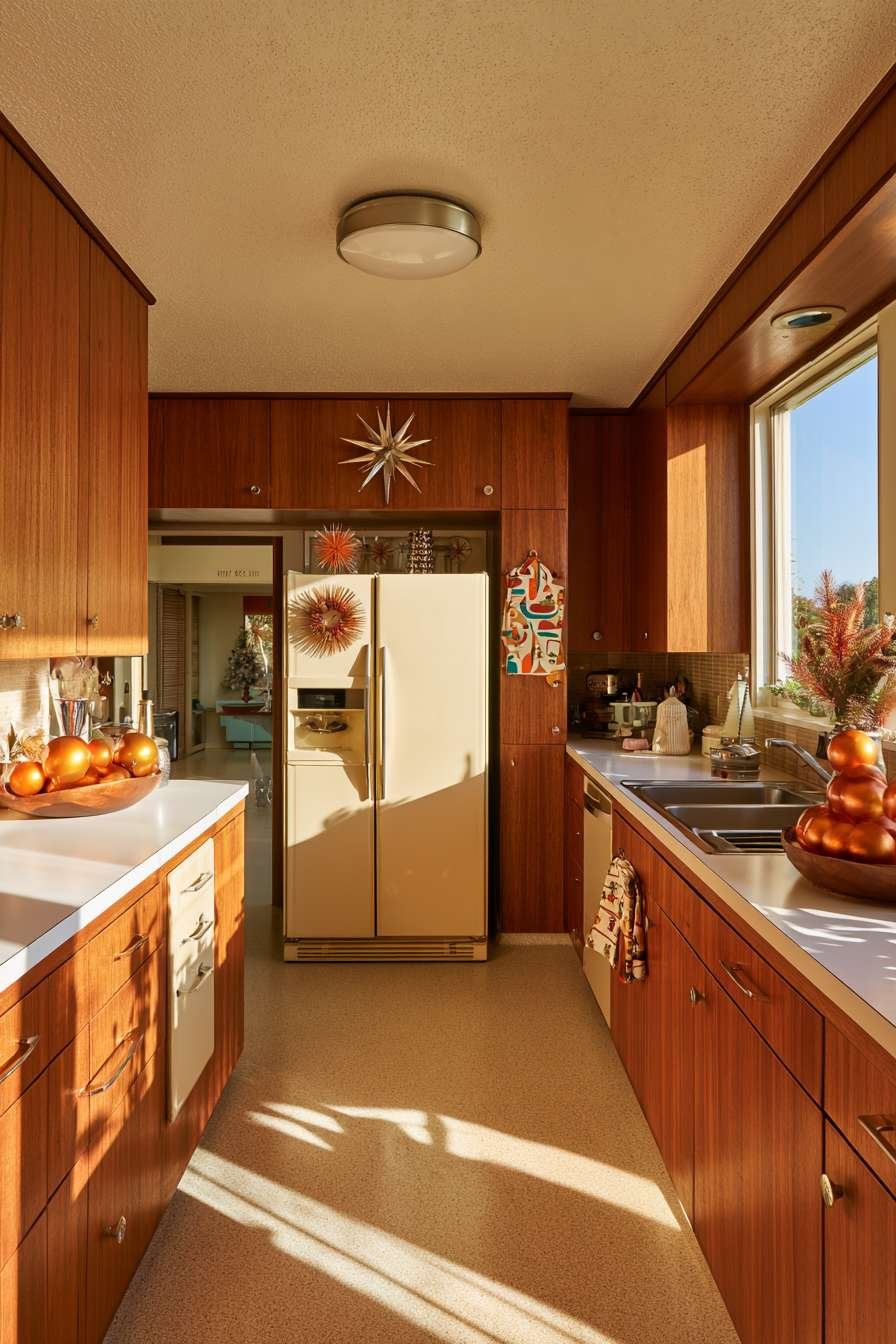
This kitchen design succeeds because it demonstrates a fundamental principle of great holiday decorating: the best Christmas decor speaks the same design language as the room it occupies. In a mid-century modern kitchen, traditional garlands and conventional Christmas ornaments would look jarring and out of place. But a starburst wreath, globe ornaments, and geometric tea towels feel native to the space — as though they’ve always been part of its design vocabulary, simply waiting for December to make their appearance.
Key Design Tips:
- Match your Christmas ornament forms to your design era — starburst, atomic, and geometric shapes suit mid-century spaces; curved organic forms suit Art Nouveau; clean spheres suit contemporary.
- Starburst wreaths can be purchased or DIYed using wire frames, wooden skewers, and natural materials like dried botanicals, seed pods, and spray-painted twigs.
- Choose warm-toned ornaments (amber, orange, gold, rust) rather than traditional red and green in a mid-century kitchen to maintain period aesthetic coherence.
- Use quality tea towels with graphic or abstract seasonal patterns as an ultra-low-commitment decorating element that can be swapped in and out instantly.
- Position a wooden bowl of grouped ornaments as a centerpiece — the bowl format is inherently mid-century, and grouping ornaments by color and size creates a more sophisticated display than scattering them.
12. The Kitchen Island Centerpiece Christmas Kitchen
The kitchen island is perhaps the single most important surface in a contemporary open-plan kitchen — it is where meals are prepared, breakfasts are eaten, homework is done, and guests gather when a party migrates inevitably toward the kitchen. Making the island the hero of Christmas kitchen decorating is not just practical but philosophically correct: it places the holiday decor at the center of where life actually happens. This design concept creates a long DIY holiday centerpiece that runs the entire length of the island — fresh greenery, white pillar candles in hurricane glass holders, and scattered pinecones dusted with faux snow creating a dimensional composition of considerable beauty.
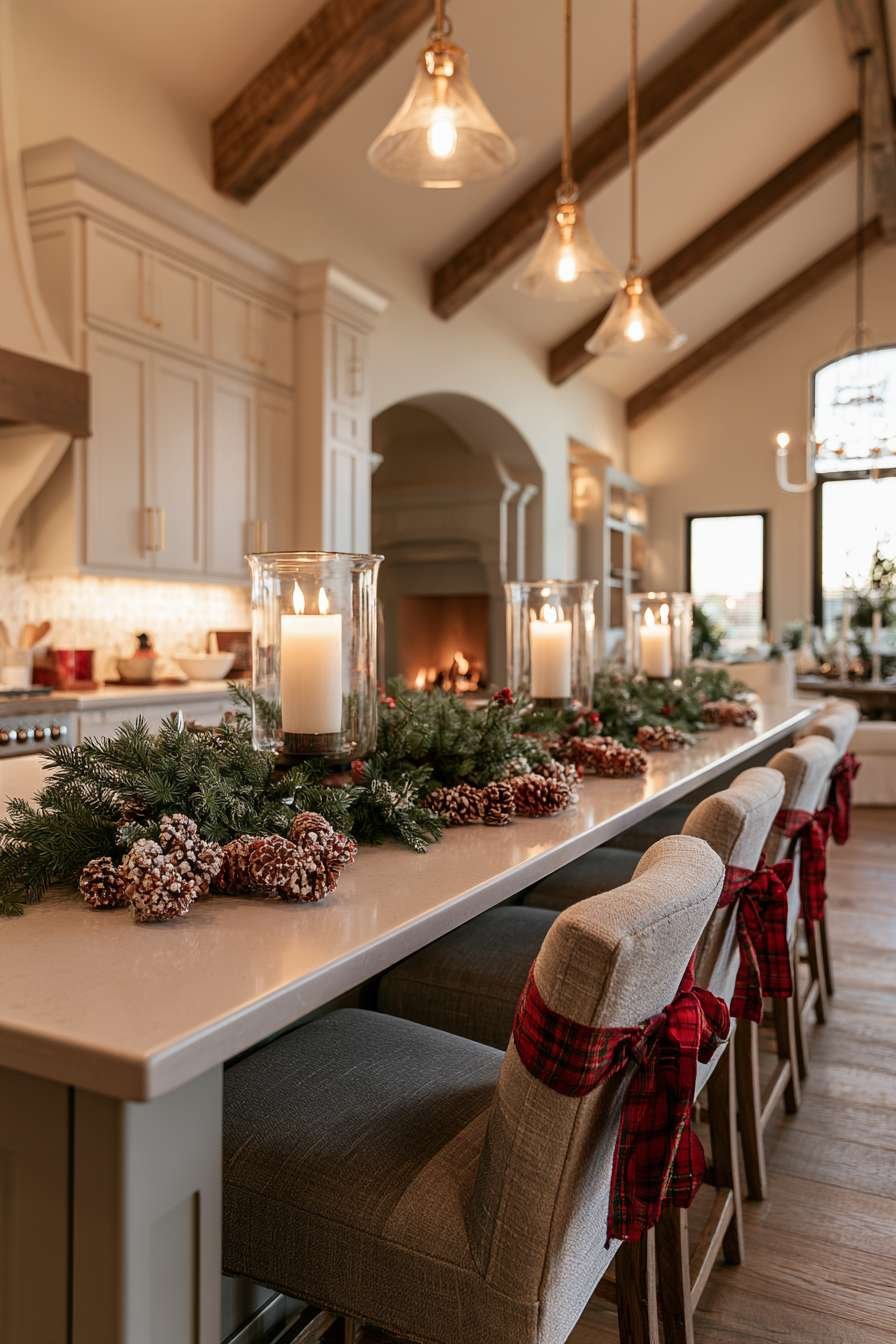
The hurricane glass holders serve a dual purpose that makes them exceptional for kitchen use: they protect the candle flame from the inevitable movement of air in an active cooking space while also amplifying the candlelight through their glass walls, creating a warm halo around each flame that reads beautifully even in a well-lit kitchen. The fresh greenery — loose stems of pine, boxwood, or eucalyptus laid directly on the island surface — keeps the arrangement grounded and organic rather than fussy, suggesting a composition that has been assembled with artful casualness rather than rigid precision.
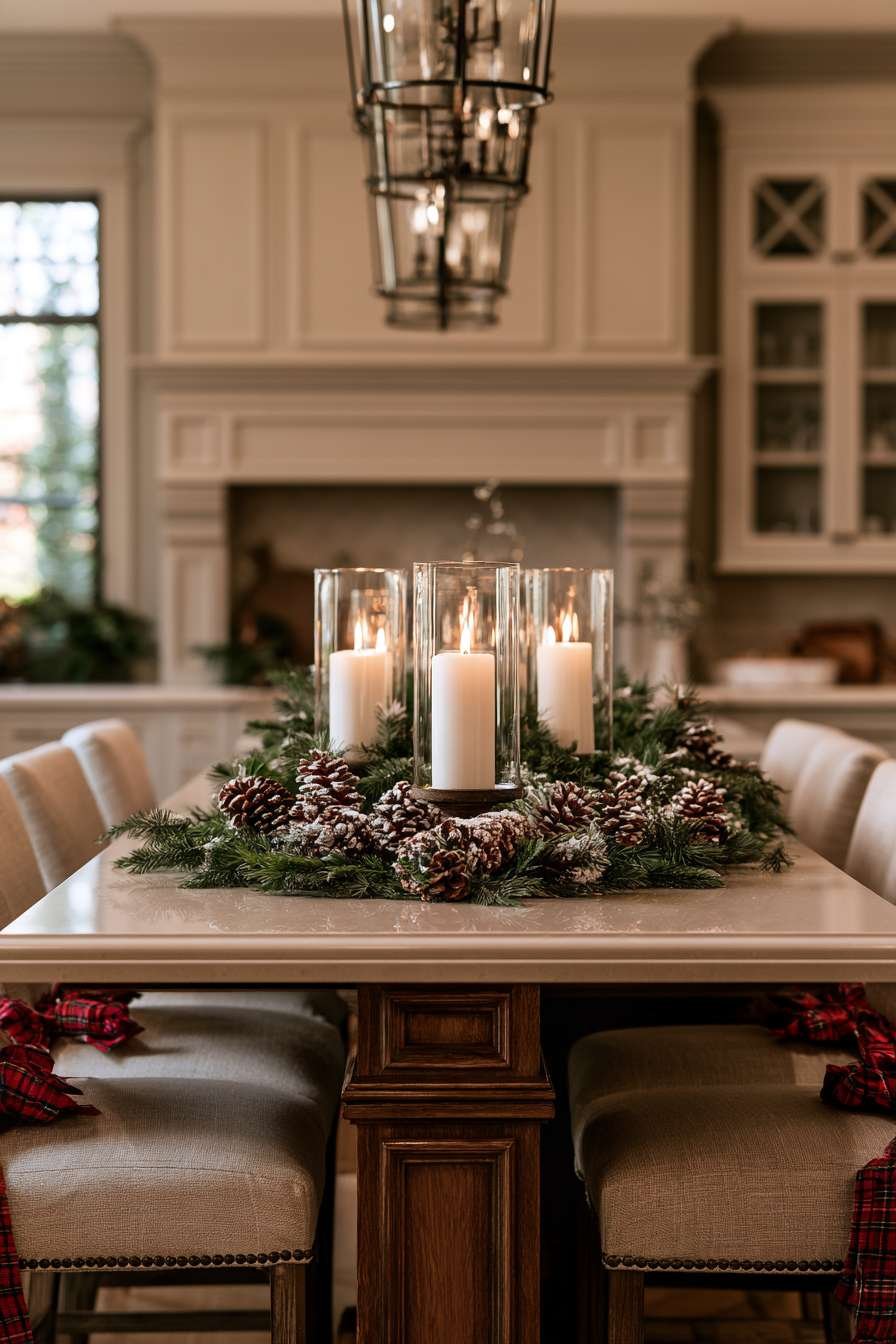
Bar stools tied with red plaid bow accents extend the decorating scheme beyond the island surface itself, incorporating the seating into the holiday composition and creating a sense of festive encirclement that makes the island area feel like a designed vignette rather than simply a countertop with decorations on it. The eye-level perspective at which interior designers photograph this concept is deliberately chosen: it captures the full dimensional depth of the centerpiece, showing the relationship between the greenery, the candlelight, and the scattered pinecones as they exist in space rather than as a flat arrangement seen from above.
Key Design Tips:
- Run a centerpiece the full length of the island rather than centering a small arrangement — a long, low composition has far more visual impact and better respects the island’s proportions.
- Use hurricane glass holders for all candles in a kitchen environment; they protect the flame from cooking-related air movement and prevent the inevitable splatters and spills of an active kitchen from reaching the candle.
- Scatter pinecones, star anise pods, or dried rosebuds loosely among the greenery — the casual distribution reads as effortlessly styled rather than overly arranged.
- Tie ribbon accents on bar stool backs to extend the holiday theme beyond the countertop into the full three-dimensional space of the island area.
- Refresh fresh greenery stems every five to seven days by trimming the ends and placing them briefly in water before rearranging — this keeps the composition looking lush and fragrant throughout the season.
13. The Range Hood Garland Christmas Kitchen
The range hood is the architectural centerpiece of any kitchen where cooking is taken seriously — it rises above the stove like a hearth crown, draws the eye upward, and creates a vertical focal point that few other kitchen elements can match. Dressing it with a fresh garland of eucalyptus, magnolia leaves, and white berries secured with copper wire transforms this functional element into the most beautiful thing in the room, and the design decision to use magnolia rather than the more conventional pine is inspired. Magnolia leaves have a particular quality — their deep glossy green on one side, their rich suede-brown on the reverse — that creates depth and visual interest no single-sided foliage can match.
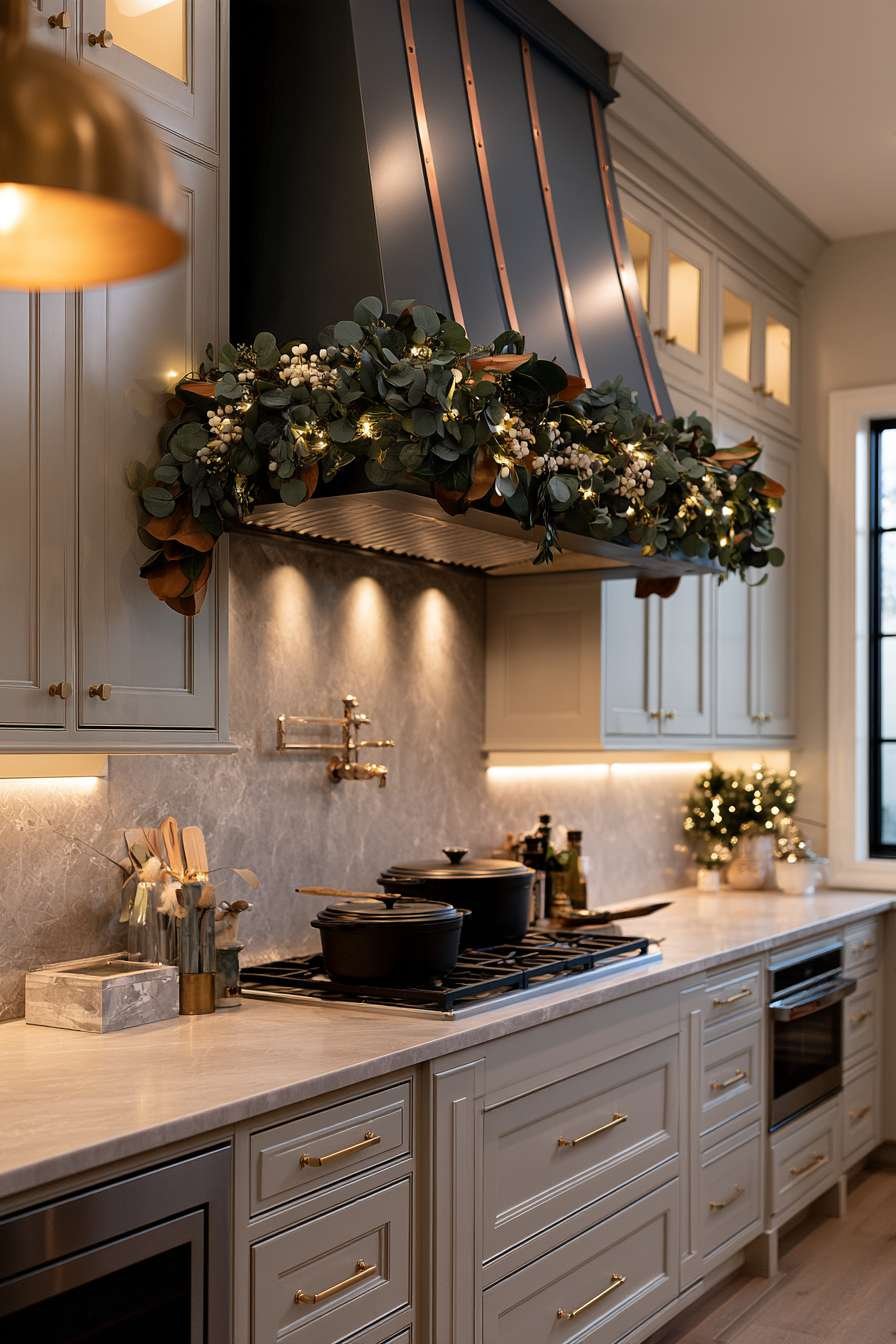
The copper wire used to secure the garland is not merely utilitarian but contributes to the material palette of the kitchen in a meaningful way, introducing a warm metallic tone that connects to the cast iron cookware sitting on the stovetop beneath. This layering of warm metals — copper wire, cast iron, and presumably the copper or brass hardware of the cabinetry — creates a material coherence that gives the kitchen its sense of being thoroughly designed rather than simply decorated. The cast iron on the stovetop is a particularly evocative touch: it suggests active holiday cooking, a kitchen in use, a household where the range hood garland watches over an actual working kitchen rather than a staged room.
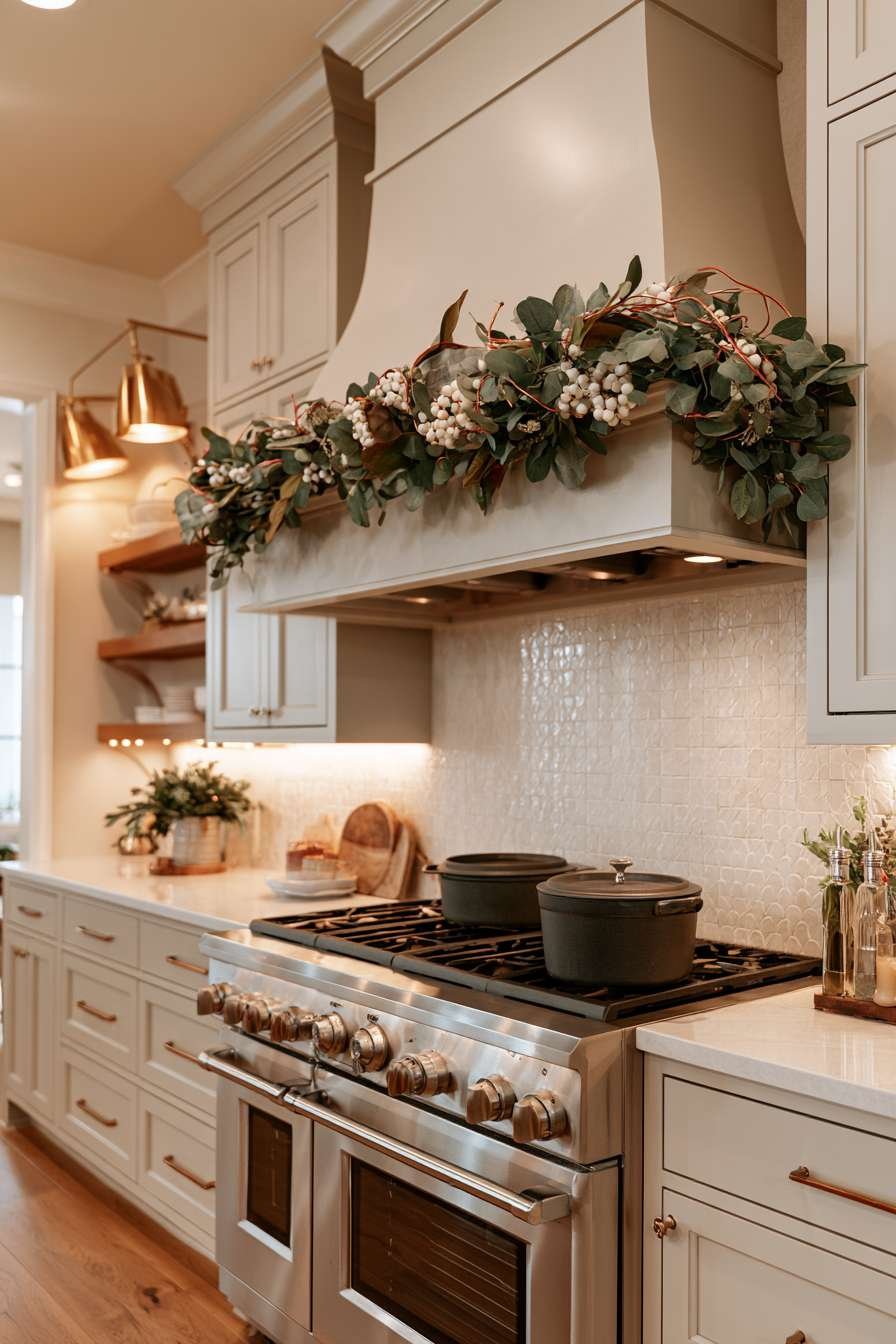
Ambient under-cabinet lighting and warm pendant lights create the golden kitchen glow that makes this design come alive in the evening hours, when the magnolia garland catches the warm light and every leaf surface — glossy, matte, and everything in between — reflects it differently. The range hood, normally the most utilitarian architectural element in the kitchen, becomes at Christmas the most beautiful, dressed in its seasonal garland like a house adorned for a festival, the light and the greenery working together to create something that transcends mere decoration and approaches genuine artistry.
Key Design Tips:
- Magnolia is one of the finest materials for holiday garlands and swags — its large leaves create immediate visual drama, its two-toned leaf surfaces add depth, and it dries beautifully rather than shedding like pine.
- Secure range hood garlands with copper or brass wire that matches the kitchen’s metal finishes; these details of material continuity are what distinguish designed spaces from merely decorated ones.
- Under-cabinet LED strips in warm amber (2700K) are among the highest-impact and lowest-cost kitchen upgrades available; they transform the cooking experience year-round but are especially magical during the holiday season.
- Place active cooking elements — a simmering pot, a cast iron skillet — on the stovetop beneath the range hood garland for photography; the combination of fire, steam, and greenery creates an irresistibly atmospheric image.
- When attaching garlands to range hoods, ensure no material contacts the hood’s ventilation intake or heat-emitting surfaces; the garland should be secured to the decorative exterior panels only.
14. The Farmhouse Kitchen Breakfast Nook Christmas Setting
The breakfast nook within a farmhouse kitchen occupies a special place in the domestic landscape — it is smaller than a dining room but more intentional than a bare kitchen table, its inherent coziness making it the ideal site for intimate holiday mornings. This design concept dresses the nook with every element of Christmas charm that its compact scale can accommodate: a round pedestal table set with holiday plaid placemats, white ceramic mugs of the kind that look as though they’ve been in the family for years, and a small Christmas tree centerpiece that proves once again that scale doesn’t determine impact.

The vintage metal tin of candy canes beside the tree is a small detail of extraordinary effectiveness: it is the kind of object that tells a story, suggesting a household where Christmas traditions are maintained from year to year, where the same tin appears on the same table every December, and where the placement of candy canes in an old tin is a ritual as meaningful as any formal decorating gesture. Behind the bench seating, shiplap walls adorned with simple framed holiday prints continue the farmhouse narrative — the prints providing the vertical scale that the nook’s low table arrangement requires, the shiplap providing the authentic material texture that this design language demands.

Morning natural light fills the breakfast nook in this concept, and the choice of that specific time of day is not accidental: breakfast nooks are morning spaces, associated with the first light of day, with coffee and quiet and the particular peace of a December morning before the household fully wakes. That light, filling the white ceramic mugs and warming the plaid placemats and catching the tinsel on the small tree, creates a moment of holiday domesticity that is — without exaggeration — among the most beautiful things that interior design can achieve.
Key Design Tips:
- Choose a small pedestal table for a breakfast nook when possible — the single central support creates more legroom and visual lightness than four-legged alternatives, and the round top encourages conversation.
- Set the nook table fully for breakfast at Christmas — mugs, placemats, napkins, and a centerpiece — even if it’s not currently in use; a fully set table reads as inviting rather than merely staged.
- Frame and hang two or three simple holiday prints above bench seating; this vertical element provides the visual anchor that low breakfast nook furniture needs to feel properly scaled within the room.
- Use white ceramic tableware year-round so that it transitions seamlessly between everyday use and holiday table settings with only the addition of seasonal textiles and a centerpiece.
- A small live or artificial tabletop Christmas tree — 12 to 18 inches — is the perfect centerpiece for a breakfast nook table; its vertical form provides the height that floral centerpieces achieve, and it performs double duty as holiday decoration and table focal point.
15. The Green and White Christmas Kitchen With Sage Cabinetry
In a moment when sage green cabinetry is experiencing a well-deserved renaissance in kitchen design, this concept demonstrates exactly why the color is so exceptionally suited to Christmas decoration: it is already, in itself, a Christmas color — deep, botanical, and rich with associations of evergreen foliage and winter gardens. Cabinet interiors painted sage green, visible through glass-front doors, are styled with white dishes and fresh greenery cuttings in small clear vases, creating a display that turns the cabinet into a curated art installation where every element is visible and intentional.

The sage green linen apron hanging from a hook beside dried herb bundles and a small holly wreath creates a vignette of remarkable completeness — a small moment in the corner of the kitchen that tells an entire design story in an area of perhaps two square feet. The dried herbs reference the kitchen’s culinary function; the linen apron its craft traditions; the holly wreath its seasonal celebration; and the sage green of the apron its material continuity with the cabinetry. Every element belongs to every other, and the result is a vignette that would not be improved by a single addition.

Soft diffused daylight suits this kitchen’s palette beautifully, bringing out the grey-green complexity of sage — a color that shifts dramatically under different light conditions, reading as silvery in cool north light, as warmly green in afternoon sun, and as deeply botanical under overcast skies. This tonal variability is precisely what makes sage green so interesting as a kitchen color, and it is what makes this Christmas kitchen design concept so visually rich: the cabinetry itself is doing much of the decorative work, its color deep enough to carry the season’s spirit without any additional green.
Key Design Tips:
- Sage green paint on kitchen cabinets is one of the highest-value design investments available; it creates a sophisticated, seasonally appropriate backdrop that reduces the effort required for holiday decorating year after year.
- Style glass-front cabinets as permanent display cases — white dishes, clear glass, and fresh or dried botanical cuttings create a display that is simultaneously functional storage and curated art.
- Dried herb bundles hung in kitchen vignettes are inexpensive, fragrant, beautiful, and genuinely functional; they are perhaps the most practical form of kitchen wall art available.
- Use sage green textiles (aprons, dish towels, napkins) to create material continuity between the cabinetry color and the kitchen’s soft furnishings — this level of color coordination elevates the space from decorated to designed.
- Small clear bud vases with single greenery cuttings are a consistently excellent styling choice for glass-front cabinets; they add botanical interest without obscuring the dishes behind them.
16. The Authentic Family Christmas Kitchen
There is a school of interior photography that values authenticity above all — that seeks to capture the genuine lived quality of spaces rather than the aspirational perfection of staged rooms. This documentary-style Christmas kitchen concept embraces that philosophy completely, creating a space that feels real in a way that no amount of professional styling can manufacture. The refrigerator as decor canvas — adorned with holiday magnets, children’s Christmas drawings, and a single pine sprig tucked into the handle — is both the concept’s most radical and most universally relatable element. Every family with children knows this refrigerator. It is the most honest surface in the house, and at Christmas, it becomes a gallery.
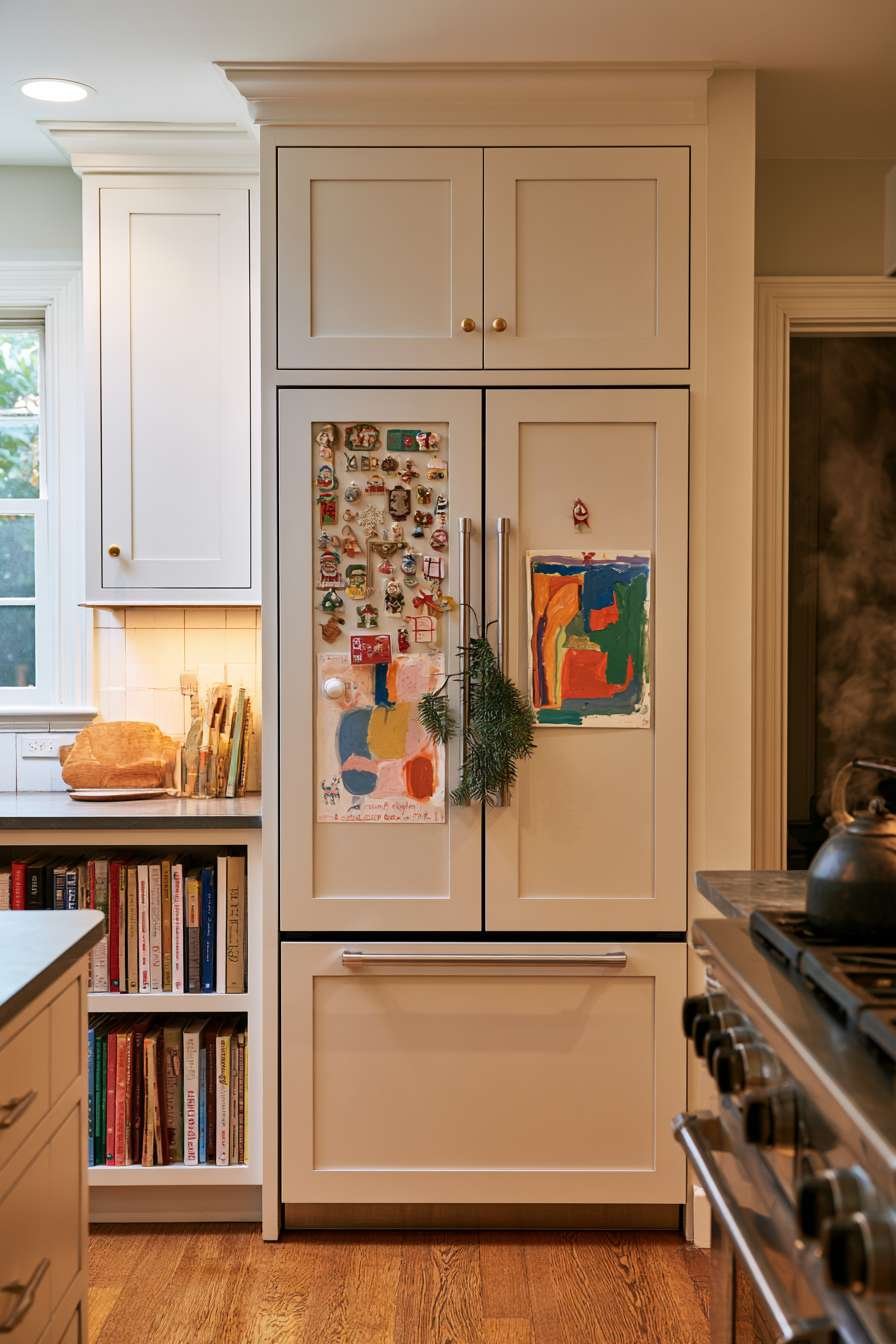
Lived-in cookbooks on a shelf, a steaming kettle on the stove, and warm ambient lighting completing the picture — these are the details that separate a family Christmas kitchen from a show kitchen. The cookbooks with their broken spines and food-stained covers, the kettle suggesting that someone has just made or is about to make a cup of tea, the ambient lighting warm enough to suggest a late morning in December when the household is still moving slowly — each detail contributes to an atmosphere of genuine habitation that is deeply moving in its ordinariness.
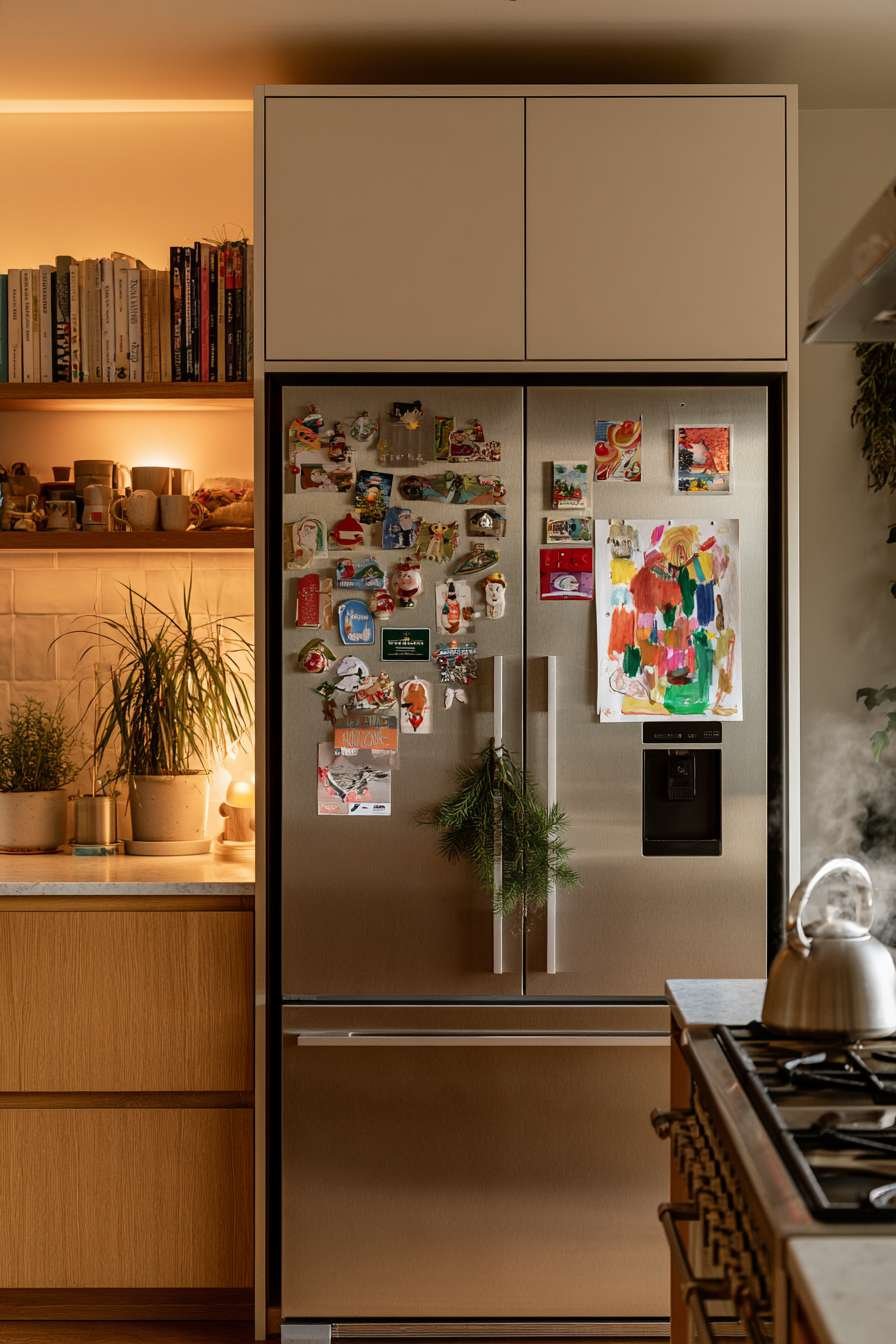
The pine sprig in the refrigerator handle is worth dwelling on: it is simultaneously the smallest and most significant decorating gesture in this article. It costs nothing, takes three seconds to execute, and yet it transforms the refrigerator — the largest and most obdurately functional object in any kitchen — into something that participates in the household’s celebration of Christmas. This is the deepest principle of all holiday decorating: that the spirit of the season can be expressed anywhere, in any space, with any material, as long as the gesture is made with genuine intention.
Key Design Tips:
- Photograph your family’s authentic Christmas kitchen — the refrigerator covered in children’s art, the pile of cookbooks, the kettle on the stove — before staging or tidying; these images will be among the most treasured you take this season.
- Display children’s Christmas drawings on the refrigerator or a dedicated wall space; this is not just sentimentally valuable but aesthetically interesting, as children’s art has a color and energy that professional decor cannot replicate.
- Tuck a single fresh botanical element (pine sprig, holly stem, rosemary cutting) into unexpected functional objects — refrigerator handles, drawer pulls, cookbook holders — for small moments of holiday surprise throughout the kitchen.
- Warm ambient lighting (2700K or lower) is essential in a family kitchen; it makes every surface look more beautiful, every meal more appetizing, and the space more welcoming to everyone who enters.
- Resist the impulse to tidy the kitchen into perfection before decorating; the lived-in quality of an active household is itself a form of beauty, and the best holiday kitchens look like places where people actually live and cook.
17. The Luxurious Dark Walnut Christmas Kitchen
Luxury in interior design is not a matter of expense so much as intention — of choosing materials, colors, and compositions with such precision and care that the result feels inevitable and complete. This high-end kitchen with dark walnut cabinetry and gold fixtures demonstrates that principle at its most exquisite. The holiday decor — deep emerald green and gold in every element — has been chosen to amplify rather than interrupt the kitchen’s existing drama: the dark walnut, already one of the most luxurious materials available for kitchen cabinetry, is deepened further by the addition of emerald velvet and gleaming gold, creating a palette of extraordinary richness.
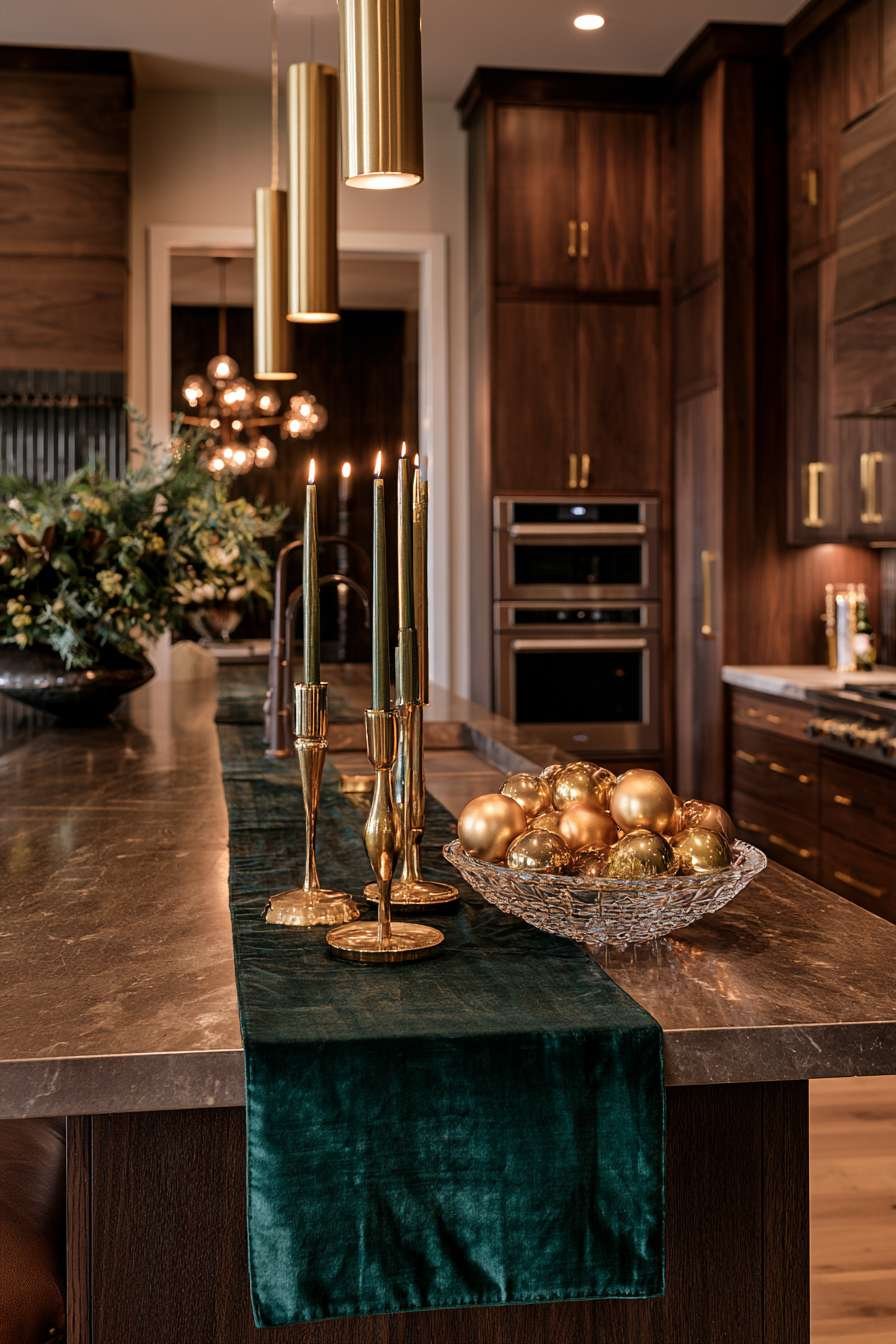
The emerald velvet table runner on the island is the kind of material choice that separates exceptional holiday decorating from merely good decorating: velvet has a depth and luminosity that no woven textile can match, its pile catching light in a way that makes it seem to glow from within, and in emerald green it reads as both ancient (associated with crown jewels and old palace interiors) and entirely contemporary (the color has been one of the dominant shades in interior design for the past several years). Gold candlestick holders with taper candles add height and the vertical dimension that any long horizontal surface needs for compositional balance.
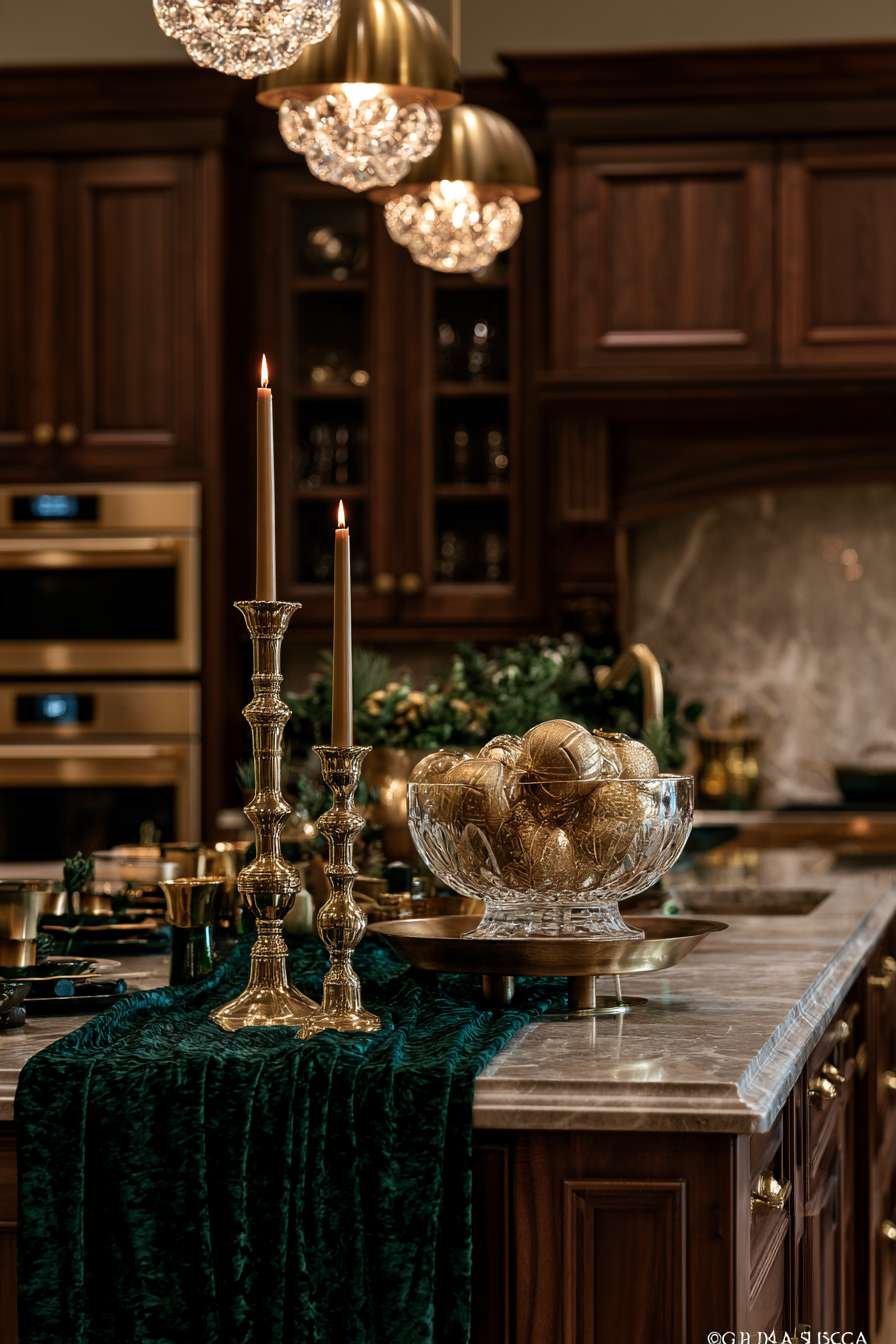
A crystal bowl filled with gold ornaments completes the island arrangement with a studied elegance that borders on the theatrical — and in a kitchen of this quality, theatrical is exactly the right register. Dramatic downlighting from pendant fixtures creates the rich pool of shadow and highlight that makes dark materials beautiful, the walnut cabinetry disappearing into shadow at its edges while the gold fixtures and emerald velvet catch the light with maximum brilliance. This is a kitchen designed for evenings — for dinner parties and champagne and the particular pleasure of a beautifully appointed space seen by candlelight.
Key Design Tips:
- Emerald green and gold is one of the most successful Christmas color combinations for luxury interiors; it has historical gravitas, contemporary currency, and a depth that red-and-green cannot match.
- Velvet is the finest Christmas textile material — use it for table runners, ribbon, and cushion covers where it can be seen and touched; its visual and tactile luxury is immediately apparent.
- Choose crystal or glass vessels for ornament displays in luxury kitchens; the transparency allows the contents to be seen fully while the cut crystal or mouth-blown glass adds its own decorative complexity.
- Use taper candles in tall candlesticks rather than pillar candles in luxury settings; the slender vertical form has more elegance and better suits the proportions of high-ceiling, high-specification kitchens.
- Dim the kitchen lighting to 40–50% of maximum for holiday evenings; dramatic downlighting at reduced intensity creates the moody, intimate atmosphere that makes dark walnut cabinetry look its most magnificent.
Conclusion
The twenty-three Christmas kitchen decor ideas explored in this article share a common understanding: that the most beautiful holiday kitchen is not the most heavily decorated one but the most thoughtfully decorated one. Whether you’re drawn to the lush abundance of a farmhouse garland installation, the disciplined restraint of a Scandinavian minimal approach, the dramatic jewel tones of a dark navy kitchen, or the honest authenticity of a family kitchen at dusk, the principles that make each concept work are the same: choose materials with intention, honor the existing character of the space, use light as a deliberate tool, and allow every decorating gesture to be an expression of genuine care for the home and the people who live in it.

What these ideas collectively demonstrate is that Christmas kitchen decorating is both simpler and richer than it might first appear. It is simpler because the most effective holiday touches are often the least expensive and the most quickly executed — a pine sprig in a refrigerator handle, a cinnamon stick napkin ring, a single wreath in a window. It is richer because those simple gestures, when made with attention and placed with care, accumulate into something that transforms the entire atmosphere of the room, making it feel warmer, more alive, and more deeply connected to the season’s best qualities of generosity, beauty, and belonging. Take these ideas, adapt them to your own kitchen’s character and your own household’s traditions, and make them genuinely yours — because the best Christmas kitchen of all is always the one that feels most unmistakably like home.